GMW 18152 Plastic Plumbing for Water/Cooling Applications - Hose Construction and Joint Verification Testing
The standard, "GMW 18152 Plastic plumbing for water/cooling applications - Hose construction and joint verification testing," developed by General Motors, an American multinational automotive manufacturing corporation, specifies design verification, manufacturing verification, and steady-state component monitoring requirements to verify thermoplastic fitting and tubing constructions for low-temperature coolant applications such as high-voltage batteries, power electronics and power controllers, surge tank degassing, radiator ventilation, and heater systems. Any additional requirements are defined by GM. This standard applies to thermoplastic coolant/water plumbing lines (single or multilayer) with fluid temperatures from -40°C to +120°C under steady-state conditions and deviations up to 135°C.
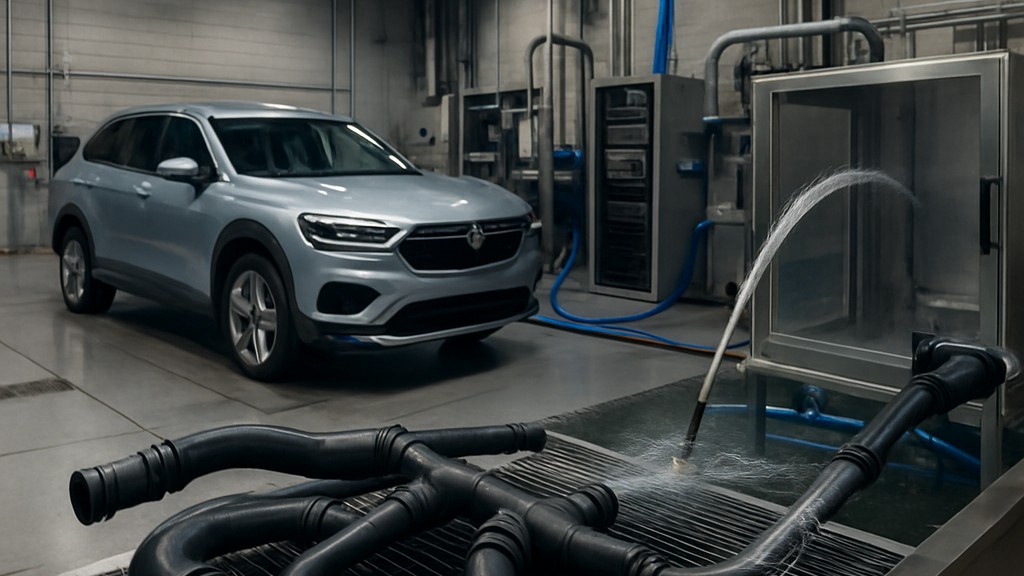
The requirements in this standard are specified as follows:
- Requirements on test specimens: Unless otherwise specified, the shape and size of test pieces shall conform to the relevant test method. The minimum number of specimens (tubing) per test is defined in the table provided in the standard. Specimens shall be finished parts or taken from finished parts. If the dimensions of the finished parts do not allow for the preparation of test pieces, tests shall be performed on material from the same production batch. To test a piping structure to the following performance characteristics in the table provided in this standard, any type of quick connector, in-line connector, T-connector, or Y-connector used in a design released in accordance with this standard shall be included in the tested specimens.
- Reliability: This standard provides a test exposure representing a reliability assessment point required by GM. This standard supports the demonstration of a required reliability of 99 percent or greater at a 50 percent confidence interval at the reliability assessment point for coolant pipe connections. The supplier must use vehicle-equivalent laboratory test fixtures to simulate vehicle-internal orientations. If the orientation may differ from one vehicle to another, the orientation that will provide the worst-case loads will be used for all physical-level reliability demonstration tests. Reliability demonstration is achieved by the design verification endurance tests specified in the table. Failure is defined as, but is not limited to, loss of function, unacceptable performance deterioration, and component non-compliance, as defined in this specification.
GM encourages the use of appropriate accelerated testing methods wherever possible, such as accelerated stress testing to reduce test time. For example, if running 23 samples is impractical, the required number of test samples can be negotiated. Sample size negotiation should consider test equipment limitations, the physical size of the test samples, and the test duration. However, reducing sample size may require longer test times or the use of other test methods, such as high-accelerated stress screening, high-accelerated stress testing, calibrated accelerated life testing, or high-accelerated life testing.
- Identification and marking: All assemblies must be prominently labeled with the GM part number, date code, and tool/cavity number. All labels must comply with GMW 14573.
- Recycling: Materials must be recyclable according to standard GMW 3116. To make recycling more feasible, efforts should be made to minimize the variety of materials used.
- Testing requirements:
- Performance and materials testing: These tests are designed to demonstrate the component's performance, but not necessarily its reliability. The table provides a summary of the required tests.
- Pipe construction tests: These tests include: vacuum test, stone impact resistance test, layer adhesion test, pipe permeability test, pipe flexibility, pipe pressure drop.
- Performance tests for joint verification: These tests include: leakage and blowing test, cold leakage test, connection blowing test after heat aging, insertion force test for quick connectors, pressure drop for quick connectors, zinc chloride test, calcium chloride test.
- Joint durability testing. These tests are designed to demonstrate component reliability.
- Test specimens: A sample or assembly is used to identify the component to be tested, including the assembly and the assembly intended for production design. For design verification, design representative test specimens may be produced from prototype assemblies or equivalent production assemblies, but must represent the design intent, including the material variation within the design tolerances and material specifications. For design verification, production test specimens should be produced on representative production equipment, including the effects of variation due to production. Sample selection of components to be used for demonstrating design verification reliability requirements must comply with GMW 15760.
- Pipe dimensions and processing requirements for samples: All pipe dimensions included in a design published to this standard must be tested in accordance with all the requirements of this standard. All processes used to produce production pipes/assemblies for which material approval is sought, including forming operations, must be included in the samples tested to this specification. If pipe is to be formed, representative samples of the formed pipe must be selected as part of the verification testing. Materials covered by this standard are divided into several types that define the material content, structure, and performance limits of each pipe type. Base materials must be tested for hydrolytic resistance in accordance with GMW 15468.
- Type A: Extrusion grade, heat stabilized and hydrolysis resistant tube capable of operating at 80 degrees continuous temperature with movement up to 90 degrees.
- Type B. Extrusion grade, heat stabilized and hydrolysis resistant tube capable of operating at 90 degrees continuous temperature up to 120 degrees movement.
- Type C. Extrusion grade, heat stabilized and hydrolysis resistant tube construction capable of operating at 120 degrees continuous temperature up to 135 degrees movement.
Our organization, which has been supporting businesses across all sectors for years through a wide range of testing, measurement, analysis, and evaluation activities, has a strong team of employees who closely follow global developments in science and technology and are constantly improving themselves. In this context, we also provide testing services in accordance with the "GMW 18152 Plastic Installations for Water/Cooling Applications - Hose Construction and Joint Verification Testing" standard.



