

The standard “VW TL 52682 PA66 Glass fiber reinforced coolant-carrying finished parts - Material requirements”, developed by the Volkswagen automotive company, describes the material requirements for glass fiber reinforced PA66 used in coolant-carrying parts. Volkswagen standard VW 50133 applies to components made from PA66-GF30 that do not come into contact with coolant.
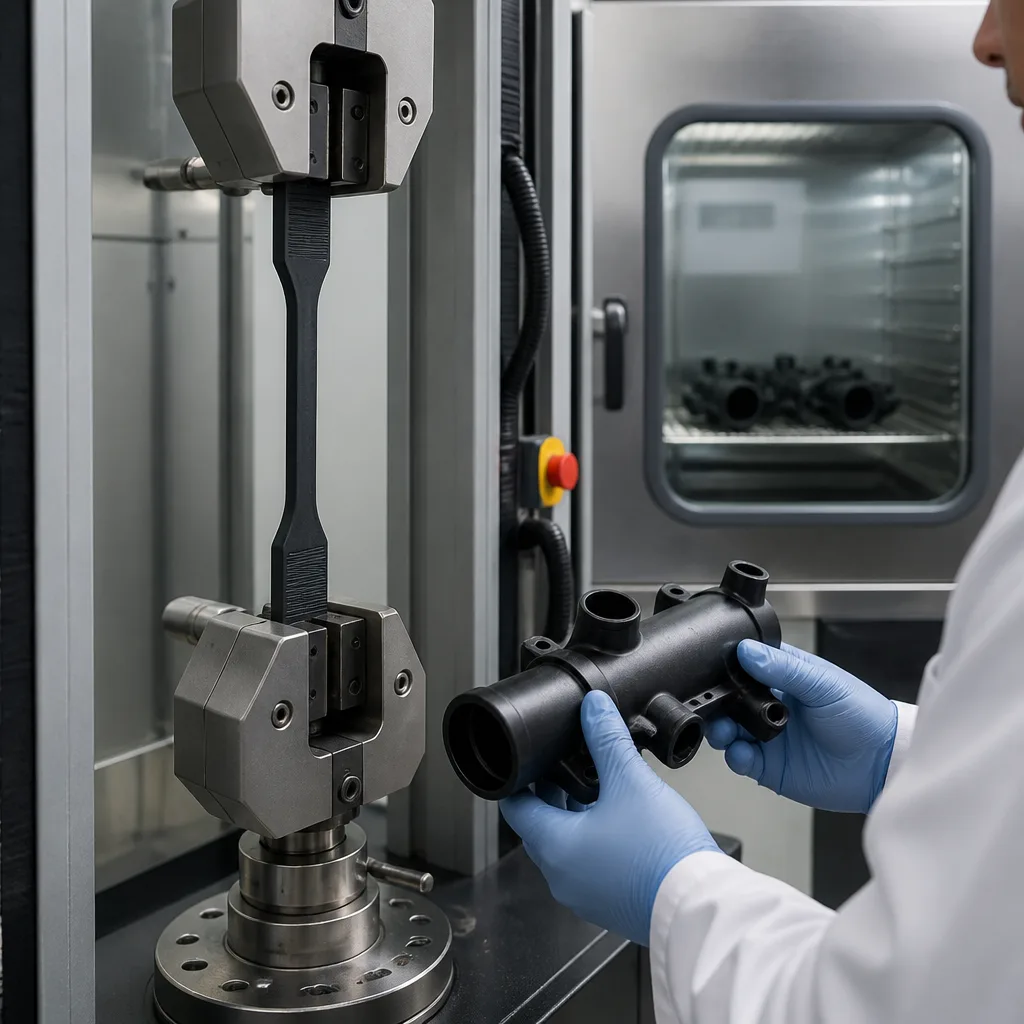
General requirements have been defined as follows:
Tests to determine mechanical properties must be performed on standard samples produced by injection molding. Milling is not permitted for sample production for tests to determine coolant resistance.
Finished parts must be free from processing irregularities such as voids, cracks, and cold joints, which negatively affect strength, service life, and desired appearance. This applies to both the surface and interior of the part.
Indentation marks in the area of ribs, reinforcement elements and fittings are acceptable only if they do not negatively affect assembly or functionality. The parts must allow for flawless assembly.
There should be no functional risk or risk of injury to assembly workers due to burrs, roughness, or loose particle debris.
The glass fibers should be distributed evenly in the material to such an extent that the glass fiber content of samples taken from three different points of a finished part does not differ by more than 1,0 percent.
During injection molding or a related process (e.g., water injection technology), the use of homogenously recycled material from the initial processing stage is permitted up to 30 percent by weight. Parts must be verified to have the expected maximum percentage of recycled material.
According to this standard, a distinction is made between dry and conditioned conditioning conditions:
In short, the VW TL 52682 standard ensures that components such as coolant pipes, expansion tanks, thermostat housings, and radiator end tanks maintain their structural integrity, leak-proofness, and long-term durability under the demanding conditions of the engine cooling system.
The main purpose of this standard is as follows:
According to this standard, the material must have the following basic properties:
Additional requirements include:
The VW TL 52682 standard involves rigorous testing on finished parts (approximately 24 parts are required for full qualification):
PA66-GF30 is a popular choice for cooling system components because it offers an excellent balance of the following features:
However, this standard PA66 is susceptible to hydrolysis (degradation in hot glycol/water). VW TL 52682 certified materials use hydrolysis-stabilized grades to prevent fiber formation and strength loss throughout the vehicle's lifespan.
The relevant standards are as follows:
The VW TL 52682 standard remains a critical benchmark in the automotive industry for ensuring reliable and long-lasting plastic cooling system components in vehicles.
The VW TL 52682 standard is necessary because it ensures that plastic materials used in automotive cooling systems can withstand the extreme thermal, chemical, and mechanical stresses inside modern vehicle engines. The main reasons this standard is important are as follows:
This standard includes pressure cycling and long-term aging requirements to verify that components remain reliable throughout the vehicle's service life.
These tests confirm that reinforced PA66 materials maintain adequate mechanical integrity under real-world operating conditions.
For many years, our organization, with its competent and experienced team, has been understanding the needs of its clients, providing the advanced testing services they require, and assisting them in the establishment, implementation, and improvement of management systems. Within this framework, we also provide testing services compliant with the VW TL 52682 standard.
To get an appointment, to get more detailed information or to request an evaluation, you can ask us to fill in our form and reach you.

