

Stain Resistance of Decorative Materials to Sulfur Dioxide and Hydrogen Sulfide
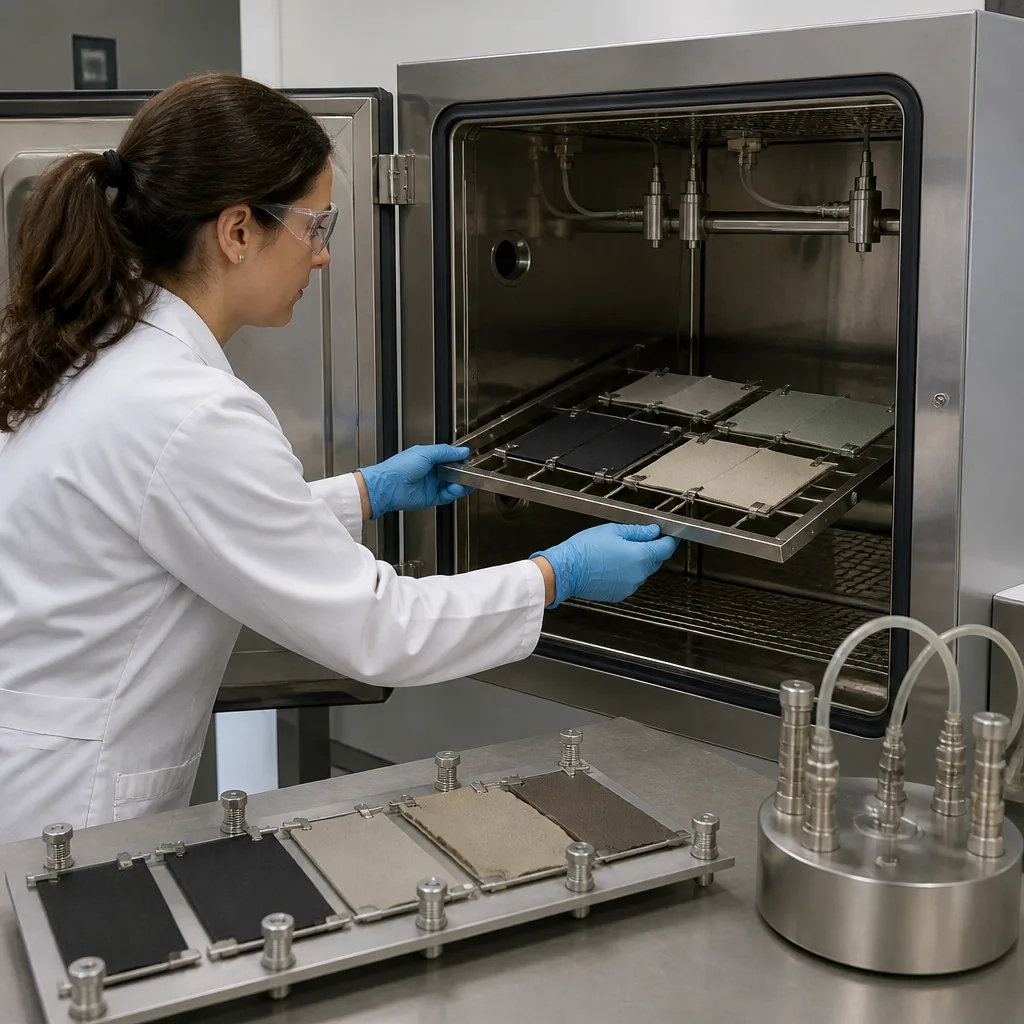
The “GMW 14864 Determination of Staining of Upholstery Materials from Sulfur Dioxide and Hydrogen Sulfide Gases” standard, developed by General Motors Worldwide (GMW), includes a material testing procedure. This standard is used to evaluate the resistance of automotive upholstery materials to discoloration or staining caused by sulfur-containing gases.
Automotive materials may be exposed to sulfur-containing gases during vehicle operation. Sulfur dioxide and hydrogen sulfide can interact with pigments, coatings, plastics, textiles, leather, and other surface materials. The GMW 14864 standard provides a controlled laboratory procedure to determine whether these gases cause visible staining or discoloration in upholstery materials.
The described test method is particularly important for components located near exhaust gas sources. For example, material specifications require this standard for parts near the exhaust system.
Sulfur dioxide is a sulfur-containing gas that can be produced during the combustion of sulfur-containing fuels. It can react with sensitive materials, contributing to chemical discoloration or surface erosion. Hydrogen sulfide is another sulfur-containing gas. It is particularly important in stain assessments because it can react with chemical components in some pigments, metals, and materials. Therefore, both gases can be used as aggressive environmental pollutants in laboratory tests.
The GMW 14864 standard applies to a wide range of automotive interior trim materials. Test laboratories use this standard for the following materials:
This makes the procedure applicable to many interior and flooring applications, rather than just one type of material.
The basic principle in the tests is to expose the prepared material samples to an atmosphere containing specified sulfur-containing pollutant gases under controlled laboratory conditions. The exposure aims to simulate an aggressive sulfur environment and determine whether the material develops unacceptable staining or discoloration.
Precise gas concentrations, exposure conditions, sample preparation, and acceptance criteria are included in this standard.
The primary characteristic evaluated in the tests is staining/discoloration. The laboratory examines the material after exposure and determines whether the sulfur-containing atmosphere has caused an undesirable change in appearance. Depending on the material specification, the evaluation involves comparison of the original/unexposed sample with an established visual or instrumental criterion. Therefore, the GMW 14864 standard is essentially a surface appearance and chemical resistance test rather than a mechanical strength test.
The GMW 14864 standard is important because a material may meet mechanical and dimensional requirements but exhibit unacceptable discoloration when exposed to sulfur-containing gases. Appearance is a crucial quality attribute in automotive upholstery. A visible stain can lead to:
Pre-production testing helps identify materials or formulations susceptible to sulfur staining.
The GMW 14864 standard may apply to components made from or containing the following materials:
For parts particularly close to the exhaust system, it is important to determine resistance to sulfur dioxide and hydrogen sulfide staining according to the GMW 14864 standard.
The GMW 14864 standard is sometimes listed by testing laboratories under the heading of hydrogen sulfide resistance or sulfur resistance testing. For example, accredited laboratories define this standard as a method for hydrogen sulfide resistance. However, this procedure addresses both sulfur dioxide and hydrogen sulfide and focuses specifically on the staining of flooring materials.
Tests conducted according to this standard generally follow these steps:
It is important to distinguish the GMW 14864 standard from traditional chemical resistance tests.
In the automotive materials development process, the GMW 14864 standard can be used to compare the following different processes:
A formulation that performs well in standard environmental tests may still be susceptible to sulfur gas staining. Consequently, this test can help materials engineers select formulations that maintain their appearance throughout the vehicle's lifespan.
In short, the GMW 14864 standard is an automotive material testing procedure used to determine the resistance of trim materials to staining caused by sulfur dioxide and hydrogen sulfide. It is particularly important for automotive materials where maintaining appearance is critical and exposure to sulfur-containing gases is possible.
The procedure covers a wide range of materials, including plastics, coated textiles, leather, elastomers, coatings, and foils, and provides a controlled way to identify materials susceptible to sulfur-induced discoloration.
The key point here is that the GMW 14864 standard is essentially an accelerated sulfur gas staining/appearance resistance test, helping to ensure that automotive interior materials maintain an acceptable appearance in potentially aggressive sulfur-containing environments.
For many years, our organization, with its competent and experienced staff, has been understanding the needs of its clients, providing the advanced testing services they require, and assisting them in the establishment, implementation, and improvement of management systems. Within this framework, we also provide testing services in accordance with the GMW 14864 standard.
To get an appointment, to get more detailed information or to request an evaluation, you can ask us to fill in our form and reach you.

