

The “GMW 3010 Determination of Tensile and Elongation Properties” standard, developed by General Motors Worldwide (GMW), is particularly important for interior materials such as textiles, coated textiles, plastic roll products, leather, leather fiber materials, and yarns. This standard provides a controlled tensile testing procedure to evaluate how a material behaves when subjected to progressively increasing tensile force. The resulting measurements help engineers determine whether a material possesses sufficient strength and deformation properties for its intended automotive application.
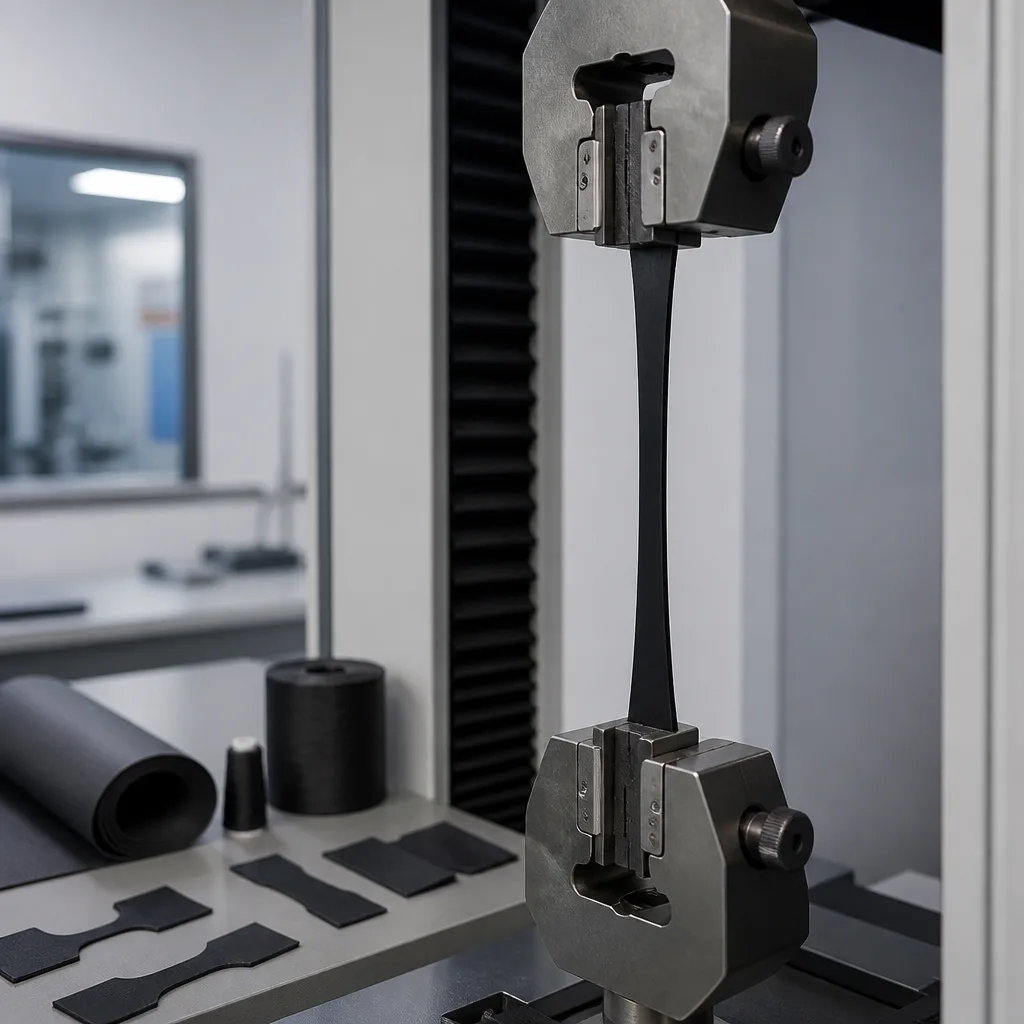
The primary objective of the GMW 3010 standard is to characterize the mechanical behavior of flexible automotive materials under stress. This standard specifies the following:
These measurements can be applied to textiles, reinforced and unreinforced plastic roll products, leather, yarns, and other applicable materials.
The GMW 3010 standard is particularly useful for automotive interior materials. Accredited laboratories use the described method for the following applications:
For example, the GMW 3010 standard is defined for artificial leather, coated textiles, leather, leather fiber materials, textiles, and yarns. This method is applicable to components such as seat upholstery, door panel fabrics, headliner materials, decorative coatings, and other flexible interior upholstery materials.
The basic principle of this method is uniaxial tensile testing. A prepared specimen is placed between the jaws of the tensile testing machine. The machine applies a tensile load while continuously measuring the force and elongation of the specimen. As the load increases, the material passes through different stages:
The resulting force-elongation relationship provides information about both strength and extensibility. For example, a material that can withstand high tensile strength but elongates very little will behave differently than a material with relatively low tensile strength but elongates significantly. Both properties can be important when selecting automotive trim materials.
The test specimen must be securely and evenly clamped to ensure the tensile load is transmitted correctly through the material. The procedure specifies the initial jaw clearance (200 mm plus/minus 0,5 mm unless another value is specified). It also describes the application of pre-tensioning before measurements are taken.
Proper sample preparation is crucial because incorrect cutting, misalignment, slippage, or uneven compression can lead to misleading tensile results.
A key feature of this standard is the application of prestressing as specified in the applicable material condition. The procedure states that prestressing is applied before the tensile measurement and that the prestressing is incorporated into the force readings. The recommended prestressing head speed is approximately 30 mm/min plus/min 5 mm/min. This helps to establish a consistent initial condition and reduce variations caused by loose or sagging material in the sample.
Key test results are as follows:
This is especially important for flexible automotive upholstery, as excessive or insufficient elongation during installation can affect appearance, dimensional stability, and durability.
The GMW 3010 standard uses different test codes/conditions for specific material applications. For example, laboratory accreditation documents indicate GMW 3010 Codes A, B, D, H, J, and S, while Code C is specifically defined for the tensile properties of teeth. Therefore, when specifying a GMW 3010 standard test, simply stating “GMW 3010” is insufficient. When General Motors requires a material specification or drawing, the relevant code and material-specific condition must also be specified.
The GMW 3010 standard is important because automotive interior materials must withstand mechanical stresses during manufacturing, assembly, vehicle use, and servicing. A material with insufficient tensile strength can lead to:
Conversely, excessive elongation can lead to size or fit issues, while insufficient elongation can make shaping or assembling the material difficult. Consequently, tensile and elongation measurements provide a quantitative basis for material selection, supplier qualification, production control, and quality verification.
GMW 3010 is a procedure specific to the original equipment manufacturer (OEM) rather than a general international tensile standard. Laboratories may perform relevant tensile tests according to standards such as ISO 13934-1, ISO 527, ASTM D5034, ASTM D412, or DIN 53504, depending on the material. For example, an accredited laboratory may list GMW 3010, along with many of these methods, for tensile strength testing. However, results from different standards should not be automatically considered interchangeable. Sample geometry, conditioning, pre-stress, test speed, calculation methods, and acceptance criteria may differ.
In conclusion, the GMW 3010 standard includes an important test method used to evaluate the tensile strength and elongation behavior of automotive flexible materials. By measuring fracture force, maximum force, elongation, and force-elongation relationship, it provides engineers with objective information about the mechanical performance of the material.
For automotive interior applications, this method is particularly useful for textiles, coated fabrics, leather, plastic roll products, and yarns. Correct application of the relevant GMW 3010 standard test code allows suppliers and laboratories to verify that materials possess the required mechanical properties before being incorporated into vehicle components.
In short, the GMW 3010 standard helps answer the following material performance question: how much tensile force can an automotive material withstand, and how much elongation will it exhibit before and during failure?
For many years, our organization, with its competent and experienced staff, has been understanding the needs of its clients, providing the advanced testing services they require, and assisting them in the establishment, implementation, and improvement of management systems. Within this framework, we also provide testing services in accordance with the GMW 3010 standard.
To get an appointment, to get more detailed information or to request an evaluation, you can ask us to fill in our form and reach you.

