

PSA D41 1029 Tensile Properties in Textiles, Coated Textiles and Leathers

PSA D41 1029 Tensile Properties in Textiles, Coated Textiles and Leathers

The “PSA D41 1029 Traction properties of textiles, coated textiles and leathers” standard, developed by the French car manufacturer PSA Group, now part of Stellantis, describes a method for determining the tensile properties of textiles, coated textiles and leathers.
PSA D41 1029 Tensile Properties in Textiles, Coated Textiles and Leathers

This applies to woven fabrics, knitted fabrics, fiber textile fabrics, and similarly coated or impregnated rubber or plastic products (such as leathers) that are not very prone to sagging.

This standard also applies to composite materials consisting of one or more textile elements and an engineering layer. However, it does not apply to materials prone to significant sagging, such as non-thermofixed knitted fabrics. The products can be applied in dry or wet conditions.

This method is valid for tensile forces of at least 50 N; tensile forces less than 50 N are measured according to the method described in the PSA D45 1124 standard.

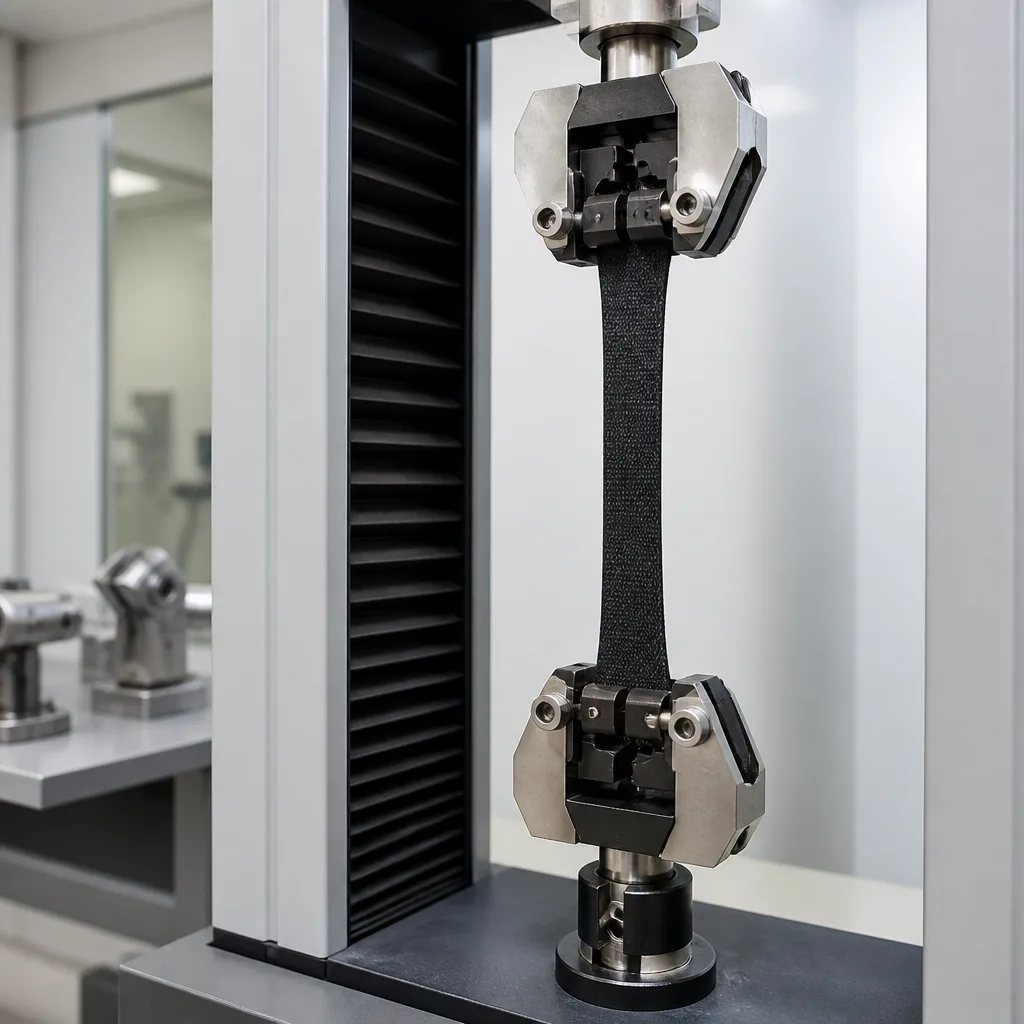
During the test, the test tube is subjected to a force that can continue until it ruptures, and this is measured by a device that indicates both the applied force and the elongation of the test tube.

In the tests, a dynamometer that meets the following conditions is used:

  • A device that records curve loads and elongation.
  • A load sensor suitable for the measurement range of the materials being tested.
  • The jaw movement speed is 100 mm/min plus/min 10 mm/min or another speed specified in the standards.
  • A tip that prevents the test tube from slipping and whose tightening does not require preloading the test tube (e.g., screw-on tip and knurled tip) (the width of the tips should be of the same quality as the width of the test tube).

The following equipment is also used in the tests:

  • Air-conditioned room: 23 degrees Celsius plus/minus 2 degrees Celsius temperature and 50% plus/minus 7% relative humidity.
  • Cutting machine: Such as notchless scissors or a hollow punch.
  • Flexible steel ruler: Half a millimeter precision.
  • Distilled water
  • Wetting agent: For example, 95% ethyl alcohol.

Test samples must be representative of the scale being characterized. To ensure this representativeness, it is necessary to determine the baseline characteristics of the population being studied. The selection criteria for test samples should be stated in the test report in accordance with the PSA A10 0156 standard. In case of doubt regarding sampling, the PSA Department should be contacted.

When preparing textile and composite samples,

  • The cut should be made so that it is more than 150 mm from the edges and ends and less than 3 meters from the main or end section.
  • In longitudinal test tubes, the longer side of the test tube is parallel to the roll edge (edge ​​strip).
  • In transverse test tubes, the greater east edge is perpendicular to the edge.
  • In right-angled test tubes, the greater east edge is positioned at a 45-degree angle to the edge, and in left-angled test tubes, the greater east edge is positioned at a 135-degree angle to the edge.

When preparing leather samples, the cutting process is carried out in a cutting facility as defined in the standards.

Test tubes should have dimensions of 300 mm plus/minus 5 mm x 50 mm plus/minus 1 mm. For stripes, wefts, or composite chains and fabrics, test tubes with dimensions of 300 mm plus/minus 5 mm x 60 mm should be used and resized to their final dimensions by fraying the ends.

Dimensions of strip-shaped materials: For materials less than 50 mm wide, test tubes are taken lengthwise and brought to the delivery position along the width of the material.

Five test tubes are taken in each direction as a sample.

The conditioning requirements are as follows:

  • Dry tests: For coated textiles and textile products, test tubes must be packaged in a pre-conditioned chamber for at least 24 hours. For leather, this packaging time is at least 72 hours.
  • Wet tests: Tensile tests can also be performed wet, as specified in the standards. Test tubes are immersed in a bath of distilled water at a temperature of 23 degrees plus/minus 2 degrees Celsius and approximately 20 times the mass of the test tube for 2 hours plus/minus 5 minutes. If wetting the material is difficult, an aqueous solution containing 1% surfactant, such as 95% ethyl alcohol, is used. Immediately before the tensile test, the test tubes are removed from the solution and wiped between two layers of absorbent paper or sheets of paper. After draining the water from each test tube, wait at least 2 minutes before performing the test.

Stating the results:

  • Fracture strength: Fracture strength is expressed in Newtons. The fracture strength is determined for each test tube. For each batch of 5 test tubes, the arithmetic mean of these determined values ​​is calculated. In the case of a composite material, the arithmetic mean of the fracture loads of each element is calculated.
  • Fracture elongation: Fracture elongation is expressed as a percentage of the initial length. The fracture elongation is determined for each test tube. For each batch of 5 test tubes, the arithmetic mean of these determined values ​​is calculated. In the case of a composite material, the arithmetic mean of the elongations corresponding to various tearings of each element is calculated.
  • Elongation under furnace load: Elongation under furnace load is expressed as a percentage of the initial length. This furnace load is specified in the manufacturer's documentation. The elongation under furnace load is determined for each test tube. The arithmetic mean of these determined values ​​is then calculated for each batch of 5 test tubes.

In short, the PSA D41 1029 standard defines a test method for determining the tensile properties (tensile strength/breaking force and elongation at break) of textiles (fabrics), coated textiles, and leathers primarily used in automotive interiors (such as seats, door panels, headliners, and upholstery).

The method described measures how much force a material can withstand when pulled before breaking, and how much it can stretch before failing. This is how interior trim materials are measured.

  • Ensures it is strong enough for daily use and long-term durability.
  • This ensures resistance to tearing or deformation from collisions or normal wear and tear.
  • It meets safety and quality requirements for automotive applications.

The typical key characteristics identified are as follows:

  • Maximum tensile force (in Newtons)
  • Elongation at fracture (in percentage)
  • Sometimes the modulus or other stress-strain characteristics

Testing is generally performed on fabrics in both the warp (longitudinal) and weft (cross) directions, and usually after conditioning or aging (exposure to heat, humidity, light).

For many years, our organization, with its competent and experienced team, has been understanding the needs of its clients, providing the advanced testing services they require, and assisting them in the establishment, implementation, and improvement of management systems. Within this framework, we also provide testing services compliant with the PSA D41 1029 standard.

WhatsApp

