

The standard "GB 8410 Flammability of Automotive Interior Materials," published among the National Standards of the People's Republic of China, describes the technical requirements and test methods for the horizontal flammability of automotive interior materials. This standard is applicable to the evaluation of the horizontal flammability of automotive interior materials.
Because there are many differences between the actual conditions (spare part location, layout, usage conditions, ignition source) of various automotive interior materials and the test conditions specified in this standard, this standard is not applicable to the evaluation of the actual interior flammability of all automotive interior materials.
The flammability of automotive interior materials must meet the technical requirements outlined in the standard. The burning rate must not exceed 100 mm/min.
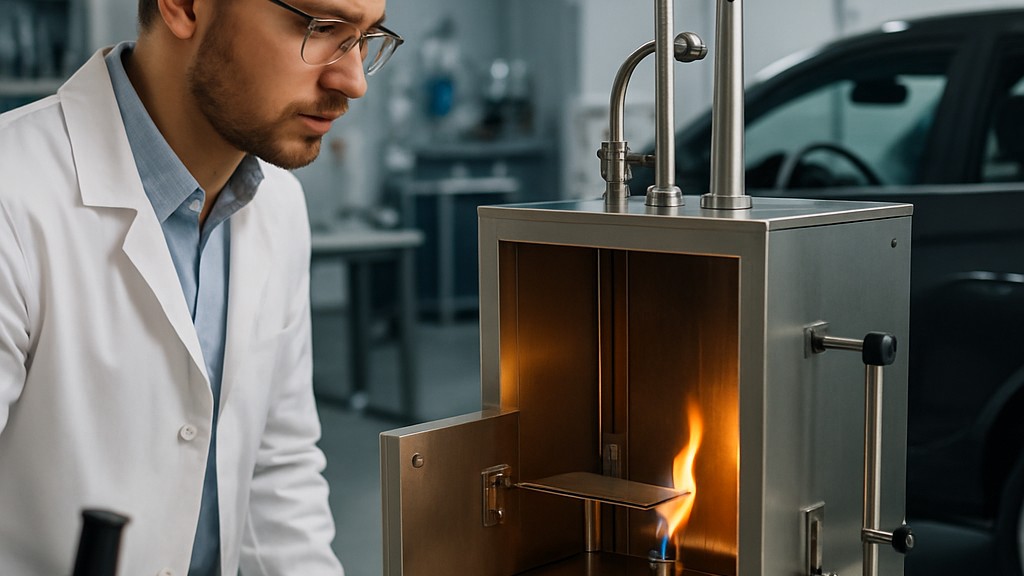
In principle, the sample is fixed horizontally to a "U"-shaped support. After the free end of the sample is burned with a flame at a certain height in the combustion chamber, the flame on the sample is checked for extinguishing or if the combustion is extinguished when the flame is extinguished, as well as the burning distance and the time required to burn that distance.
The firebox used in the tests was constructed of sheet steel. The front of the firebox has a heat-resistant glass observation window that can cover the entire front or serve as a small observation window. Ten 19 mm diameter ventilation slots are located at the bottom of the firebox. Near the top of the four walls are 13 mm wide ventilation slots. The firebox is supported by four 10 mm high legs. A thermometer opening is located in the upper right-center of the firebox. This opening is 20 mm from the inside of the rear panel.
At one end of the firebox is a lockable opening that allows the sample to be inserted. At the other end is a small door with a hole for the gas line, a base to support the gas lamp, and a flame height indicator. At the bottom of the firebox is a tray to collect melted drips, located between, but not covering, two rows of vents.
The sample support is a frame composed of two "U"-shaped, corrosion-resistant metal plates. The bottom plate of the support has six pins, while the top plate has corresponding holes to help hold the sample evenly. The pins also serve as the starting and ending points of the burn distance. The other bottom plate of the support contains not only six pins but also a heat-resistant metal support measuring 0,25 mm in diameter and 25 mm in length. This support should be used for specific purposes.
After mounting, the bottom of the sample should be 178 mm above the bottom plate of the firebox. The front end of the sample support should be 22 mm from the inside surface of the firebox. The two longitudinal outer edges of the test support should be 50 mm from the inside surface of the firebox.
A gas lamp is a flame source for testing purposes. Its nozzle has an inner diameter of 9,5 mm, and its valve structure allows for easy control and adjustment of flame height. When the gas lamp is placed in the combustion chamber, the center of the nozzle opening should be 19 mm lower than the center of the free end of the sample.
To ensure comparability of test results, the fuel gas used in the gas lamp should preferably be liquefied gas. Other combustible gases, such as natural gas and town gas, can also be used. Liquefied gas is recommended for fortification testing.
In the fast-paced automotive industry, safety remains paramount. Among the numerous regulations governing vehicle production, fire safety standards for interior components play a critical role in protecting occupants from potential hazards during accidents or electrical malfunctions. The GB 8410 standard specifies mandatory requirements for the fire resistance of materials used in vehicle cabins. Compliance with this standard is essential for all vehicles manufactured or imported from China, ensuring that interior components such as seats, dashboards, carpets, and headliners do not excessively contribute to the spread of fire.
The GB 8410 standard specifically addresses the flammability of materials used in the passenger and cargo compartments of motor vehicles. This includes textiles, plastics, composites, coatings, and other surface treatments that could ignite and spread flames. This standard does not assess the overall fire performance of a vehicle's entire interior, but provides a controlled laboratory assessment of material behavior under flame exposure.
The following are outside the scope of this standard:
It's important to note that while this standard simulates specific fire scenarios, it doesn't comprehensively predict all real-world indoor fires. Manufacturers should combine it with other tests (e.g., the GB 32086 standard for vertical flammability in certain vehicle categories) for holistic safety assessments.
In short, the GB 8410 standard stands out as the cornerstone of automotive fire safety.
Our organization, with its competent and experienced team, has been understanding the needs of its customers for years, providing them with the advanced testing services they need, and assisting them in establishing, implementing, and improving management systems. In this context, we also provide testing services in accordance with the GB 8410 "Flammability of Automotive Interior Materials" standard.
To get an appointment, to get more detailed information or to request an evaluation, you can ask us to fill in our form and reach you.

