

The “VW PV 3305 Vulcanized rubber products - Ozone resistance and permanent deformation test” standard, developed by the Volkswagen automotive company, describes a test method applied to determine the ozone resistance and permanent deformation of vulcanized rubber products.
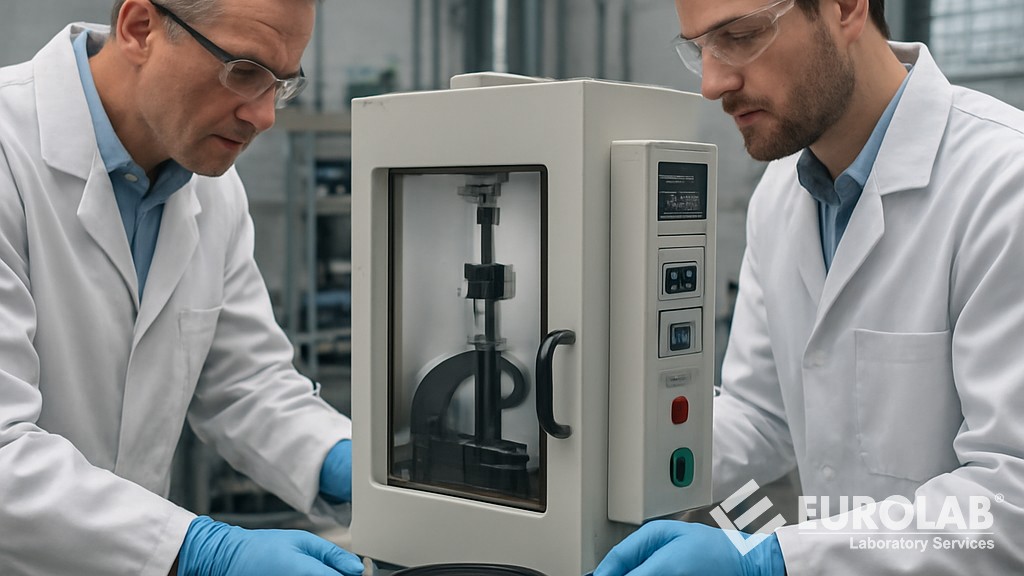
In ozone resistance testing, sample sections approximately 125 mm long and 10 mm wide are punched out of the relevant finished part and assembled according to the shape given in the standard. To ensure objective evaluation, textile tape is first applied to the ends of the sample sections (compressed surface and transition to the observation area).
The test is performed for 48 hours in an ozone chamber at an ozone concentration of 2 ppm (15 percent), a temperature of 25 degrees plus/minus 3 degrees Celsius, and a relative humidity of 60 percent plus 5 percent. Unless otherwise specified in the material specifications, inspections should be performed with 20 percent elongation. Sample parts are placed in the ozone chamber 15 minutes after assembly.
In permanent deformation testing, sample sections approximately 10 mm wide and 125 mm long are drilled through the corresponding 10 mm wide finished part and assembled according to the shape given in the standard. Unless otherwise specified in the material properties, tests should be performed with 20% elongation.
After the test period is complete, the sample is discharged and then its length is measured. Samples aged at high temperatures should be acclimatized to room temperature for 45 minutes before discharge.
Tensile strength (permanent deformation) is calculated using the formula given in the standard.
In the high-risk automotive manufacturing world, where vehicles must withstand extreme environmental conditions, material integrity is paramount. Volkswagen, a world leader in automotive manufacturing, has developed a rigorous suite of testing standards known as PV specifications to ensure every component, from interior trim to seals and elastomers, meets uncompromising quality criteria. Among these, the VW PV 3305 standard stands out as a critical test protocol focusing on evaluating ozone resistance and permanent deformation in non-metallic materials. This standard helps prevent costly failures such as cracking or warping under real-world conditions, protecting both vehicle performance and passenger safety.
As electric vehicles and autonomous driving technologies push the boundaries of materials science, standards like VW PV 3305 remain essential for innovation.
Volkswagen Group’s test procedure standards continue to expand globally, encompassing diverse climates from the arid deserts of the Middle East to the humid tropics of Southeast Asia. These standards cover everything from corrosion to weathering, but the VW PV 3305 standard specifically targets the insidious threat of ozone. Ozone is a reactive gas that can silently make rubber and plastics brittle over time.
Ozone, found in city smog and originating from vehicle emissions, presents a unique challenge. Unlike visible wear and tear from UV rays or humidity, ozone acts at the molecular level, causing microcracks that lead to permanent deformation. The VW PV 3305 standard is periodically updated to incorporate advances in polymer chemistry and is also aligned with international standards such as ISO 1431 for rubber ozone cracking. Today, these standards are mandatory for suppliers within the Volkswagen Group's broader ecosystem. Non-compliance has the potential to halt production lines.
The VW PV 3305 standard essentially measures both crack resistance and permanent deformation resistance by evaluating how materials respond to controlled ozone exposure. The test is divided into two main parts: ozone resistance and a broader assessment of deformation under stress.
There should be no visible cracks longer than 1 mm, and minimal discoloration or chalking should be observed. Results are rated on a scale of 0 (no damage) to 5 (severe cracking).
The described procedure draws upon older standards such as the DIN 53509 standard, but adds a Volkswagen Group-specific rigor, including cyclical humidity changes to simulate stop-start driving conditions. Advanced laboratories perform these tests using state-of-the-art chambers and often combine the VW PV 3305 standard with complementary protocols such as VW PV 3307 (plastic and elastic deformation) for comprehensive qualification.
The VW PV 3305 standard is not limited to laboratories; it's an integral part of everyday automotive design. Reduced ozone resistance can lead to leaks, noise, and even airbag failures. Suppliers use this standard to certify EPDM (ethylene propylene diene monomer) rubbers that demonstrate superior performance under this standard thanks to ozone-scavenging additives.
The risks are higher with electric vehicles. Battery housings and charging port seals must be ozone-resistant from high-voltage arcs. Materials compliant with the VW PV 3305 standard are used to ensure longevity in electric powertrains. Competitors are also adopting similar ozone testing to comply with regulations.
For many years, our organization, with its competent and experienced staff, has been understanding the needs of its customers, providing the advanced testing services they require, and assisting them in the establishment, implementation, and improvement of management systems. Within this framework, we also provide testing services to businesses in accordance with the "VW PV 3305 Vulcanized rubber products - Ozone resistance and permanent deformation test" standard.
To get an appointment, to get more detailed information or to request an evaluation, you can ask us to fill in our form and reach you.

