

The “Ford Engineering Material Specification – Crease Test – With and Perpendicular to Machine Direction” standard, developed by Ford Motor Company (Ford), describes a material evaluation method used to determine how resistant interior trim materials are to folding, creasing, and deformation without showing unacceptable damage. This test method is commonly applied to automotive materials such as coated fabrics, vinyls, synthetic leathers, laminated textiles, and other interior trim components.
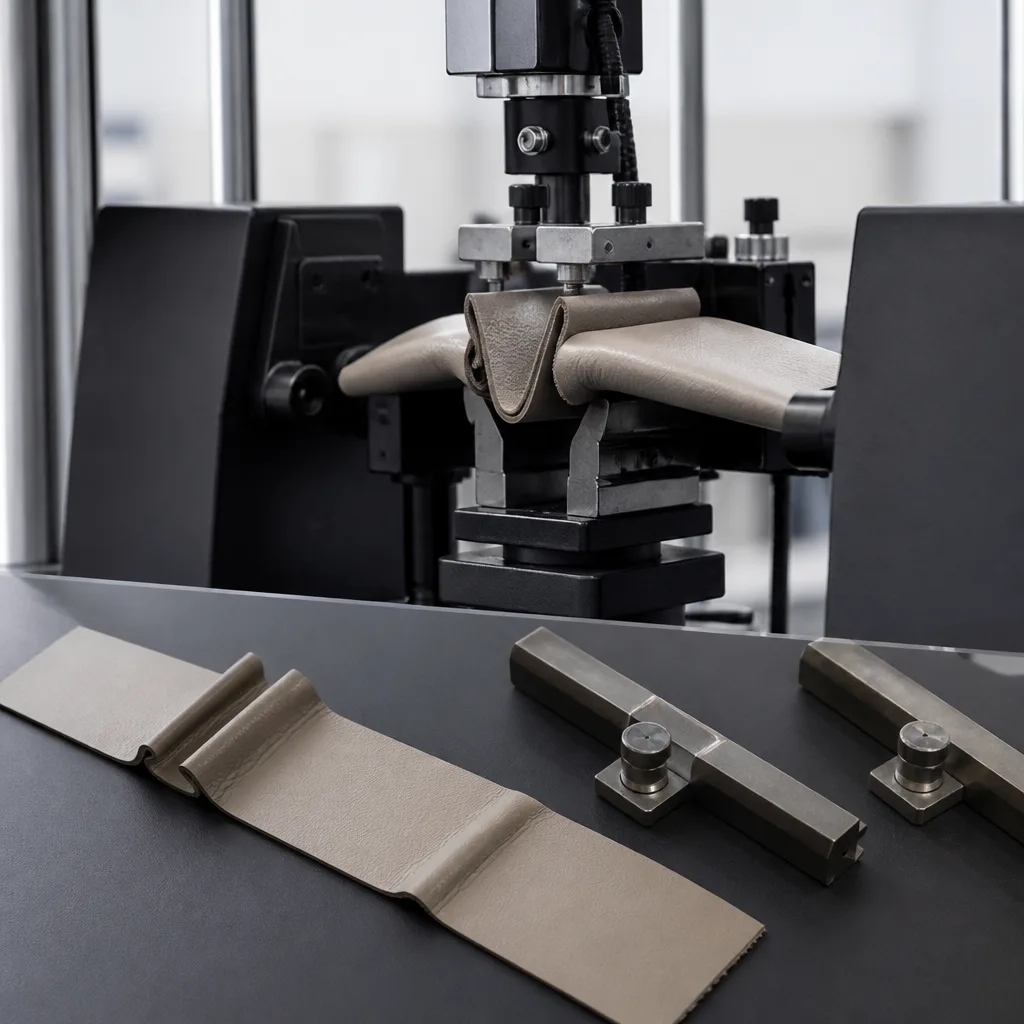
The primary purpose of wrinkle testing is to assess a material's resistance to:
Many automotive interior trim materials are subjected to sharp bending during manufacturing and vehicle use. Door panels, dashboard trims, seat upholstery, armrests, and console trims can all be subjected to repeated wrinkling. This testing method helps ensure these materials remain durable and visually acceptable throughout the vehicle's lifespan.
This standard evaluates samples in terms of two main materials:
Testing in both directions is important because many textiles and coated materials exhibit anisotropic behavior, meaning their performance can vary depending on the orientation.
In general, the testing method follows these steps:
In general, the review focuses on the following topics:
Materials are typically evaluated based on the following criteria:
Acceptable limits are specified in the relevant Ford material specification.
The Ford wrinkle test is commonly used in the following areas:
The Ford crease test is conceptually similar to other automotive flexibility and folding assessments such as the following:
Ford engineering material specifications are commonly used directional material property definitions when reporting mechanical test results such as parallel-to-machine and perpendicular-to-machine wrinkle tests, tensile strength, flexural strength, tear strength, or wrinkle resistance. In this context, in parallel-to-machine (WMD) wrinkle testing, the test specimen is oriented parallel to the manufacturing or machine direction of the material. For textiles, nonwovens, paper, and many automotive upholstery materials, this corresponds to the primary manufacturing direction. In perpendicular-to-machine (AMD) wrinkle testing, the test specimen is oriented perpendicular to the machine direction at 90 degrees.
These aspects are important because many sheet materials are anisotropic, meaning their properties differ depending on the test orientation. Materials generally exhibit higher strength and stiffness in the machine orientation than in the orientation perpendicular to the machine orientation.
For the Ford wrinkle test, samples are wrinkled in both directions and evaluated:
The reason this test is performed in both directions is because automotive interior materials (such as fabrics, vinyls, coated textiles, headliners, and door trim) are used in multiple directions within a vehicle. A material that performs well in one direction may crack, wrinkle, or whiten in another. Performing both WMD and AMD tests ensures consistent appearance and durability regardless of the mounting direction.
For example, a specification might require the following:
or
The individual values reflect the directional performance of the material.
In short, the machine orientation is the direction in which the material is manufactured or processed. Since many automotive materials are anisotropic (their properties vary depending on the orientation), Ford requires testing in both orientations. This is because interior trim materials can be mounted in different orientations within a vehicle, and wrinkle resistance can differ significantly between WMD and AMD.
The Ford crease test is important because it evaluates whether automotive interior materials can withstand the folding, bending, and creasing stresses encountered during manufacturing, assembly, and vehicle use without developing visible or structural defects. This standard is considered important for the following reasons:
Ford wrinkle testing is important because it ensures interior trim materials can withstand bending and folding without cracking, splitting, or losing their appearance. It helps maintain vehicle quality, supports manufacturing integrity, verifies laminate integrity, reduces warranty risks, and ensures materials meet durability standards throughout the vehicle's lifespan.
In short, the Ford crease test is a durability and appearance test used to verify that automotive upholstery materials can withstand crease and fold formation in both machine and cross-machine directions without cracking, delamination, or unacceptable cosmetic damage.
For many years, our organization, with its competent and experienced staff, has been understanding the needs of its customers, providing the advanced testing services they require, and assisting in the establishment, implementation, and improvement of management systems. Within this framework, we also provide testing services in accordance with the Ford crease test standard.
To get an appointment, to get more detailed information or to request an evaluation, you can ask us to fill in our form and reach you.

