

The “GMW 4726 Waterproofing Properties of Automotive Textiles” standard, developed by General Motors Worldwide (GMW), is a test standard used to evaluate the waterproofing properties of automotive textile materials. This standard typically uses a spray test to assess how effectively a textile surface resists water.
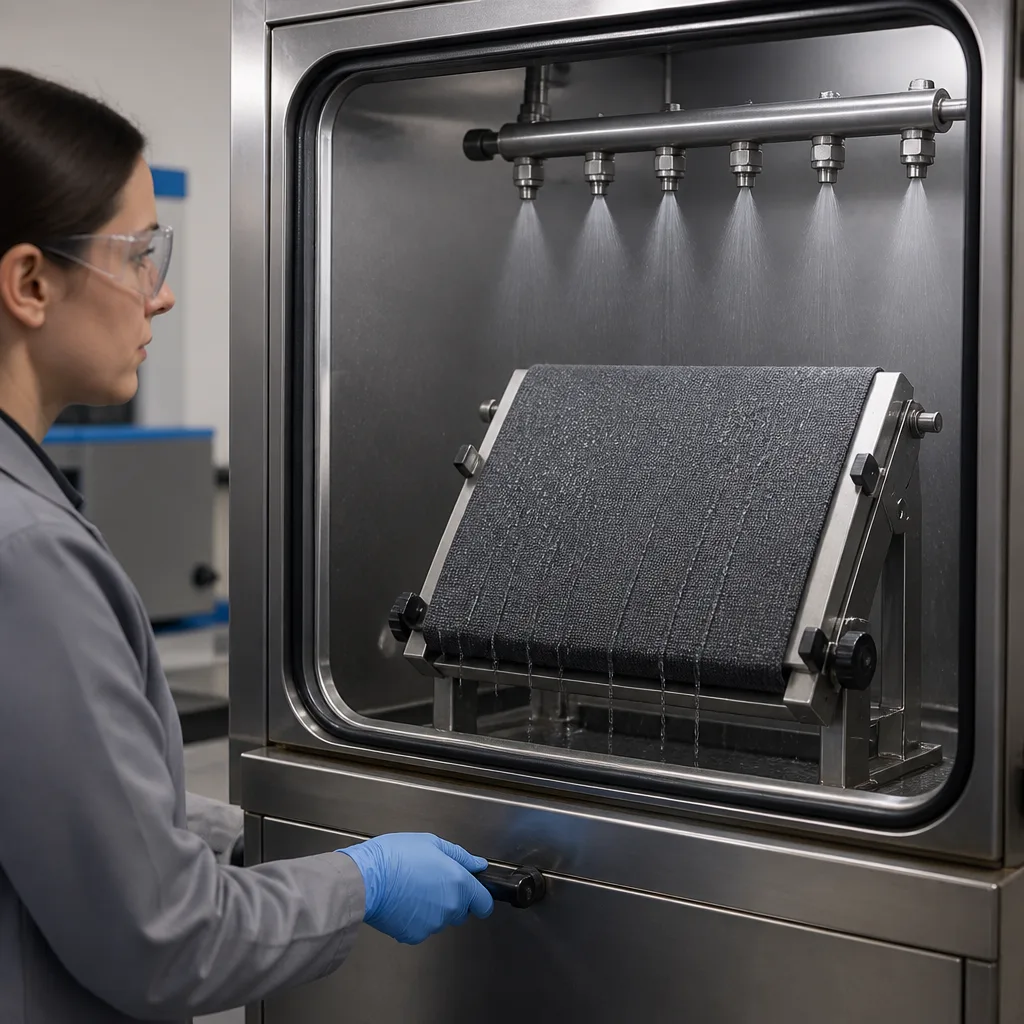
Waterproofing is a crucial property for automotive fabrics used in areas such as seat upholstery, door panels, headliners, luggage racks, and other textile-covered interior components. A fabric's resistance to water helps prevent the material from quickly wetting, staining, absorbing, and deteriorating.
The primary goal of the GMW 4726 standard is to provide a repeatable method for determining the surface water repellency of automotive textiles. Unlike water absorption tests, which determine how much water a material absorbs, water repellency tests evaluate the behavior of water droplets when they come into contact with the textile surface. A water-repellent fabric typically causes water to form droplets and remain on the surface or repel, rather than immediately penetrating the textile.
The method described in the GMW 4726 standard is defined by testing laboratories as a spray test. Generally, the test involves exposing a conditioned textile sample to a controlled spray of water. The appearance of the wetted sample is then visually assessed according to a standardized grading system. For example, 250 mL of distilled water is sprayed onto a stretched fabric sample, and the resulting surface condition is then visually evaluated on a 0-10 rating scale.
The basic concept can therefore be summarized as follows: textile conditioning, sample assembly, application of standardized water spray, visual assessment of wetting, and assignment of water repellency rating.
Sample preparation, equipment configuration, spraying conditions, evaluation criteria, and acceptance requirements are detailed in the GMW 4726 standard. These details depend on the publication of the standard and the vehicle/material specification.
In general, the testing process follows these steps:
The observed result is converted into the corresponding water repellency rating.
The GMW 4726 standard uses a visual evaluation scale of 0–10 to determine the post-spray surface appearance assessment. The basic interpretation is that the assessment represents the textile's apparent resistance to wetting. A fabric treated with a strong water-repellent should show significantly less wetting than a fabric that readily absorbs and releases water.
Typical equipment used when performing GMW 4726 testing includes:
The GMW 4726 standard is closely related in principle to the spray test approach used for textile water repellency, and laboratories often list both GMW 4726 and ISO 4920 standards together under water repellency testing.
Waterproofing can be an important performance characteristic for automotive textiles because interior fabrics may come into contact with water during vehicle use, cleaning, transportation, and exposure to environmental factors. This standard is considered important for the following reasons:
The GMW 4726 standard applies to textile materials used in automotive applications, including:
Water repellency testing, along with tensile strength, tear strength, elasticity and durability, flammability, abrasion, friction, dimensional stability, and seam fatigue tests, are included in textile laboratory qualification programs.
The GMW 4726 standard should not be confused with many other common automotive textile tests. These standards and the main characteristics evaluated are as follows:
These tests complement each other. For example, a textile might have excellent abrasion resistance but still need a separate assessment for waterproofing.
In conclusion, the GMW 4726 standard defines a test method used to evaluate the water resistance of automotive textile surfaces. This standard involves a controlled spray test followed by a visual assessment of the textile surface.
This test is particularly useful for verifying the consistency of waterproofing processes and the performance of automotive upholstery and interior textiles. The results can help automotive manufacturers and suppliers check material quality, appearance, and resistance to liquid exposure.
For laboratory proficiency testing or production approval, the latest version of the current standard should always be used, including specified sample preparation, conditioning, spraying parameters, evaluation criteria, and acceptance requirements.
For many years, our organization, with its competent and experienced staff, has been understanding the needs of its clients, providing the advanced testing services they require, and assisting them in the establishment, implementation, and improvement of management systems. Within this framework, we also provide testing services in accordance with the GMW 4726 standard.
To get an appointment, to get more detailed information or to request an evaluation, you can ask us to fill in our form and reach you.

