

Developed by BMW, a multinational vehicle manufacturer, the “BMW AA 0551 Bending stiffness - Two-point procedure” standard is an internal test specification designed specifically to evaluate the bending stiffness of materials used in automotive components. This standard is directly based on the German industry standard “DIN 53121 Paper and cardboard tests - Determination of bending stiffness by beam method”.
The DIN 53121 standard specifies methods for determining the bending rigidity (flexural rigidity or bending resistance) of paper, cardboard, and especially corrugated cardboard. Bending rigidity measures a material's resistance to bending within its elastic range. This is an important property for packaging performance, workability in printing presses, converting operations, and the stacking strength of boxes.
This standard uses the beam method and defines three main bending test variants:
In these tests, a strip of material is bent in a controlled manner (usually to a defined angle or deflection), and the relationship between the applied bending moment and the resulting curvature/deflection is measured within the elastic range.
In the automotive industry, bending rigidity is a crucial mechanical property that measures how resistant a material is to bending under load. This is particularly important for parts such as:
This testing method helps ensure that materials maintain their structural integrity, tactile feel, durability, and shape during assembly, use, and aging. BMW uses this test, often in conjunction with other “AA” series tests for environmental resistance, abrasion, or hydrolysis, to qualify suppliers and materials for series production.
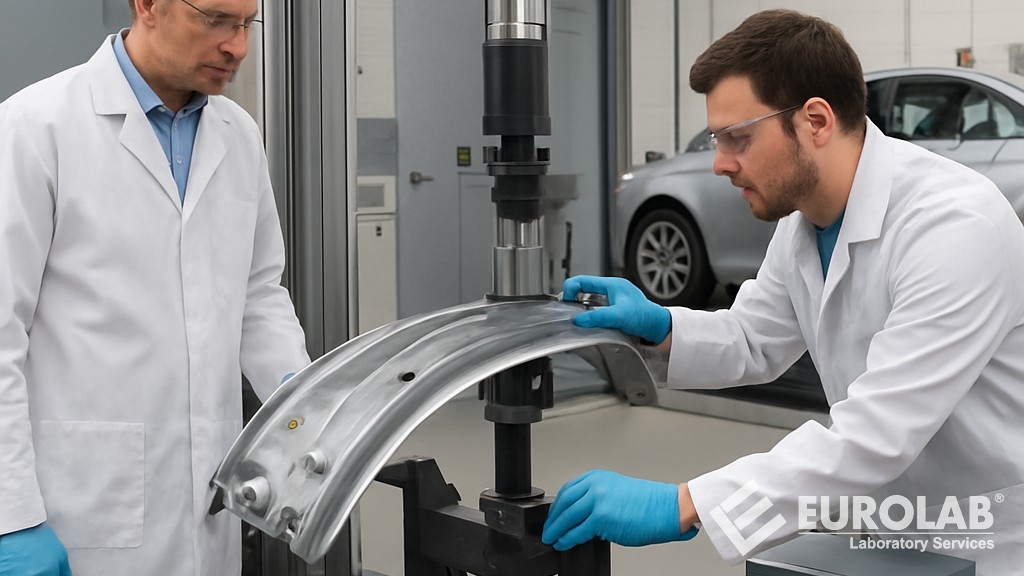
The BMW AA 0551 standard adapts the two-point beam method from the DIN 53121 standard: A strip-shaped specimen is clamped at one end (cantilever installation) or supported at two points. A specific force or deflection is applied, and the resulting bending behavior is measured. The basic output, bending stiffness, indicates rigidity. Test conditions may include specific temperature, humidity, or preconditioning according to BMW requirements (e.g., after aging or exposure tests).
This standard is included in the lists of BMW automotive component tests offered by accredited laboratories. It is usually grouped together with other material evaluations:
It supports compliance with broader BMW material standards, such as thermoplastics (BMW GS 93016 standard) or coated parts (BMW GS 90011 standard) where bending properties contribute to long-term performance.
For BMW suppliers and engineers, passing the BMW AA 0551 standard ensures that components meet superior quality expectations. It prevents sagging fabrics, cracked coatings, or poor tactile feel in vehicles. Non-conformity can lead to rejection in approval processes.
The BMW AA 0551 standard is a BMW-specific materials testing standard used to evaluate the mechanical properties (particularly flexibility or bending behavior) of certain interior components or materials, such as plastic or polyamide-based parts used in the passenger compartment.
This standard is closely related to the German industrial standard DIN 53121, which defines a test method for determining the bending stiffness/flexibility properties (typically under defined conditions such as temperature or aging) of films, foils, thin sheets, or similar flexible materials.
Like other premium car manufacturers, BMW applies very strict interior material and component requirements for several important reasons:
In short, the BMW AA 0551 standard aims to prevent problems that could lead to warranty claims, customer complaints, or damage BMW's reputation for engineering excellence by ensuring that certain interior plastic components remain flexible and sufficiently robust throughout the car's lifespan. This is a key part of BMW's comprehensive material qualification system for suppliers.
For many years, our organization, with its competent and experienced team, has been understanding the needs of its clients, providing the advanced testing services they require, and assisting them in the establishment, implementation, and improvement of management systems. Within this framework, we also provide testing services in accordance with the BMW AA 0551 standard.
To get an appointment, to get more detailed information or to request an evaluation, you can ask us to fill in our form and reach you.

