

The standard "Renault D45 1601E Passenger compartment materials - Volatility of additives on a single surface," developed by the French automobile company Renault, describes a test method for characterizing additive loss in fabric or plastic parts. This method is applicable to all passenger compartment materials.
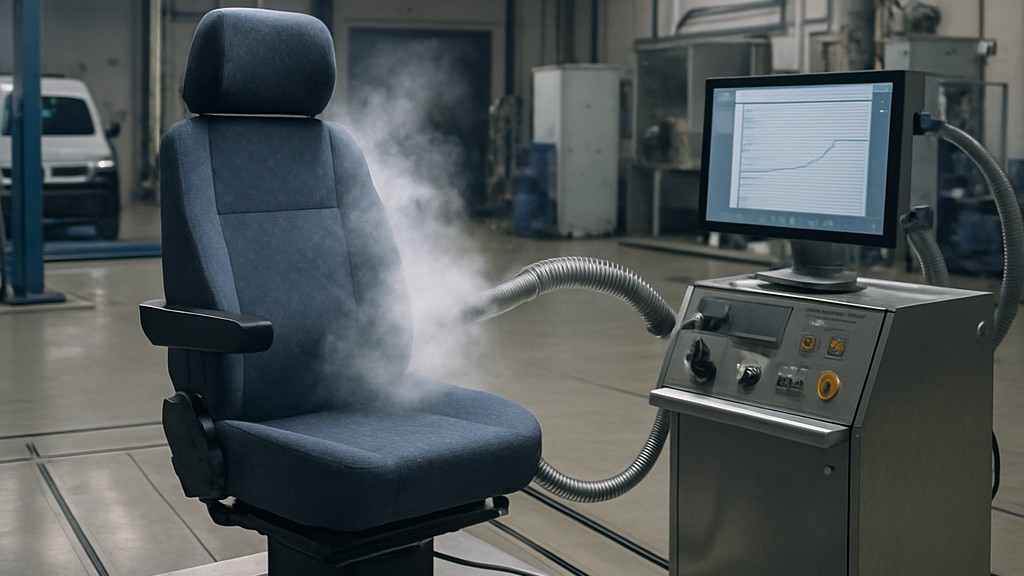
In principle, this method measures the weight of the additive loss in a sample with a 1 dm2 surface that is in contact with activated carbon at a certain temperature and for a certain period of time.
Three 122 mm diameter samples are cut from the material being analyzed or from a flat section of the analyzed sample. The samples are conditioned in the chamber for at least 24 hours. For hydrophilic materials (e.g., felts, shredded leather, TEP cotton linings, polyurethane foam), the samples are conditioned in the chamber for at least 72 hours. The fresh activated carbon is reactivated at 105°C for at least 2 hours.
Weigh each sample to the nearest milligram (in grams). Each sample is placed on the fixture and the device is moderately compressed simultaneously. The sample is covered with 20 g of fresh reactivated activated carbon, covering the entire surface. The lid is placed.
To avoid altering the carbon distribution, avoid tilting or shaking the fixtures. The temperature probe is placed in contact with the lid. The temperature is monitored throughout the test period.
The fixtures are placed in the furnace:
The fixtures are removed from the furnace, and the activated carbon is removed. The samples are removed from the fixtures, shaken vigorously, wiped with a cloth, or blown clean. The samples are conditioned as before the initial weighing. The weight in grams is determined for each sample.
When expressing the results, the volatility of the additives is expressed in grams per square meter and is characterized by the average weight loss (g) of three samples relative to the evaporation surface in m2.
In short, the Renault D45 1601E standard refers to the assessment of additive volatility in passenger compartment materials, specifically on a single surface. This test is a typical part of Renault's automotive material qualification standards to ensure a safe and comfortable cabin environment by limiting the emission of volatile substances.
The purpose of this standard is to evaluate the tendency of vehicle interior materials, such as plastics, textiles, and coatings, to release volatile substances under heat. This can cause fogging on glass surfaces (a visibility concern) and odor or health effects for passengers. In principle, a single test surface of the material is heated under controlled conditions, and the amount of volatile substances released and condensed on a cooler surface is measured.
The main test parameters include temperature exposure (usually between 80°C and 120°C), duration (usually 3 to 16 hours), and condensation measurement (using a glass or metal plate). Evaluation criteria include the weight of the condensed material and the visual change in fogging or transparency.
According to this standard, specific limits for acceptable volatility levels are defined according to:
This test is typically applied during the qualification of:
The purpose of these tests is to minimize user exposure to volatile organic compounds (VOCs) and ensure that the interior air quality meets the vehicle's interior environmental and safety criteria.
The Renault D45 1601E standard is necessary for several key reasons related to passenger safety, comfort, and environmental compatibility. The main reasons for this standard's importance are:
Our organization, which has been supporting businesses across all sectors for years through a wide range of testing, measurement, analysis, and evaluation activities, has a strong team of employees who closely follow global developments in science and technology and are constantly improving themselves. In this context, we also provide testing services to businesses in accordance with the "Renault D45 1601E Passenger compartment materials - Volatility of additives on a single surface" standard.
To get an appointment, to get more detailed information or to request an evaluation, you can ask us to fill in our form and reach you.

