Fiat - Humid Heat Resistance Test
Developed by Fiat Chrysler Automobiles (FCA) (now Stellantis), an Italian-American automotive company, the humid heat resistance test is an environmental durability requirement used in automotive validation programs to evaluate how materials, components, coatings, adhesives, electrical systems, and interior upholstery behave when exposed to prolonged high humidity and high temperature conditions. This test aims to simulate real-world service environments such as tropical climates, condensation cycles, humid storage, and prolonged cabin humidity exposure.
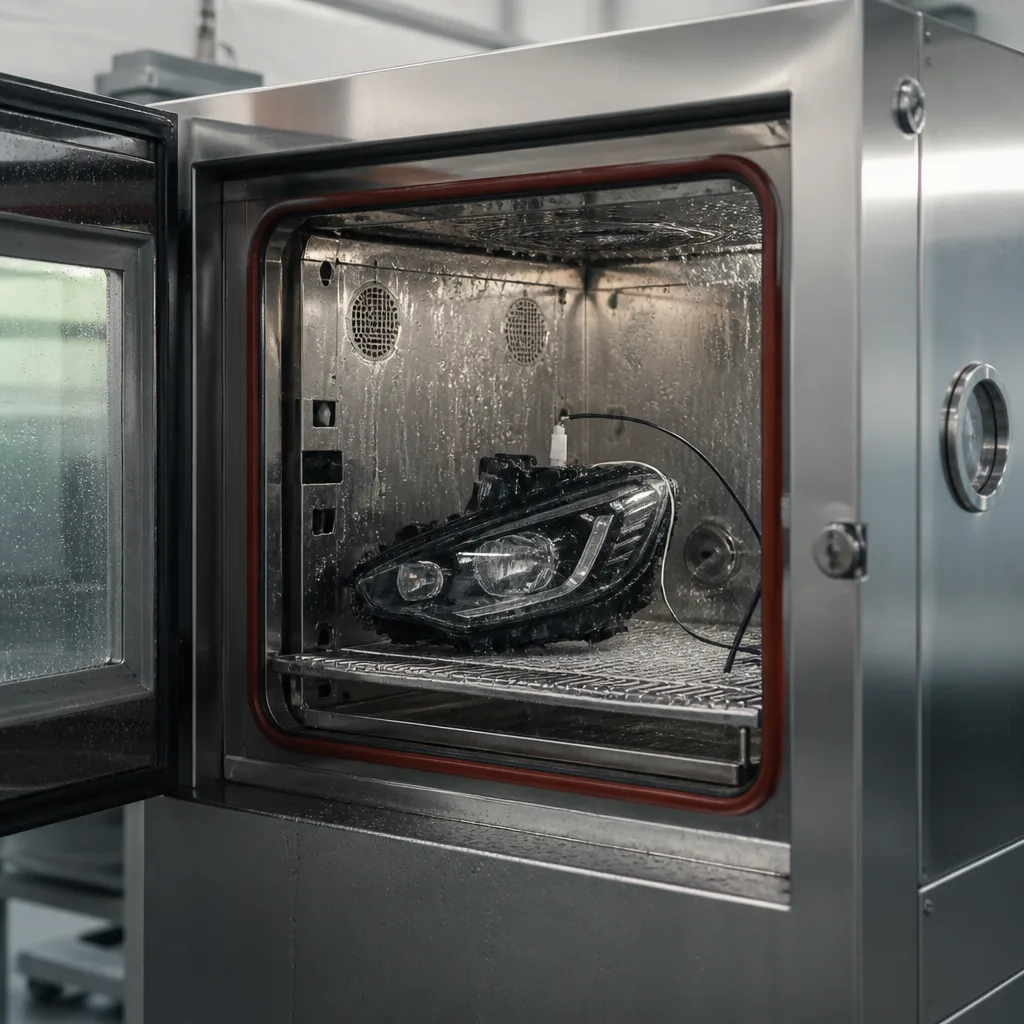
In Fiat engineering documentation, this requirement is part of broader environmental aging specifications, climatic resistance procedures, or material qualification standards used for supplier approval and vehicle validation.
The primary purpose of moist heat resistance testing is to determine whether a component can maintain its properties after being exposed to hot and humid environmental conditions:
- Mechanical integrity
- Dimensional stability
- Surface appearance
- Adhesion performance
- Electrical functionality
- Corrosion resistance
- Odor/emission stability
This test is particularly important because vehicles are routinely subjected to the following conditions:
- Solar heating followed by condensation.
- Tropical humidity
- Water inlet
- Moisture accumulation inside the cabin
- Temperature cycle along with dew formation
- Long-term storage in humid environments
Without moist heat verification, components may fail prematurely due to corrosion, swelling, delamination, electrical leakage, mold growth, or adhesive degradation.
Fiat's humid heat resistance test is generally applied in the following areas:
- Interior components:
- instrument panels
- Door trims
- Armrests
- Pole coverings
- Ground systems
- Seat foams and coverings
- Decorative films
- Electrical and electronic components:
- Keys
- Sensors
- Electronic control units
- connectors
- Lighting modules
- Cable harnesses
- Coatings and surface systems:
- Painted plastics
- Soft-touch coatings
- Chrome coatings
- Decorative laminates
- Adhesive assemblies:
- Adhesive bonds
- Foam laminations
- Textile bonding
- Velvet surfaces
Moist heat resistance testing typically follows internationally accepted climatic aging principles such as:
- International Organization for Standardization (ISO) standards
- International Electrotechnical Commission (IEC) climatic tests
- Automotive original equipment manufacturers' environmental aging procedures.
Common conditions include:
- Temperature: 40 degrees to 85 degrees
- Relative humidity: 85 to 95 percent
- Duration: 24 hours to 1000 hours
- Exposure mode: Continuous or cyclical
- Condensation: Usually included.
In general, this method follows these steps:
- Initial inspection: Before testing, components are documented in terms of dimensions, color, gloss, mechanical strength, and functional performance.
- Conditioning: Samples can be stabilized under laboratory conditions before exposure.
- Moist heat exposure: The sample is placed in a climate-controlled chamber where temperature and humidity are carefully controlled. Exposure conditions may include: constant climate, cyclical humidity, and condensation cycle.
- Recovery period: After aging, the parts are conditioned at room temperature.
- Final evaluation: The component is examined from the following perspectives:
- Corrosion
- Cracking
- Swelling
- Layer separation
- Adhesive failure
- Electrical fault
- Surface imperfections
- Odor changes
- color change
Moisture heat exposure testing can reveal weaknesses that are not visible in standard room temperature tests:
- Metallic components: Possible failures include:
- Oxidation
- Galvanic corrosion
- Rust formation
- Plastics: Possible failures include:
- Hydrolysis
- Impact
- Fragility
- Loss of firmness
- Adhesives: Possible malfunctions include:
- Ligament weakening
- Edge lifting
- Foam separation
- Electronics: Possible malfunctions include:
- Insulation leakage
- Short circuits
- Contact corrosion
- Sensor drift
- Decorative surfaces: Possible defects include:
- blistering
- Whitening
- Peeling
- Reduced brightness
Humidity is one of the most destructive environmental factors affecting vehicle durability. Humid heat resistance testing is considered necessary due to the following factors to which vehicles are exposed globally:
- Tropical climates
- Coastal salt moisture
- Rain and condensation
- Thermal cycle from winter to summer
This testing method helps suppliers ensure the following:
- Long service life
- Reduced warranty claims
- Stable appearance quality.
- Electrical reliability
- Passenger safety
This testing method is particularly critical for modern vehicles because,
- Electronic content has increased significantly.
- Lightweight polymers are more sensitive to moisture.
- Multi-material fastening systems are widely used.
Fiat's humid heat requirements are generally technically compliant with the following standards:
- IEC 60068-2-78 Environmental tests - Part 2-78: Tests - Test chamber: Moist heat, steady state
- IEC 60068-2-30 Environmental tests - Part 2-30: Tests - Test Db: Moist heat, cyclical (12 hour + 12 hour cycle)
- ISO 16750 Road vehicles – Environmental conditions and tests for electrical and electronic equipment.
- ISO 6270 Paints and varnishes - Determination of resistance to moisture.
However, Fiat usually adds the following:
- Acceptance criteria specific to original equipment manufacturers.
- Vehicle-specific climate profiles
- Supplier qualification rules
- Material-specific assessments
Moist heat resistance testing is important because it confirms that automotive components can withstand exposure to environmental influences for years:
- Functional impairment
- Cosmetic deterioration
- Failure due to corrosion.
- Loss of passenger comfort
- Security risks
In practice, this testing method prevents problems such as the following:
- Peeling instrument panels
- Corroded connectors
- Moldy interiors
- Separated floors
- Fogged lighting systems
- Electrical instability
For Fiat and its suppliers, resistance to humid heat is a fundamental reliability and durability requirement in the automotive product development process.
For many years, our organization, with its competent and experienced team, has been understanding the needs of its clients, providing the advanced testing services they require, and assisting in the establishment, implementation, and improvement of management systems. Within this framework, we also provide humid heat resistance testing services to businesses.



