

The SAE J1530 Automotive Carpet Material Test Method for Determining Resistance to Fiber Loss, Abrasion and Pilling, an aerospace standard, describes a test method for determining the abrasion resistance, fiber loss, and pilling resistance of automotive carpet materials.
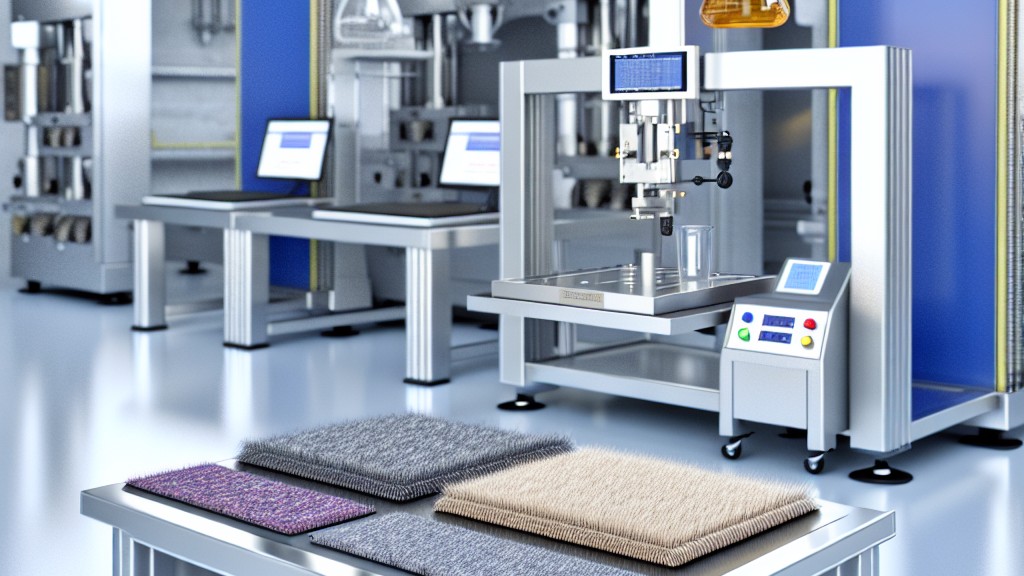
Materials and equipment required for testing resistance to fiber loss by sample weight include:
Test specimens are prepared using a circular die approximately 100 mm in diameter or cut along the circular line on the mounting card. A hole punch is used to make a 6 mm diameter hole in the center of the specimen. If necessary, an S-37 mounting card may be used to secure the specimen. Specimens shall be conditioned at 24 degrees plus/minus 23 degrees and 2 percent plus/minus 50 percent relative humidity for at least 5 hours.
When testing, H-18 wheels are mounted and the tester is set for a load of 1000 g per wheel. Before each specimen is tested, the abrasive wheels are ground against a type S-11 abrasive paper surface finisher mounted on the turntable for at least 25 cycles to finish the surface. If the wheels are out of round, crowned, or excessively clogged with worn material, the wheels should be ground using a diamond tool wheel surface finisher until the condition is corrected. If there is any doubt about the condition of the wheels, new wheels should be used. The ground abrasive wheels are vacuumed or brushed to remove loose particles. Weigh the specimen to the nearest 0,1 g. Record the weight as W1. When it is necessary to collect lost fibers, the vacuum hose is covered with a piece of whisk meter cloth to collect the worn fibers and the hose is attached to the vacuum port of the Taber abrasive. The specimen is placed on the turntable. The clamp plate is placed on the turntable screw and the nut is tightened. The clamping ring is adjusted to fit snugly over the sample and the turntable. The clamping ring is pressed and held on the turntable perimeter. The sample edges are adjusted under the clamping ring to remove wrinkles from the sample. The ring adjustment screw is then tightened. The abrasive wheels are lowered onto the surface of the sample. The vacuum nozzle is placed 3 mm above the surface of the sample and the vacuum is set to 60 to 70. The vacuum is turned on and the test is run for the specified number of cycles. If fibers are collected, the vacuum hose is removed from the vacuum port. The whisk meter cloth is carefully held and the collected fiber is placed in a transparent plastic bag. The whisk meter cloth is discarded. The sample is removed from the turntable. The sample is vacuumed with the vacuum hose to remove loose fibers. The vacuum hose on the Taber abrader is replaced. The sample is weighed to the nearest 0,1 g. Its weight is recorded in grams. The fiber loss is calculated in grams by following the equation given in the standard.
Unless otherwise specified, abrasion resistance is a continuation of the fiber loss test. The sample is placed back into the abrader and the test is run for the number of cycles specified for the abrasion requirements. The results are reported as agreed upon by the parties.
The Taber abrasion tester used in these tests is a test device used to determine the relative resistance of materials to a mechanical abrasive effect such as friction, scrubbing or erosion.
Our organization has a strong staff that closely follows the developments in the world in the field of science and technology and constantly improves itself. Among the numerous test, measurement, analysis and evaluation studies provided for businesses in various sectors, there are also test services in accordance with the standard "SAE J1530 Test method for determining the resistance of automotive carpet materials to fiber loss, resistance to abrasion and bearding".
To get an appointment, to get more detailed information or to request an evaluation, you can ask us to fill in our form and reach you.

