

The standard "PSA D44 1237 Abrasion of upholstery parts for carpets and plastic sheet coverings by Taber Machine" developed by PSA, a French multinational automotive company, describes a procedure for evaluating the abrasion resistance of lining carpets (plain non-woven material or appearance pile, tufting, and similar) used in interior spaces (such as rear seats, trunk lid mats, cabin, shelves, floor mats). This standard applies to mats or material that have been converted before being homogeneously combined. It also applies to plastic mats or floor mats (rubber known as PUR or TPO). This standard is based on the principles of the standard "SAE J1530 Test Method for Determining the Resistance to Fiber Loss, Abrasion Resistance and Load-Carrying Capacity of Automotive Carpet Materials".
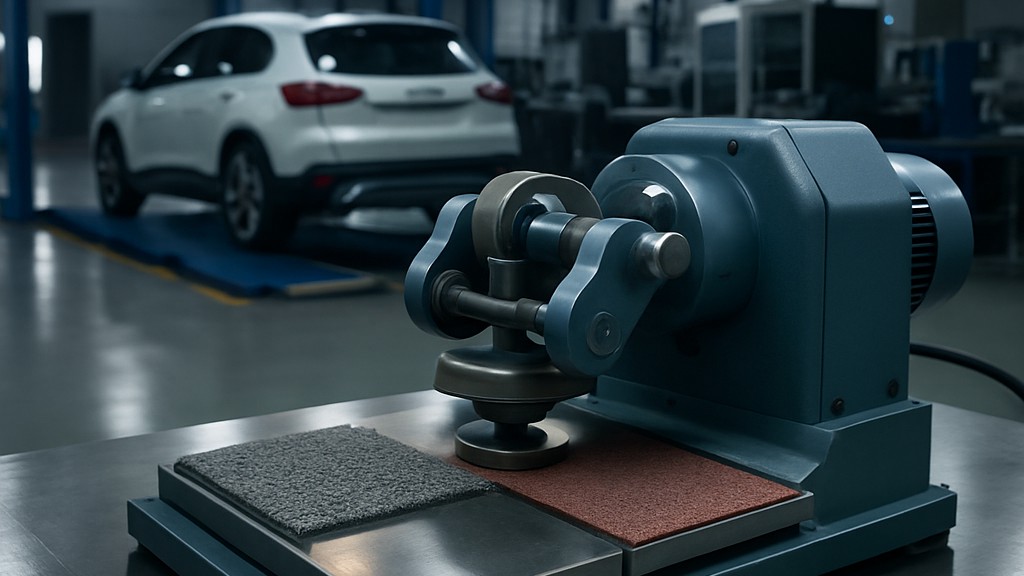
In principle, a test specimen rotated about a vertical axis is subjected to the abrasive action of a pair of wheels rotating in the opposite direction, perpendicular to the horizontal plane of the specimen and at a specified pressure. Abrasion resistance is assessed by the degree of deterioration of the specimen by a combination of wheels, weight, and number of cycles. For carpet coverings, classification is performed by abrasion and grinding. For other coverings (wood, TPO, PVC mesh), classification is performed by mass loss, grayscale value, and appearance assessment.
The abrasive machine used in the tests operates with a suction system connected to a vacuum pipe, a flow control device and the following accessories:
The following equipment is also used in the tests:
Test samples or specimens should be representative of the scale to be characterized. To ensure this representativeness, the baseline characteristics of the population being studied must be determined. Selection criteria for test samples or specimens must be specified in the test report in accordance with PSA A10 0156. In case of doubt regarding sampling, the PSA should be contacted to determine the appropriate guidelines.
The abrasive grinding wheel preparation process must be performed on a pair of abrasive wheels and cannot be performed individually. At the end of this process, the surface of each wheel must be smooth in appearance and flat across its entire width. If it is not, the adjustment or correction process is repeated. After preparing the stones, all dust is removed with a brush.
Before using a new pair of abrasive wheels, they must be adjusted with an abrasive disc. This adjustment is the same as described in the procedure, but with a 500 g load applied to each moving arm for 50 cycles.
After each test, the abrasive stone pair needs to be corrected with an abrasive disc in the same arrangement described in the procedure, but under a load of 500 g per moving arm for 50 cycles.
At least three test samples are taken with a cutting tool: flat discs with a diameter of 105 mm plus or minus 2 mm and a constant width of no more than 7 mm. If necessary, any thickness that could affect the test result is flattened laterally. A hole with a diameter of 7 mm plus or minus 0,5 mm is drilled in the center of the test sample. It is checked for foreign or contaminated particles. If possible, these are removed without altering the surface of the test sample. Otherwise, a new test sample is prepared. For washable coatings (TPO, PVC mesh, wood), each test sample is weighed. The test samples are stored in a conditioned room for 24 hours. Prior aging of the test samples may be required.
In the automotive manufacturing world, ensuring the longevity and quality of interior materials is paramount. It's critical for textile floor coverings like carpets and mats to withstand the constant friction caused by foot traffic, shifting loads, and environmental factors. This is where a specialized test method, the PSA D44 1237 standard, comes into play. This standard provides a rigorous procedure to simulate real-world wear, helping manufacturers verify material performance before vehicles hit the road.
Created as part of PSA's comprehensive suite of materials testing protocols, this standard focuses on a unique method designed to mimic the mechanical stresses in ground textiles. By subjecting samples to controlled abrasion cycles, it provides quantifiable data on durability and prevents issues like pilling, fraying, or premature failure that can lead to costly recalls or customer dissatisfaction.
Ultimately, the PSA D44 1237 standard exemplifies the precision engineering behind everyday automotive comfort. By simulating the relentless rush of daily commutes, it protects the passenger experience and brand reputation. For engineers, suppliers, and enthusiasts, understanding this standard highlights the invisible precision that makes vehicles not only drivable but also durable. As electric vehicles usher in new material paradigms, the PSA D44 1237 standard continues to evolve.
Our organization, which has been operating for many years and meticulously follows global developments in science and technology, conducts testing, measurement, and analysis in a wide range of areas for businesses across all sectors with a skilled team and extensive infrastructure. In this context, we also provide testing services in accordance with the "PSA D44 1237 Wear of upholstery components for carpet and plastic sheet coverings by Taber Machinery."
To get an appointment, to get more detailed information or to request an evaluation, you can ask us to fill in our form and reach you.

