

The “GMW 14468 Sound Transmission Loss and Sound Power-Based Insertion Loss Buck Evaluation Procedure” standard, developed by General Motors Worldwide (GMW), is an engineering standard relating to the acoustic evaluation of vehicle components and assemblies using a Buck evaluation procedure. Its purpose was to provide a controlled method for evaluating the acoustic performance of components by measuring sound transmission loss (STL) and sound power-based insertion loss (PBIL). However, this standard has now been discontinued and replaced by the “GMW 14176 Sound Transmission Loss (STL) and Sound Power-Based Insertion Loss (PBIL) Buck Evaluation Procedure”.
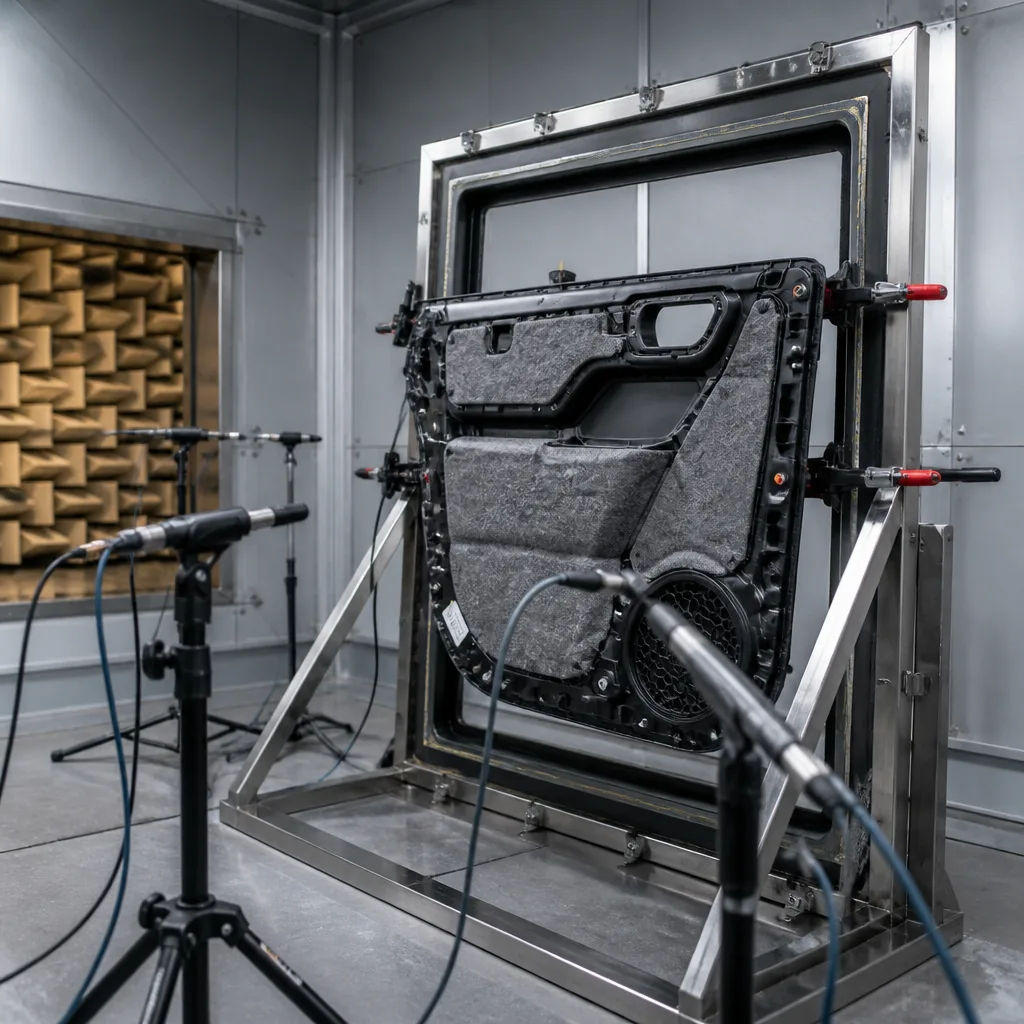
Vehicle noise is affected not only by noise from the engine, powertrain, tires, and other sources, but also by how effectively vehicle structures and acoustic materials prevent this noise from reaching the passenger compartment. This standard addresses this issue by providing an engineering procedure to evaluate the acoustic performance of components in a controlled test rig configuration. The basic measurements are as follows:
These measurements help engineers determine whether a component or material provides adequate acoustic insulation or noise reduction.
Sound transmission loss (STL) describes how effectively a partition or component reduces sound transmission from one side to the other. It is usually expressed in decibels. A higher STL value indicates better sound insulation. For example, an automotive dashboard, floor assembly, door system, or acoustic barrier can be evaluated to determine the amount of airborne noise prevented from passing through the component. Sound transmission loss (STL) is particularly useful for engineers during the development phase, allowing them to compare alternative materials, structures, thicknesses, and acoustic treatments.
The second important measurement related to the process is insertion loss based on sound power (PBIL). Insertion loss evaluates the reduction in acoustic output resulting from the application of a component or acoustic treatment. Rather than simply asking how much sound passes through a material, the measurement takes into account the change in radiated sound power produced by adding the component to the test configuration. A higher PBIL value generally indicates that the treatment being tested provides a greater acoustic benefit. This is particularly valuable for evaluating components such as:
A key feature of the process is the use of a test prototype. A test prototype is a controlled physical representation of a vehicle or a part of a vehicle structure. Instead of testing the entire production vehicle, engineers can assemble the component or assembly into a repeatable laboratory structure. This offers several advantages:
The principles addressed in the GMW 14468 standard are applicable to many vehicle noise, vibration, and harshness (NVH) improvement activities:
STL and insertion loss measurements can help determine whether a firewall application provides adequate acoustic insulation.
During testing, the component is assembled in a defined configuration, and acoustic measurements are taken under controlled conditions. The aim of STL testing is to determine the acoustic attenuation provided by the test specimen. In PBIL testing, engineers compare the acoustic performance of the configuration with and without the component or process. The data obtained can then be used to compare designs.
The GMW 14468 standard is important because automotive acoustic enhancement requires more than simply measuring the overall noise level inside a finished vehicle. Engineers need to know where noise is entering the vehicle and how effectively individual components are blocking it. Therefore, component-level acoustic testing provides valuable engineering information before full vehicle validation. For example, if two instrument panel insulators have similar material properties but one produces significantly higher sound loss, the higher-performance design might be preferred for vehicle enhancement.
STL and PBIL are related but should not be treated as identical measures:
This distinction is important because a material that exhibits good conduction loss properties in the laboratory will not necessarily deliver the same improvement in complex vehicle assembly.
The GMW 14468 standard approach offers several advantages for automotive development:
Today, General Motors engineering operations are required to adhere to the GMW 14176 standard, rather than the previous GMW 14468 standard which applied automatically.
For many years, our organization, with its competent and experienced staff, has been understanding the needs of its clients, providing the advanced testing services they require, and assisting them in the establishment, implementation, and improvement of management systems. Within this framework, we also provide testing services in accordance with the GMW 14468 standard.
To get an appointment, to get more detailed information or to request an evaluation, you can ask us to fill in our form and reach you.

