

The “GMW 14145 Automotive Seat Material Seam Strength Test” standard, developed by General Motors Worldwide (GMW), includes a test procedure used to determine the strength of seams in automotive seat materials. This standard evaluates the tensile force required to break a seam prepared under specified conditions. It primarily applies to upholstery materials used in vehicle seats, including textiles, leather, and plastic roll materials.
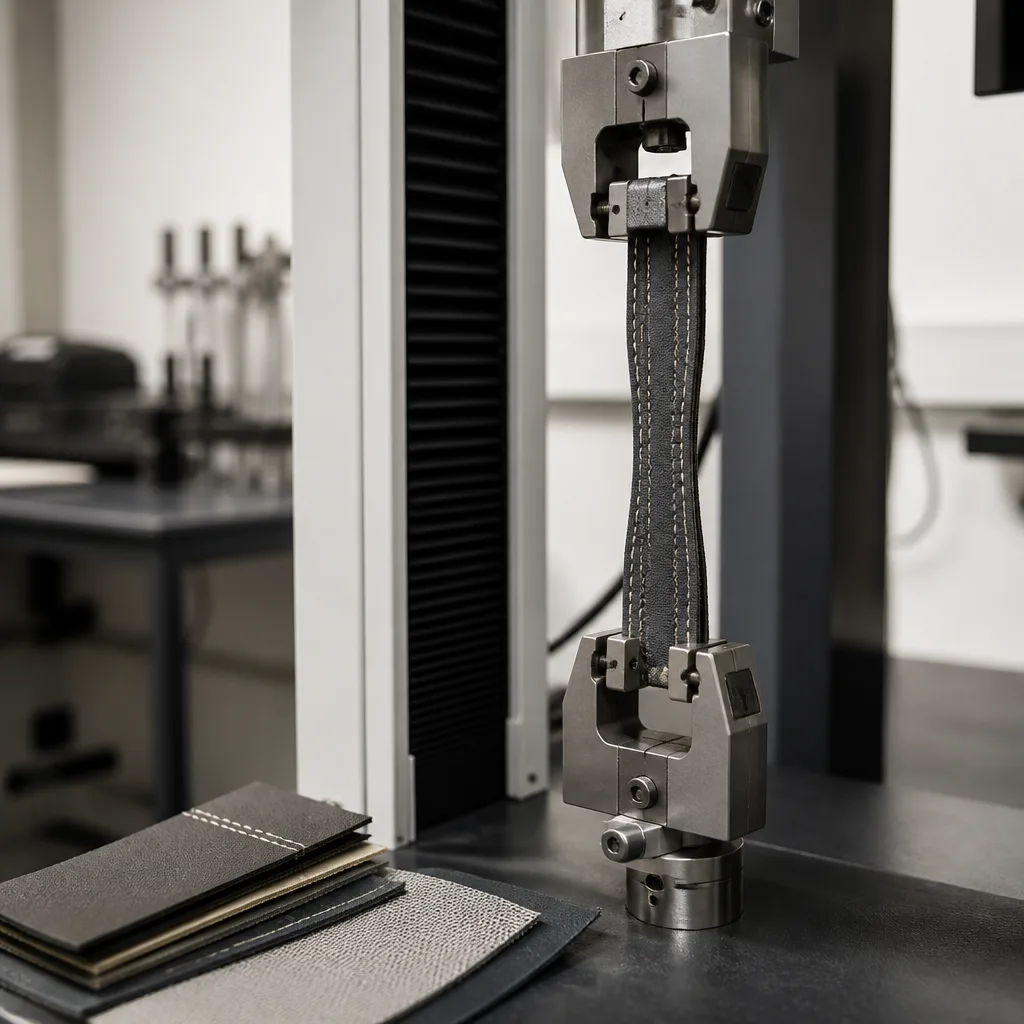
Seam strength is a crucial property in automotive seats because seat covers are subjected to repeated loading, stretching, friction, passenger movement, and environmental conditions throughout the vehicle's lifespan. A seam that is significantly weaker than the surrounding material can become a point of failure, even if the upholstery itself possesses sufficient strength.
The basic concept in the GMW 14145 standard is simple: a sample containing a prepared weld is subjected to tensile load until the weld fractures. The force required to cause the fracture is then used to characterize the strength of the weld.
This standard defines seam strength as the tensile force required to break a seam prepared under standardized conditions. This approach allows General Motors and its suppliers to assess whether a particular floor covering structure can withstand the mechanical stresses expected during vehicle use.
The GMW 14145 standard is designed for seat materials, specifically the following upholstery materials:
This procedure is more concerned with the performance of the welded structure than the tensile strength of the seamless material. This distinction is important because a material may have good tensile properties while its welded portion performs poorly.
Automotive seat covers are subjected to significant mechanical stresses. These stresses can occur in the following situations:
The seam is often a mechanically sensitive area because it creates holes and alters the path of the load within the material. If the seam is not strong enough, various problems can arise:
Therefore, the GMW 14145 standard provides an important quality control tool for seat cover manufacturing.
The basic principle is a tensile test on a prepared seam. Generally, this test method follows these steps:
Therefore, the test provides a quantitative indication of whether the suture structure is sufficiently strong.
The exact sample dimensions, seam configuration, conditioning requirements, machine settings, loading speed, number of samples, and acceptance criteria are specified in the GMW 14145 standard.
The primary result is the force required to cause the seam to rupture. A higher measured seam strength value generally indicates a stronger seam structure, but the result should always be interpreted according to the material type, seam design, failure mode, and applicable General Motors requirements. The test can also provide useful information about how the sample failed. For example, failure might include:
The failure mode can be as important as the numerical strength because it helps engineers determine whether the problem stems from the stitching process, thread, material, or structural design.
The following factors affect seam strength:
In conclusion, seam strength should be considered not merely as a property of the flooring material itself, but as a systems property of the material and seam structure.
For automotive manufacturers, seats are a component with a high rate of use. Seat covers must maintain both their functional integrity and appearance throughout repeated use. The GMW 14145 standard contributes to this goal by providing a controlled method for evaluating one of the most important mechanical properties of stitched upholstery.
This test can be used in the following situations:
For automotive upholstery suppliers, compliance with the GMW 14145 standard helps demonstrate that seat materials and stitching constructions can meet General Motors' mechanical performance requirements. Suppliers must check the following variables:
Good control of these variables increases repeatability and reduces the risk of producing seemingly acceptable material that performs poorly after stitching.
In short, tests conforming to the GMW 14145 standard focus on the following characteristics:
In conclusion, the GMW 14145 standard is important because stitching is a critical part of automotive seat cover construction. Even a material with good inherent strength can fail prematurely if the stitching structure is inadequate. This standard supports material selection, stitching process optimization, supplier qualification, quality control, and automotive seat durability by providing a standardized method for measuring stitching strength.
For many years, our organization, with its competent and experienced staff, has been understanding the needs of its clients, providing the advanced testing services they require, and assisting them in the establishment, implementation, and improvement of management systems. Within this framework, we also provide testing services in accordance with the GMW 14145 standard.
To get an appointment, to get more detailed information or to request an evaluation, you can ask us to fill in our form and reach you.

