

The “Ford TM-01.11-L-13556 Encapsulated Pin or Clip Retaining Force Test” standard, developed by Ford Motor Company (Ford), describes a laboratory test method used to evaluate the retaining force of encapsulated pins or clips used in automotive components. This procedure measures the force required to remove or separate a fastener from its mating component, ensuring that clips and pins remain securely attached for the entire lifespan of a vehicle.
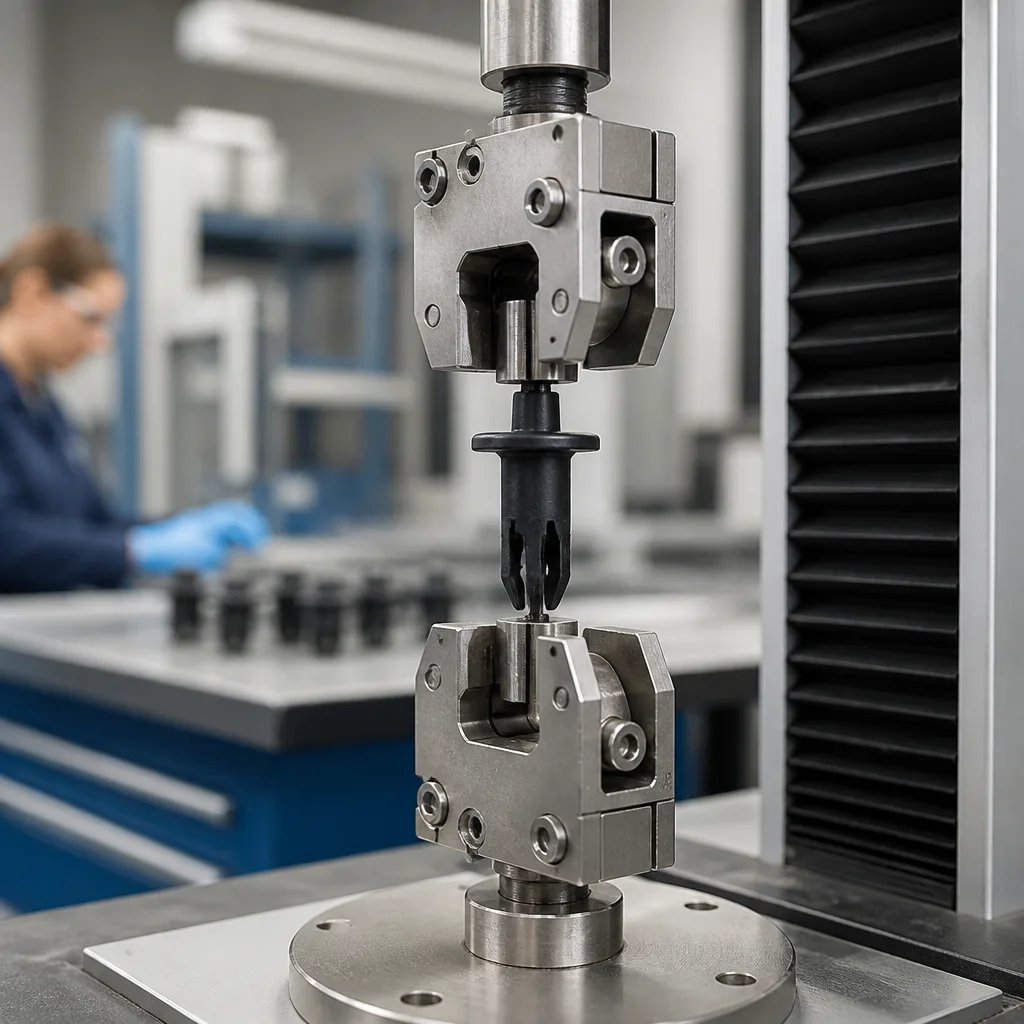
The purpose of this standard is to verify that coupling systems provide adequate mechanical retention during production, transportation, and vehicle operation.
Modern tools rely on thousands of clips and connecting pins to quickly join components without threaded fasteners. These include:
The Ford TM-01.11-L-13556 standard ensures that these linkage systems provide adequate holding power while remaining usable when maintenance or repair is required.
Encapsulated pins or clips are fasteners that have the following characteristics:
Unlike traditional screws, these fasteners become an integral part of the component and must resist pulling without damaging the surrounding material.
The Ford TM-01.11-L-13556 standard generally applies to the following:
The described test method measures the holding force required to remove an encapsulated pin or clip from its assembly. Typically, while the component is secured to a test setup, a tensile testing machine applies a continuously increasing load to the pin or clip until one of the specified endpoints is reached. The measured force is recorded in Newtons (N).
The equipment typically used in these tests includes:
To ensure repeatable and comparable results, the loading speed is controlled.
Depending on the component design, the laboratory records the following values:
During testing, engineers evaluate how the assembly breaks. Typical breakage patterns include:
The fracture pattern is as important as the measured force, as it reveals potential design weaknesses.
In automotive manufacturing, holding tests are crucial because loose connection systems can cause the following problems:
By verifying the holding force during product development and manufacturing, Ford helps ensure consistent assembly quality and long-term durability.
The Ford TM-01.11-L-13556 standard is typically applicable to components such as these:
Several variables can affect the measured holding force, including:
Using the Ford TM-01.11-L-13556 standard helps manufacturers in the following areas:
The Ford TM-01.11-L-13556 standard is one of several Ford engineering test methods used to evaluate the mechanical performance of automotive components. While this method focuses specifically on holding strength, complementary Ford standards may evaluate:
Together, these tests provide a comprehensive assessment of the connectivity system's performance.
The Ford TM-01.11-L-13556 standard is valuable because it ensures that encapsulated pins and clips used in a vehicle maintain adequate holding power throughout manufacturing, transportation, and the vehicle's lifespan. While clips and pins are relatively inexpensive components, failures can lead to quality issues, increased warranty costs, and even safety concerns.
This standard is considered important for the following reasons:
In conclusion, the Ford TM-01.11-L-13556 standard is a crucial mechanical testing standard that verifies the holding force of encapsulated pins and clips used in Ford vehicles. By measuring the force required to remove these fasteners and evaluating failure modes, the standard helps engineers ensure that automotive components remain securely attached under normal operating conditions, maintaining manufacturability and serviceability.
For many years, our organization, with its competent and experienced staff, has been understanding the needs of its customers, providing the advanced testing services they require, and assisting them in the establishment, implementation, and improvement of management systems. Within this framework, we also provide testing services to businesses in accordance with the Ford TM-01.11-L-13556 standard.
To get an appointment, to get more detailed information or to request an evaluation, you can ask us to fill in our form and reach you.

