

The “GMW 14146 Seam Break Strength” standard, developed by General Motors Worldwide (GMW), includes an automotive material testing method used to evaluate the resistance of textile and leather upholstery materials to tearing or pulling at a stitched or punctured point. This standard is particularly applicable to automotive seats, interior trim, upholstery, and other components where the strength of the stitched connection is critical.
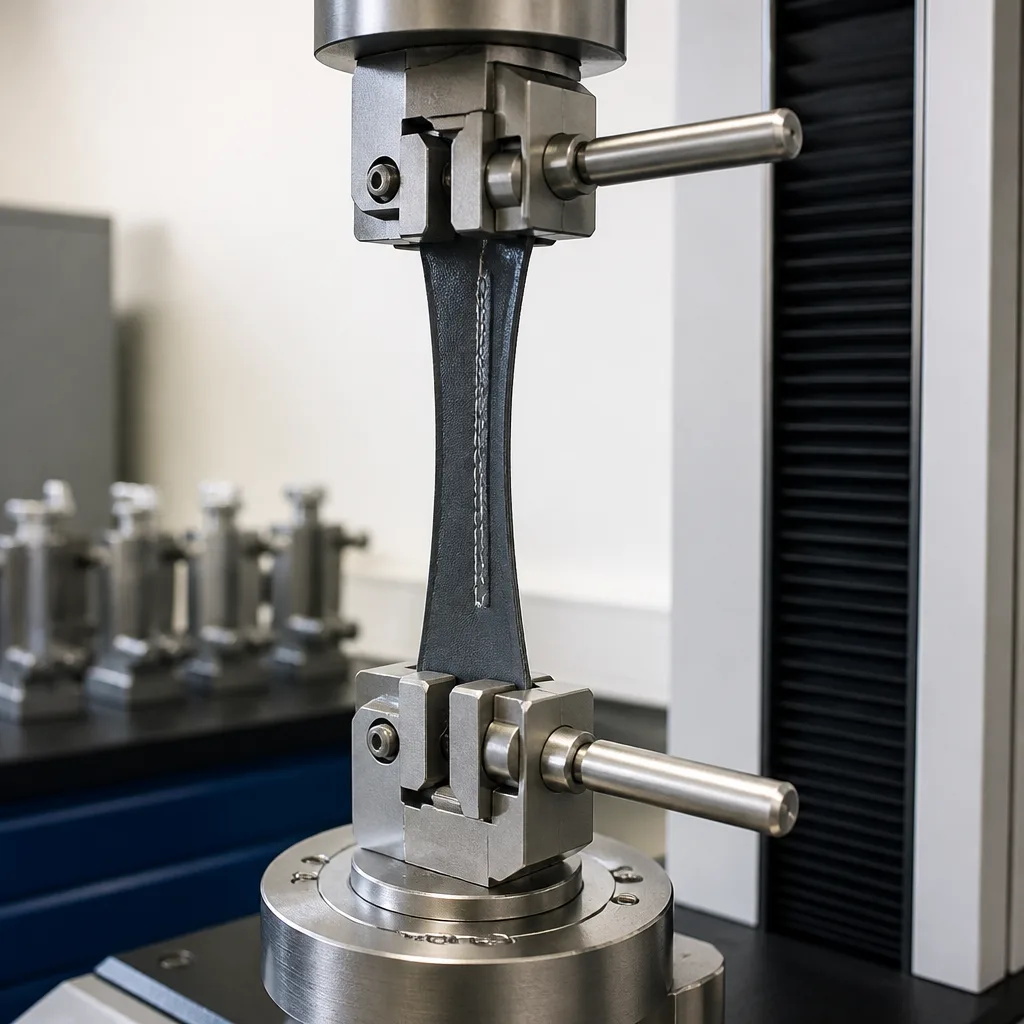
The primary purpose of the GMW 14146 standard is to determine how much force is required to pull the threads or fibers from an upholstery material. In an automotive interior, seams are subjected to repeated mechanical stresses. Passengers sit in and move around seats, upholstery panels are handled during vehicle operation, and materials can be subjected to stretching, bending, and localized loading. A material's overall tensile strength may be sufficient, but it can still break around the seam or penetration point. Therefore, instead of measuring the tensile strength of the material, the GMW 14146 standard focuses specifically on seam rupture resistance. The test result is based on the maximum force reached during the pulling process.
The GMW 14146 standard applies to automotive textiles, leather, felt, and other upholstery materials where resistance to tearing from seams or penetration is important. Typical applications include:
This standard distinguishes between traditional textile-type materials and leather, as their structures and failure mechanisms may differ.
One of the key features of the GMW 14146 standard is that it includes two different procedures:
The maximum force obtained represents the material's resistance to the type of localized damage associated with seam penetration.
Higher maximum strength obtained in the tests indicates higher weld fracture resistance. Lower maximum strength means greater susceptibility to localized fracture. Therefore, the test provides a quantitative way to compare different materials, structures, surface treatments, and production batches.
It is important to understand that the result is not simply a measure of overall fabric strength. It evaluates a much more localized failure mechanism.
Seams are one of the most common ways to join automotive upholstery materials. A material may appear strong during normal inspection, but it can fail when concentrated force is applied to a seam. Low tensile strength of seams can lead to:
This issue is particularly important for seating materials because seats are subjected to repeated loading and movement.
The GMW 14146 standard helps manufacturers identify materials that can withstand these local forces before incorporating them into production components.
The exact dimensions of the specimen, equipment configuration, conditioning requirements, loading rate, and acceptance criteria should be taken directly from the controlled GMW 14146 standard, but the basic test principle is as follows: specimen preparation, conditioning, penetration/mandrel attachment, controlled tensile testing, force measurement, determination of maximum force, and evaluation according to the relevant requirement. A suitable tensile testing machine or equivalent force measuring device is usually required to apply the controlled motion and record the resulting force. Since variables such as loading rate, specimen orientation, material conditioning, and equipment geometry can affect the measured force, the test should be performed under controlled conditions.
Several characteristics can affect the performance of automotive upholstery materials, including:
One of the most important applications of seam tear testing is automotive seats. Seat covers typically contain seams where two or more pieces of material are joined. During vehicle use, forces pass through these seams and are transmitted to the surrounding material. If the material around the seam is weak, the material itself may tear while the thread remains strong. This is an important distinction: a strong thread does not necessarily create a strong seam. The material must also be able to transmit the applied load without excessive localized tearing.
The GMW 14146 standard is useful in various stages of automotive development:
The GMW 14146 standard is important because it addresses a specific failure mode that conventional material strength tests cannot adequately represent. Other reasons why this standard is important include:
For many years, our organization, with its competent and experienced staff, has been understanding the needs of its clients, providing the advanced testing services they require, and assisting them in the establishment, implementation, and improvement of management systems. Within this framework, we also provide testing services in accordance with the GMW 14146 standard.
To get an appointment, to get more detailed information or to request an evaluation, you can ask us to fill in our form and reach you.

