

The standard “KIA MS300-57 A measurement process for determining VOC emissions from vehicle interior parts” developed by Hyundai-Kia Motors Company, the oldest motor vehicle manufacturer in Korea, describes a measurement process for determining volatile organic compounds (VOC) emissions from vehicle interior parts. According to this standard, the test sample is the assembly part and the tests are carried out using a 1 m3 VOC emission test chamber.
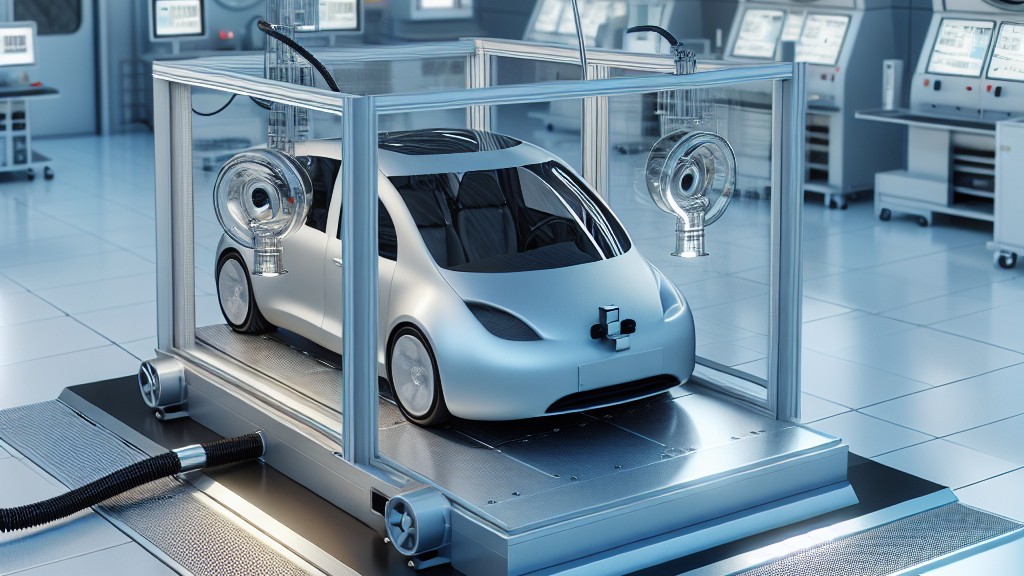
This test method describes the determination of volatile organic compound (VOC) emission from the assembly part in principle. The assembly part is placed in a 1 m3 VOC emission test chamber that can control temperature and humidity, and the test chamber is operated for 2 hours under the specified test conditions (temperature, humidity, ventilation). Then, the air in the test room is sampled and the samples are analyzed using analysis equipment (GC/MSD, HPLC).
This test method targets assembly parts mounted inside the vehicle. Each sample (assembly part) is tested in a quantity of vehicles containing all the detailed parts specified in the table entitled “Part Assembly for Testing” given in the standard . For parts not listed in this table or additional parts, the relevant departments should be consulted. If the result of this test meets the management criteria among the requirements of this standard, the VOC emission test for the sub-components comprising the part assembly (KIA MS300-55 standard) may be skipped.
Test samples must be in the same condition as immediately before assembly and must be tested within 72 hours after being stored on the assembly line. Additional processing for testing must be prohibited. When submitting test samples, samples must be sealed with plastic or aluminum packaging to prevent contamination during transportation. Details of the samples (production date, test date, suppliers, colors, materials, etc.) must be recorded and stored.
The “part assembly for testing” table mainly includes the following parts: C/PAD module, steering wheel, HVAC (heating, ventilation and air conditioning), headliner, skylight, sun visor, door trim, door module, weather strip, seat, seat belt, console, floor carpet, noise, vibration and harshness package, car mat, rear package tray, column trim, trunk trim, wiring, wiring, airbag and tire.
If the evaluation result of the parts is below the reference value in the table titled “Requirements for each assembly part” given in the standard, it is passed, but if it exceeds it, it is rejected. The values in this table are given on the following basis: benzene, toluene, ethyl benzene, xylene, styrene, formaldehyde, acetaldehyde and acrolein.
For the purposes of this standard, the following definitions apply:
The test chamber is an airtight, lockable room with a volume of 1 m3 plus/minus 0,05 m3. It is equipped with an air mixing device and a shelf that allows the sample to be stored without contact with the walls. An inlet and an outlet pipe must be provided to regulate the air exchange and for air sampling purposes.
The wall surfaces of the test chamber and the shelf supporting the sample should be made of stainless steel or glass. In the installations or parts inside the test chamber that cannot be made of any of the specified materials for technical reasons, materials with very low emission and organic matter adsorption should be selected.
To prevent uncontrolled air exchange, leakage air currents due to lack of sealing during air exchanges at 1.000 Pa overpressure must be kept to less than 0,1 percent of the test chamber volume and 1 percent of the incoming air flow per minute. To prevent external air flow, testers performing emissions tests should always work with a slight overpressure and/or excess air volume in the test chamber compared to atmospheric pressure in the laboratory. It is particularly important to observe this during air sampling.
The ideal mixing required in the test chamber is the basic principle of this procedure. This must be provided by a suitable air mixing device that can also meet this requirement when dealing with bulky test samples. The flow velocity must be greater than 0,1 m/s in the centre of the empty test chamber.
It should be ensured that the chamber is thoroughly cleaned between tests using a suitable cleaning process, for example thermal desorption at elevated temperatures.
Due to the strong link between emission behavior and test temperature, the temperature control unit in the test chamber must meet strict requirements. If necessary, it should be possible to cover a wide temperature range depending on the test conditions. The spatial and temporal temperature deviation should not exceed plus/minus 0,5 degrees.
The air supplied to the test chamber should be humidified to prevent the formation of vapor and aerosols.
Tests involving air exchange and removal of air samples require a clean gas flow. Before a test, the total concentration of volatile organic hydrocarbon compounds in the incoming air should not exceed 50 μg/m3 in total and 5 μg/m3 for individual substances. The fine dust content should be reduced by using a 7 μm particle filter to prevent adsorption of analyzes.
This test method provides a broad overview of the emission spectrum of samples under developed climatic conditions.
Our organization has a strong staff that closely follows the developments in the world in the field of science and technology and constantly improves itself. Among the numerous test, measurement, analysis and evaluation studies provided for businesses in various sectors, there are also test services in accordance with the standard "KIA MS300-57 A measurement process to determine VOC emissions from vehicle interior parts".
To get an appointment, to get more detailed information or to request an evaluation, you can ask us to fill in our form and reach you.

