

Developed by Ford Motor Company (Ford), the “Ford IT-0815 Maximum Deflection and Twist for Interior Trim Quality and Feel” standard is an internal engineering and verification specification used in the development and qualification of automotive interior trim and plastic components. This standard defines how materials and assemblies should perform under real-world stress conditions such as heat, UV exposure, mechanical deformation, and long-term aging.
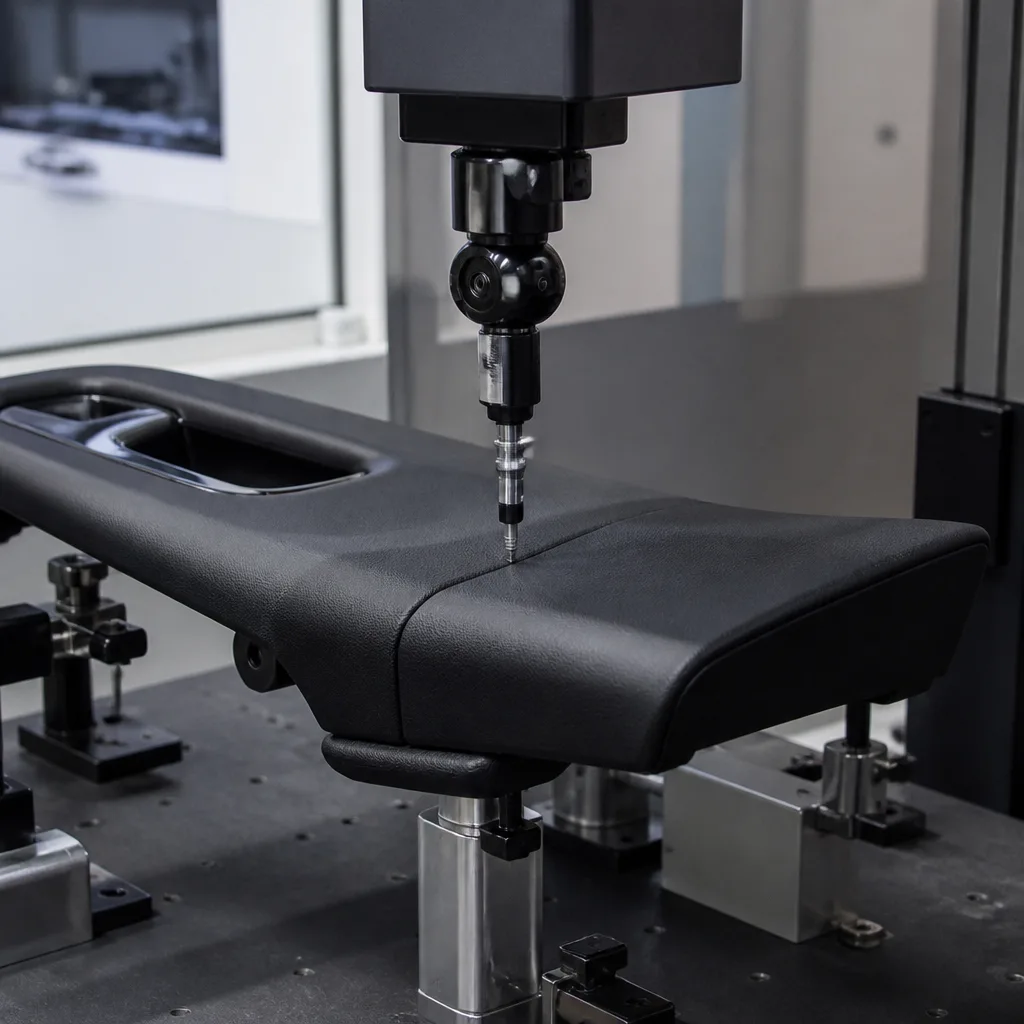
The primary goal of the Ford IT-0815 standard is to ensure that interior components meet the following requirements:
This is especially important for visible cabin components such as:
The Ford IT-0815 standard typically focuses on the following:
In automotive engineering, yaw and torsion are measurements used to evaluate how much a component moves when a force is applied. Standards such as Ford IT-0815 use these measurements to assess the stiffness and feel of interior trim components.
Deviation is the linear displacement or bending of a part from its original position. Deformation is the linear displacement or bending of a part from its original position when subjected to a load. For example, if a dashboard moves 3 mm inward when pressed, the deformation of the panel is 3 mm. If a center console bends slightly downward when pressed, this downward movement is deformation. A smaller deformation usually indicates a stiffer and more robust component.
Rotation is the angular movement or bending of a component around a pivot point or axis when a force is applied. For example, pressing down on one corner of a floor panel might cause the panel to bend slightly. Pulling a handle might cause the part to rotate around its mounting points. The angle at which the part moves is the angle of rotation.
Two parts may have the same deflection but exhibit different rotational behavior. Therefore, it is important to take both measurements.
Flexibility and torsion measurements are typically performed on the following parts:
Engineers apply a specific force and measure how much the part bends and rotates.
The Ford IT-0815 standard uses flexibility and rotation limits to ensure that interior components meet the following requirements:
Excessive flexibility or twisting can make the vehicle feel less robust, even if the component doesn't actually fail.
In short, yaw is how much a component bends or moves linearly under load. Rotation, on the other hand, is how much a component bends or rotates under load. Both are key indicators of stiffness, durability, and perceived quality. The Ford IT-0815 standard uses these measurements to ensure interior trim components feel robust, stable, and well-designed.
This standard is important because it helps ensure the vehicle maintains the rigidity, fit, and tactile quality expected by customers throughout its lifespan. It is generally important for the following reasons:
This standard helps verify that the components maintain their dimensional stability and structural integrity despite these conditions.
Excessive deformation can affect the operation or alignment of these systems. This standard helps ensure that functional performance is maintained.
For many years, our organization, with its competent and experienced team, has been understanding the needs of its customers, providing the advanced testing services they require, and assisting them in the establishment, implementation, and improvement of management systems. Within this framework, we also provide testing services compliant with the Ford IT-0815 standard.
To get an appointment, to get more detailed information or to request an evaluation, you can ask us to fill in our form and reach you.

