

The “GMW 17408 Flexible Expanded Rubber and Rubber-like Materials for Automotive Sealing Applications” standard, developed by General Motors Worldwide (GMW), is a material specification for flexible expanded rubber and rubber-like materials used in automotive sealing and insulation applications. This standard covers materials used in air and dust seals, water seals, gaskets, insulators, rattle protection, and gap sealing applications.
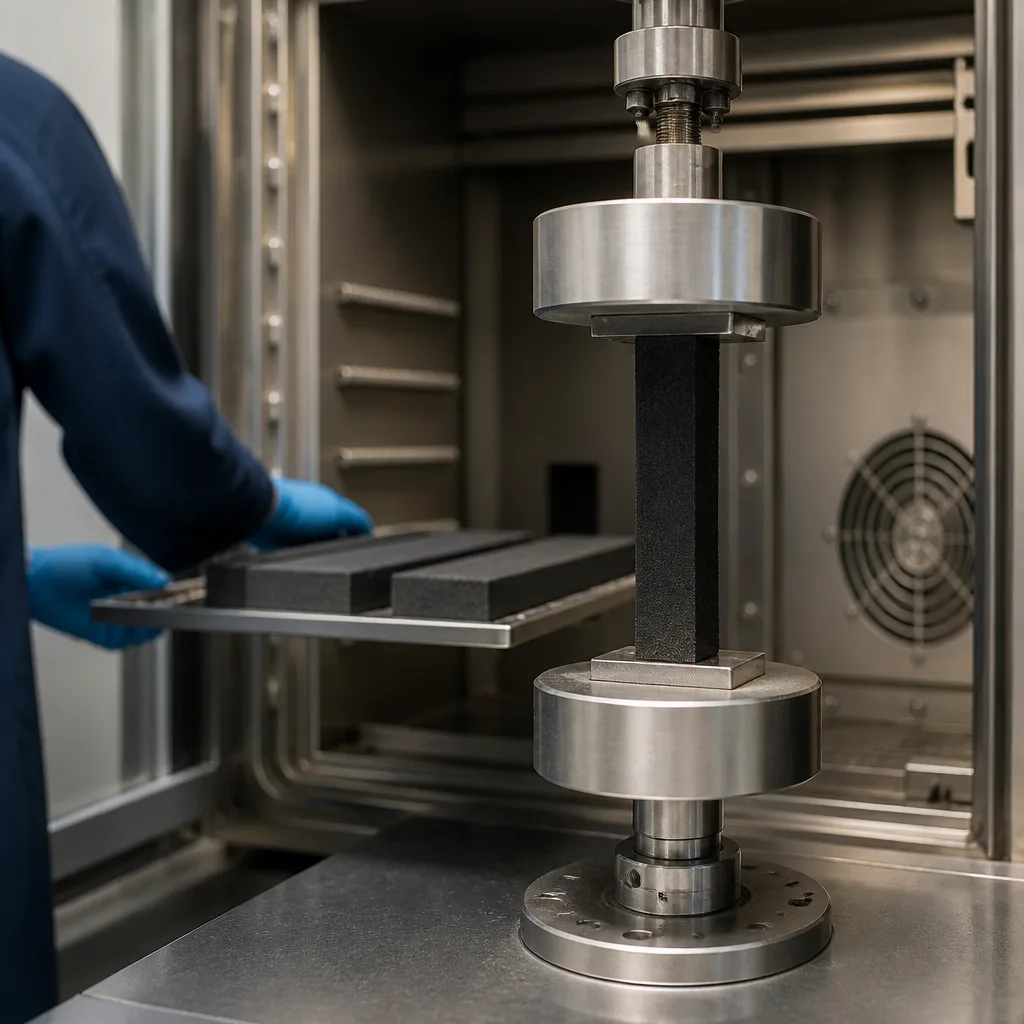
The GMW 17408 standard is particularly important because sealing materials must maintain their functional performance over a wide range of temperatures, environmental conditions, compression levels, and service conditions. This standard establishes a common framework for the classification and evaluation of these materials for General Motors vehicle applications.
The GMW 17408 standard applies to flexible expanded rubber and rubber-like materials that can be supplied as sheets, strips, die-cut components, or sliced products. A pressure-sensitive adhesive may also be added to one side when required by the application. Typical applications include:
Commercial automotive foam products certified according to the GMW 17408 standard are used in applications such as instrument panels, HVAC modules, door locks, sunroofs, side mirrors, and NVH seals.
One of the key features of the GMW 17408 standard is its classification system. This specification categorizes materials into different classes and types, allowing engineers to select a material based on its intended function and compression behavior. For example,
Commercial material data shows a classification from Type I to Type V, with progressively different foam properties such as ultra-soft, extra-soft, soft, medium, and hard grades.
The GMW 17408 standard is not limited to a single polymer family. Depending on the application, the engineering drawing or material specification defines the required polymer base. Examples include:
The specification specifically requires the identification of the polymer base material when the standard is stated in the engineering documents.
It is important to note that this standard does not cover all types of automotive foam. This standard specifically excludes silicone, polyurethane, and polyolefin foams because these material families are addressed in other General Motors specifications.
Some sealing components require an adhesive backing to hold their position during assembly. The GMW 17408 standard allows the use of the “ADH” suffix when an adhesive is specified. In such cases, the adhesive material must meet the requirements of the GMW 16443 standard.
Low-friction coatings may also be specified when the sealant needs to slide against another surface. This is identified using the suffix “CO”. Such coatings can help reduce friction and prevent undesirable behavior between the sealant and the mating substrate.
The GMW 17408 standard evaluates sealing materials through a range of physical and functional requirements. Depending on the material class, type, and application, the evaluation may include the following areas:
One of the greatest strengths of the GMW 17408 standard is that it does not treat every sealing application the same way. Engineering documentation should include essential application information, including:
Specific tests are selected according to the intended interior, exterior, engine compartment, or exterior lighting application. This approach helps to avoid over- or under-specificating the sealant.
The GMW 17408 standard is important because although sealing components may seem simple, failures can cause significant vehicle problems. An inadequate seal can lead to:
The GMW 17408 standard helps General Motors and its suppliers select materials with predictable sealing properties by defining material classifications and performance requirements. It also provides a common technical language among vehicle manufacturers, material suppliers, component manufacturers, and testing laboratories.
The GMW 17408 standard has replaced the earlier GMW 15473 standard.
In conclusion, the GMW 17408 standard is primarily designed for flexible expanded rubber and rubber-like materials used for sealing, insulation, and void management functions. It addresses applications involving air, dust, water, noise, and rattling control and provides a classification system based in part on material compression behavior and intended application.
Compliance with the GMW 17408 standard is important for automotive suppliers because it provides a controlled method for the selection and verification of sealants. The correct class, type, polymer, adhesive/coating configuration, and application-specific requirements must always be confirmed.
For many years, our organization, with its competent and experienced staff, has been understanding the needs of its clients, providing the advanced testing services they require, and assisting them in the establishment, implementation, and improvement of management systems. Within this framework, we also provide testing services in accordance with the GMW 17408 standard.
To get an appointment, to get more detailed information or to request an evaluation, you can ask us to fill in our form and reach you.

