

Developed by Jaguar, a British multinational automotive company, the “Jaguar STJLR.00.5235 Cabin corrosion verification requirements - Total vehicle” standard describes laboratory corrosion testing requirements for components, connections, assemblies, and subassemblies designed for use in all Jaguar and Land Rover vehicles. This standard is not applicable to functional testing of exhaust systems or serviceability of components due to the static nature of the test methods used.
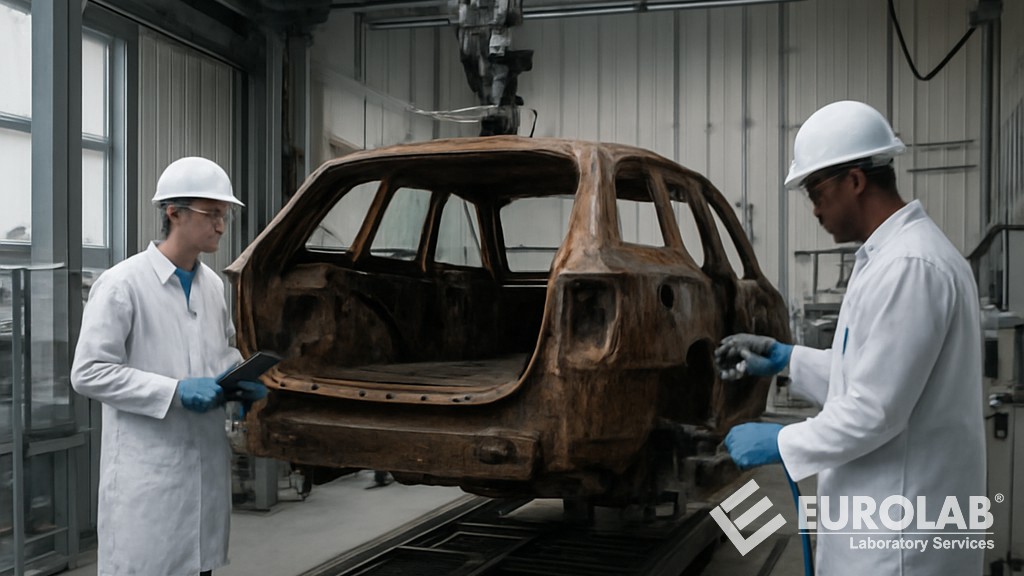
This standard defines cabin corrosion testing requirements to qualify components, assemblies, and subassemblies for use in whole-vehicle corrosion testing. Whole-vehicle corrosion testing must be met for engineering approval.
The requirements specified in this standard are consistent with the appearance and functionality requirements defined in the “STJLR.00.5180 Total vehicle corrosion resistance” standard. Additional cabin corrosion testing requirements may also apply, as defined in the relevant engineering standard for metallic and non-metallic coatings.
The section on laboratory corrosion testing requirements defines cabin corrosion testing requirements for components, assemblies, and subassemblies, correlating with the salt spray and climatic loading portion of the corrosion test in accordance with the standard “TPJLR.00.141 General test procedure for automotive components - Environmental, mechanical and electrical verification”.
The cyclic corrosion test specified in this standard is designed to maximize corrosion in crevices such as lap joints and edge flanges, but is also applicable to painted aluminum and steel surfaces, galvanic corrosion of mixed-material joints, and puncture of unpainted surfaces.
The aim is to test components and systems in the vehicle's steering position whenever possible and to ensure that they reach target areas defined by a risk analysis of salt solution exposure or a "failure mode and effects analysis" process.
Unless otherwise specified, coating systems should not be scratched prior to testing. Where component preconditioning is required, details should be agreed upon with a materials engineering corrosion specialist prior to testing.
Test requirements are structured according to the vehicle area defined below:
In cases where a region specifies both appearance and functionality assessments, the total testing time is taken as the functionality testing time. Appearance is assessed according to specified pass/fail criteria, while functionality is assessed according to acceptance criteria.
In the world of luxury automotive engineering, Jaguar Land Rover (JLR) has long set its own standards for performance, refinement, and reliability. At the heart of these high standards lies the use of precisely formulated lubricants that meet the brand's stringent specifications. One such specification, the Jaguar STJLR.00.5235 standard, represents a commitment to optimizing engine and transmission performance under a variety of operating conditions. While Jaguar Land Rover's lubricant approvals are typically defined by specific models and engine types, the STJLR.00.5235 standard stands out as a versatile standard encompassing manual transmission fluids or similar applications designed for seamless gear changes and long-lasting durability.
Jaguar Land Rover's standards are proprietary standards developed in collaboration with major oil producers. These approvals go beyond general industry standards, involving rigorous testing for factors such as shear stability, oxidation resistance, and compatibility with modern emission systems.
The STJLR.00.5235 standard is closely aligned with transmission oils and reflects standards such as STJLR.65.15003, which specifies premium manual transmission oils based on Ford WSS-M2C200-D and other global norms.
STJLR.00.5235 is essentially designed for applications requiring exceptional thermal stability and friction control, such as manual transmissions in high-performance Jaguars. Key performance criteria include:
Jaguar STJLR.00.5235 tests incorporate JLR's own protocols, including long-term dynamometer runs simulating city, highway, and off-road driving. The fluids must exhibit less than 5% viscosity loss after 240.000 km and be resistant to foaming under extreme pressure, a critical requirement for synchronous transmissions in some Jaguar models.
As a result, by adhering to the Jaguar STJLR.00.5235 standard, the company not only extends component lifespan but also unlocks the full dynamic potential of its vehicles.
For many years, our organization, with its competent and experienced staff, has been understanding the needs of its clients, providing the advanced testing services they require, and assisting in the establishment, implementation, and improvement of management systems. Within this framework, we also provide testing services to businesses in accordance with the "Jaguar STJLR.00.5235 Cabin corrosion verification requirements - Total vehicle" standard.
To get an appointment, to get more detailed information or to request an evaluation, you can ask us to fill in our form and reach you.

