

The standard "VW PV 3353 Vehicle interior trim surfaces - Soiling and cleaning behaviour of vehicle headliners and interior pillar trim decorative material" developed by the Volkswagen automobile company describes a procedure for testing the soiling and cleaning behaviour of vehicle headliners and interior pillar trim decorative materials in the vehicle interior. According to this standard, the surfaces must be textile laminated or equipped with textile fabric.
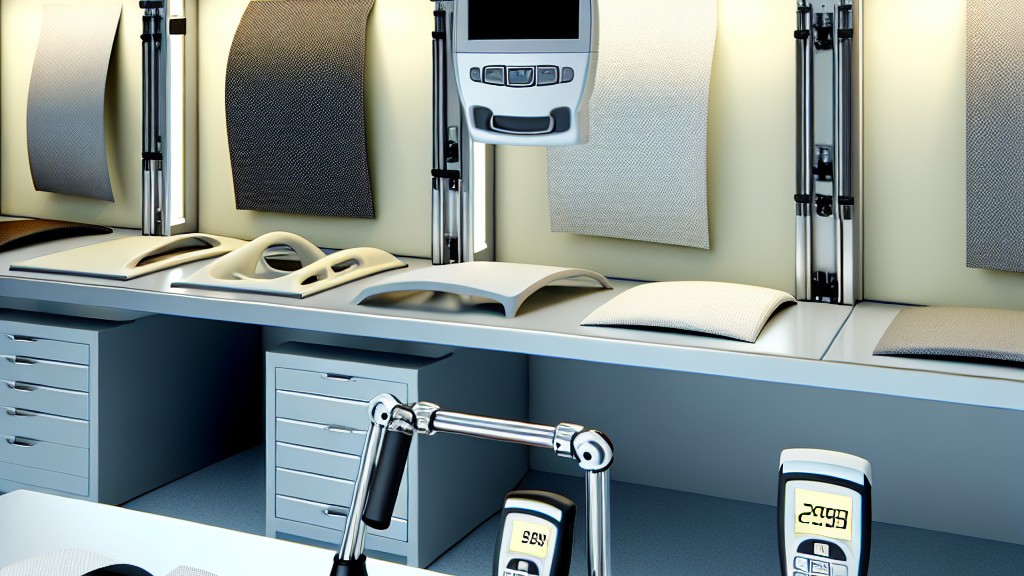
The equipment and ancillary equipment used in these tests include:
In addition, the following test equipment is needed:
Unless otherwise agreed during the sample preparation stage, five round samples shall be prepared using a sample cutter or punch. For roll products, samples shall be taken evenly distributed over the entire width. For moulded parts, samples shall be taken from the flattest possible surfaces. All existing substrate bodies shall be removed prior to testing.
When determining the soiling behavior, two round specimens are placed one after the other in the Schopper rotary abrasion tester in accordance with the standard “DIN 53863-2 Textile research - Design of textile fabrics, design options”. For non-laminated textiles, a woven felt backing is used in accordance with the standard “EN ISO 12947-1 Textiles - Determination of abrasion resistance of fabrics by the Martindale method - Part 1: Martindale abrasion tester”. The cotton fabric soiled with carbon black/olive oil is placed on the mounting plate (wear block). The contact force should be 5 N, the bulge height should be 5 mm and the abrasion cycles should be 100 cycles. The round specimen is applied evenly to the soiled fabric.
When determining the cleaning behavior with a foam cleaner, a cotton cloth is used to manually rub the foam cleaner with light pressure in accordance with the manufacturer's instructions until the contaminants are removed from the sample surface so that they are no longer visible on the white cleaning cloth. The sample is evaluated after it has dried.
While determining the cleaning behavior with surfactant solution, the other round sample is cleaned with surfactant solution. Here, the surface is rubbed thoroughly by hand using a saturated cotton cloth, pressing gently until the contaminants can no longer be removed from the sample surface and are no longer visible on the white cleaning cloth. The sample is evaluated after drying.
When making the assessment, each of the contaminated samples treated with special cleaners must be visually assessed using the grey scale according to the standard “DIN EN 20105-A02 Tests for colour fastness of textiles - Grey scale for assessing colour change” and compared with the untreated sample. The results must be stated as a grey scale grade, half digits must be allowed for the final assessment grade.
Our organization, which has been trying to support businesses from every sector with its testing, measurement, analysis and evaluation studies carried out in a wide range for years, has a strong staff that closely follows the developments in the world in the field of science and technology and constantly improves itself. In this context, testing services in accordance with the standard “VW PV 3353 Vehicle interior upholstery surfaces - Contamination and cleaning behavior of vehicle ceiling upholstery and interior pillar upholstery decorative material” are also provided to businesses.
To get an appointment, to get more detailed information or to request an evaluation, you can ask us to fill in our form and reach you.

