

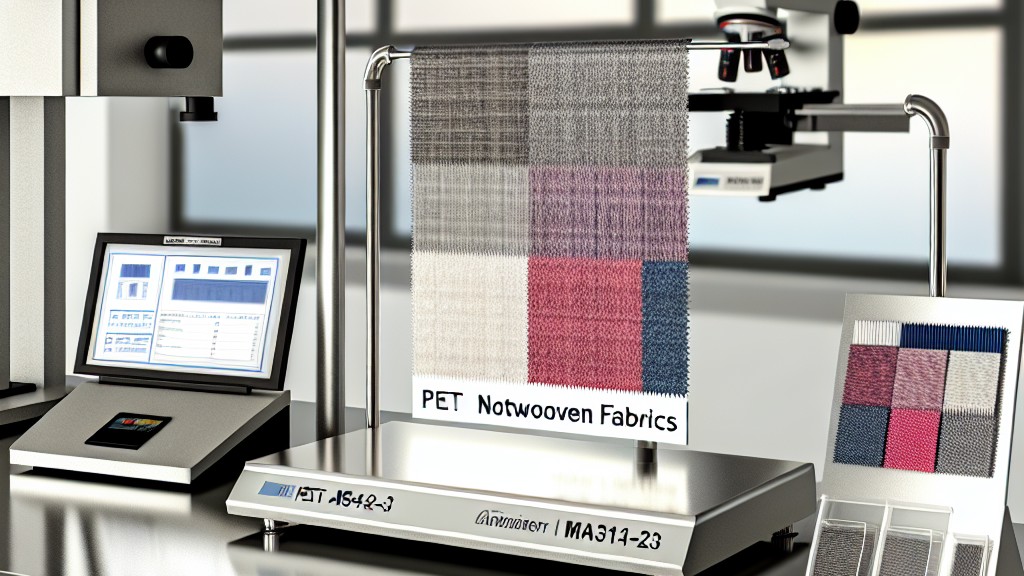
The “KIA MS341-23 Under covers manufactured from PET (polyethylene terephthalate) nonwoven fabric etc.” standard, developed by Hyundai-Kia Motors Company, the oldest motor vehicle manufacturer in Korea, applies to under covers manufactured from polyethylene terephthalate (PET) nonwoven fabric etc. This specification is used as classified in the table given in the standard or as indicated in engineering drawings. The classification is as follows:
Type B and Type C are nonwoven compressed batts containing 60 percent or more low-melting-point fibers to increase strength.
The general requirements in this standard are described as follows:
This material shall be tested by the methods specified in this standard and shall conform to the specified requirements. Samples shall be manufactured by the same process as the parts.
In general, the standard laboratory condition for the tests is 23 degrees plus/minus 2 degrees and 50 percent plus/minus 5 percent relative humidity. All tests are performed on samples at least 48 hours after molding and immediately thereafter at least a 24-hour conditioning period under the standard conditions specified herein.
Thickness: 100 cm2 samples are prepared (length 100 mm and width 100 mm are recommended). It should be in accordance with Method A described in the “ISO 9073-2 Textile - Test methods for non-woven fabrics” standard. At least 5 test samples should be used and average values should be reported.
Weight: 100 cm2 samples are prepared (length 100 mm, width 100 mm is recommended). Measured with an electronic scale to the third decimal place. At least 5 test samples should be used and average values should be reported.
Water absorption: Samples with a length of 150 mm and a width of 50 mm are prepared. The samples are immersed in water at 1 degrees plus/minus 40 degrees for 2 hour. The samples are allowed to remain in this condition for 24 hours. It is measured to the third decimal place with an electronic balance. At least 5 test samples should be used and the average values should be reported.
Chip resistance: Must comply with the standard “KIA MS600-35 test method - Paint and coating film for body”. Samples of 150 mm length and 70 mm width are prepared. The fracture angle is 45 degrees. 5 kgf/cm2 air pressure and 3,5 kg gravel shock are applied to the sample surface. The surface of the samples is examined. At least 3 test samples must be used and the worst case of the test values must be reported.
Chemical resistance: Samples with a length of 100 mm and a width of 50 mm are prepared and immersed in a chemical specified in the table provided in the standard for 24 hours. After removal, the samples are allowed to stand for 24 hours. At least 3 test samples should be used and the worst case of the test values should be reported. The test chemicals included in the table include: gasoline, diesel, antifreeze, engine oil and washing fluid.
Tensile strength: It shall comply with “ASTM D5034-09 Standard Test Method for Tensile Strength and Elongation of Textile Fabrics (Grip Test)” and “ASTM D5035-11 Standard Test Method for Tensile Strength and Elongation of Textile Fabrics (Strip Method)” standards. Specimens with a length of 150 mm and a width of 25 mm are prepared. The test speed is 25 mm/min, and the distance between clamps is 100 mm. At least 5 test specimens shall be used and the average values shall be reported. Specimens shall be exposed to a temperature of 23 degrees plus/minus 2 degrees and a relative humidity of 50 percent plus/minus 5 percent for 24 hours. When heat aging is performed, the specimens shall be exposed to the specified temperature for 240 hours, and then allowed to stand for 1 hour. If the temperature is not specified, the test condition is 120 degrees plus/minus 2 degrees. When water aging is performed, the samples are immersed in water at 240 degrees plus/minus 40 degrees for 2 hours and allowed to stand for 1 hour.
Samples with a length of 150 mm and a width of 50 mm are prepared. The test speed is 5 mm/min and the aperture length is 100 mm. At least 5 test samples should be used and the average values should be reported. Samples are kept at 23 degrees plus/minus 2 degrees and 50 percent plus/minus 5 percent relative humidity for 24 hours. When heat aging is performed, samples are exposed to the specified temperature for 240 hours and then allowed to stand for 1 hour. If the temperature is not specified, the test condition is 120 degrees plus/minus 2 degrees. When water aging is performed, samples are immersed in water at 240 degrees plus/minus 40 degrees for 2 hours and allowed to stand for 1 hour.
Sound absorption: Must comply with the standard “ISO 354 Acoustics - Measurement of sound absorption in a reverberation chamber”. Frameless flat samples of 840 mm length and 840 mm width are prepared. At least 5 test samples must be used and average values must be reported.
Flammability: Must comply with “KIA MS300-08 Standard test method - Flammability resistance for interior materials” standard.
Our organization has a strong staff that closely follows the developments in the world in the field of science and technology and constantly improves itself. Among the numerous test, measurement, analysis and evaluation studies provided for businesses in various sectors, there are also test services in accordance with the standard of "KIA MS341-23 PET (polyethylene terephthalate) nonwoven fabric etc. produced under covers".
To get an appointment, to get more detailed information or to request an evaluation, you can ask us to fill in our form and reach you.

