BMW PR 384 Heel Test
Developed by BMW, a leading German multinational company in the automotive sector, the “BMW PR 384 Heel Test” standard describes adhesive bonding and material testing, particularly for shear strength and related properties in automotive components. This standard focuses specifically on advanced or follow-up assessments of shear strength, recovery behavior, and related mechanical properties of bonded joints after specific conditioning or stress scenarios.
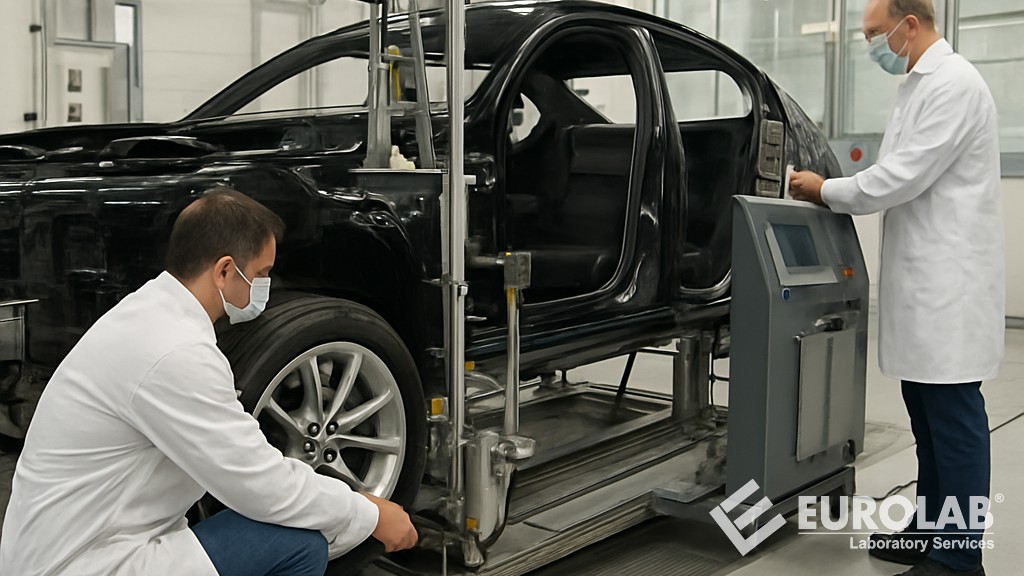
This standard is most commonly referenced in the context of automotive adhesive qualification for structural, semi-structural, and interior applications. It is directly based on, or complements, the BMW PR 380 standard, which covers the basic adhesive testing framework, including shear strength measurements at room and high temperatures, peel tests, and intermediate assessments.
The BMW PR 384 standard is often referred to in conjunction with sub-sections of the BMW PR 380 standard, particularly for the following:
- Evaluations of shear force/thrust shear strength under enhanced or recovery conditions.
- Intermediate/indentation/recovery tests.
- Final conditioning performance: Evaluating how adhesive bonds behave after environmental exposure, thermal cycling, humidity, or partial loading, and then measuring the maintained strength (e.g., shear force after recovery phase).
These tests typically include the following:
- Preparation of standardized bonded test specimens (e.g., single-layer shear joints).
- Application of defined aging/conditioning treatments (climate chambers, extreme temperatures, humidity).
- Mechanical loading is applied (cutting at constant speed).
- Recording of force values, failure modes (cohesive failure is preferred over adhesive failure), and visual/quantitative analysis.
The BMW PR 380 standard is a basic guideline. It defines fundamental tests such as:
- BMW PR 380 § 2.4.1.1 Shear strength at room temperature.
- BMW PR 380 § 2.4.1.2 High temperature shear strength.
- BMW PR § 2.3.6 Intermediate / recovery test.
The BMW PR 384 standard acts as an extension or special variant. It is typically used for more detailed recovery phase measurements, incremental tests, or specific post-aging shear assessments that go beyond the standard BMW PR 380 standard procedures. Laboratories list them sequentially because many test protocols chain them together (e.g., an intermediate step is performed in the BMW PR 380 standard, followed by the BMW PR 384 standard for the final shear/recovery measurement).
Typical applications include:
- Structural adhesives: Used in body frames, collision-prone areas, and battery trays.
- Lightweight bonding: Aluminum, composites, carbon fiber reinforced plastics.
- Interior and flooring: Where ties must withstand prolonged vibration, temperature changes, and humidity without separating.
- Supplier part approval: During the production part approval process, material change verifications, or process audits.
Essentially, the BMW PR 384 standard helps preserve the structural integrity, safety, and longevity that define BMW vehicles by ensuring adhesive bonds deliver consistent, high-performance results in demanding recovery or phased testing scenarios.
In an era of increasing vehicle electrification and weight reduction, adhesive bonding is replacing or complementing traditional welding/bolting methods. This standard ensures these connections withstand vibration, thermal cycling, corrosion, and impact loads, directly impacting BMW's reputation for build quality and driving dynamics.
This standard includes the following subsections:
- The BMW PR 384.1 standard is a specific test procedure focusing on wear resistance or abrasion testing using the heel. This is a heel/step indentation/wear test designed to simulate repeated heel impacts and friction on floor coverings, carpets, mats, or similar interior textile/floor components in vehicles. It evaluates how resistant floor materials (e.g., carpet, mat, or glued floor covering) are to mechanical wear, particularly in the entry/exit areas of the car, subjected to repeated impact, friction, and pressure. This method uses a standardized heel setup to apply controlled friction, pressure, and cyclical motion over a specific number of cycles. The evaluation typically measures:
- Visible wear and tear (pilling, fiber loss, surface damage).
- Color change or material deterioration.
- Loss of pile height, loss of support integrity, or (if glued) layer separation.
- Any functional impairment (e.g., reduced slip resistance or aesthetic deterioration).
In BMW vehicles, floor areas exposed to high pedestrian traffic, dirt, and heel pressure are critical for interior durability and perceived quality (e.g., the driver's side floor mat area).
- The BMW PR 384.2 standard is part of the broader BMW PR 384 family of standards, which specifically deals with durability and performance assessments of interior materials prone to foot traffic and mechanical wear. The aim of this method is to simulate real-world wear of shoe heels (especially women's high heels or men's suit shoes) on vehicle floor coverings, carpets, mats, or bonded interior textiles. It evaluates resistance to repeated friction, wear, pressure, and rubbing in high-traffic entry/exit areas (e.g., driver footwell area). A standardized heel apparatus (simulated shoe heel shape/material) is used during the test. Cyclic motion, pressure, and friction are applied (dry, wet, or combined conditions in some variants). The test is run for a specified number of cycles. At the end of the test, damage of the following types is assessed:
- Surface abrasion / material loss.
- Linting, fiber breakage, or flattening of the feathers.
- Discoloration / staining.
- Layer separation (if glued layers are involved).
For many years, our organization, with its competent and experienced team, has been understanding the needs of its clients, providing the advanced testing services they require, and assisting them in the establishment, implementation, and improvement of management systems. Within this framework, we also provide testing services in accordance with the BMW PR 384 standard.



