

The Volvo STD 429-0003 Determination of organic emissions from non-metallic materials in vehicle interiors - Organic materials standard, developed by Volvo, describes a test method used to determine the emissions of organic compounds (Total volatile organic compounds, TVOCs) emitted from non-metallic materials located in or near the vehicle interior.
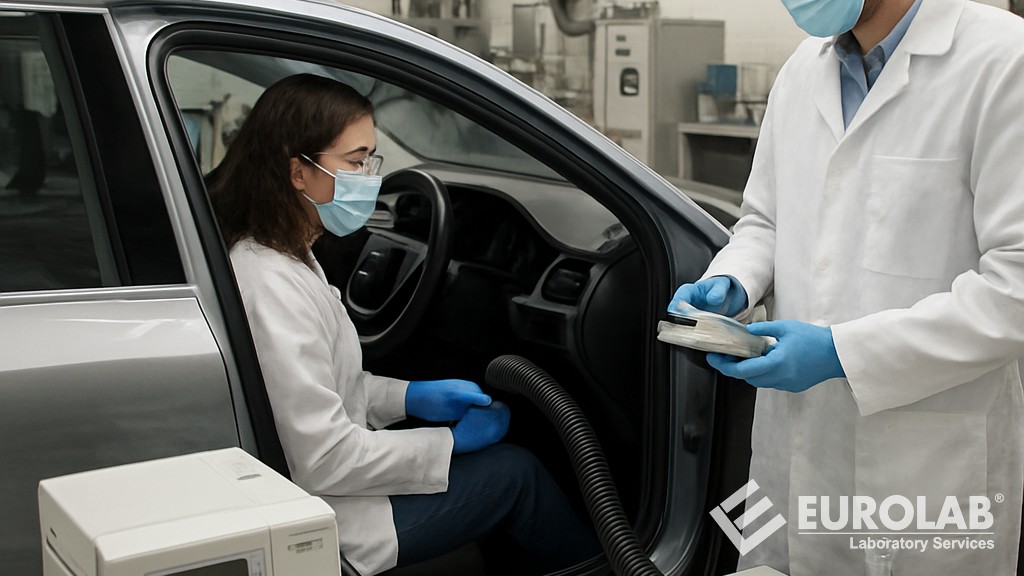
The sum of individual substances as determined by gas chromatography analysis and flame ionization detector is used as a measure of the total emission of a material. The test is performed using the Head-Space technique after tempering at 1 degree. The relevant sampling points, relevant requirements, and specific provisions regarding the application of the test can be found in the relevant technical specifications and drawings. If the components consist of more than one different material, separate tests may be required for each material.
In principle, component testing should be carried out no earlier than one week and no later than four weeks after the date of manufacture. Storage of components from the date of manufacture to the date of testing should be the same as when the components were delivered for production (same temperature, humidity, packaging, etc.). Test samples extracted from the components should be manufactured on the day the testing process begins.
Sample conditioning is not normally necessary. The only exception is natural materials (cotton, wood, leather, wool). These materials should be cut into small pieces, dried in calcium chloride for 24 hours, and then weighed.
The sample should be taken from the specified point along the entire cross-section of the component. It should be divided into particles weighing between 10 mg and 25 mg (without heating). If necessary, other types of sample preparation may be specified in the drawing or technical regulations. This should be stated in the results report.
The amount of test to be weighed depends on the size of the Head-Space container, which has a minimum volume of 5 ml. For a 10 ml Head-Space container, 1.000 g plus/minus 0,001 g of the sample should be weighed (i.e., a maximum weighing error of 0,1 percent). Metal parts must be removed before weighing. Organic substances such as paint and adhesives firmly adhering to metal parts should be removed mechanically before weighing.
The sample is weighed in a Head-Space container (at least three Head-Space containers per sample). The Head-Space container is then sealed gas-tight using a septum, with the Teflon coating facing the inside of the Head-Space container.
Immediately prior to measurement, the Head-Space flask is tempered to 120 degrees plus/minus 2 degrees. The test time in the Head-Space is 5 hours plus/minus 5 minutes at 120 degrees plus/minus 1 degree, and the analysis should be performed immediately afterward. At least three samples of each material should be analyzed. The blank value is determined using the average of at least three measurements taken with empty Head-Space flasks. The measurement should be performed in the same and repeatable manner with all sample analyses, blank values, and calibration solutions. The column should be ignited once a week by heating to its maximum operating temperature for 15 minutes.
In the high-risk world of automotive manufacturing, where every component must meet stringent safety, performance, and environmental standards, Volvo stands out with its unwavering commitment to innovation and sustainability. A cornerstone of this understanding is the Volvo STD 429-0003 standard, a critical test protocol designed to measure and control organic emissions from interior materials. As electric vehicles and autonomous driving technologies reshape the industry, this and similar standards play a vital role in creating healthier and more comfortable cabins for drivers and passengers.
The Volvo STD 429-0003 standard essentially involves a methodical process for measuring volatile organic compound (VOC) emissions using advanced analytical techniques to simulate real-world cabin conditions. Because this procedure is both rigorous and repeatable, it has become a benchmark for suppliers worldwide.
The basic steps of the described process are as follows:
The Volvo STD 429-0003 standard is also a driving force for innovation for suppliers. By reformulating polymers to meet stringent limits, suppliers have made progress in interiors with recycled content without compromising air quality. For Volvo, this standard forms the basis for new models where cabin air is purified by advanced HVAC systems, but material emissions must be kept to a minimum to prevent overloading of filters.
For many years, our organization, with its competent and experienced staff, has been understanding the needs of its clients, providing the advanced testing services they require, and assisting them in the establishment, implementation, and improvement of management systems. Within this framework, we also provide testing services to businesses in accordance with the "Volvo STD 429-0003 Determination of organic emissions from non-metallic materials in vehicle interiors - Organic materials" standard.
To get an appointment, to get more detailed information or to request an evaluation, you can ask us to fill in our form and reach you.

