PSA D45 1046 Flexible Cellular Flooring Materials Constant Thickness Compression Set
The standard “PSA D45 1046 Flexible cellular trim materials compression set at constant thickness”, developed by PSA, a French multinational automotive company that manufactures cars and motorcycles under brands such as Peugeot, Citroën and Opel, describes a method intended to determine the compression set of flexible cellular trim materials of constant thickness. This standard is applicable to cellular materials, except for parts made of cellular rubber or plastic materials, to which the test method described in the standard “PSA D45 1540 Cellular materials made of rubber or plastics - Compression depth after compression at constant deformation” must be applied.
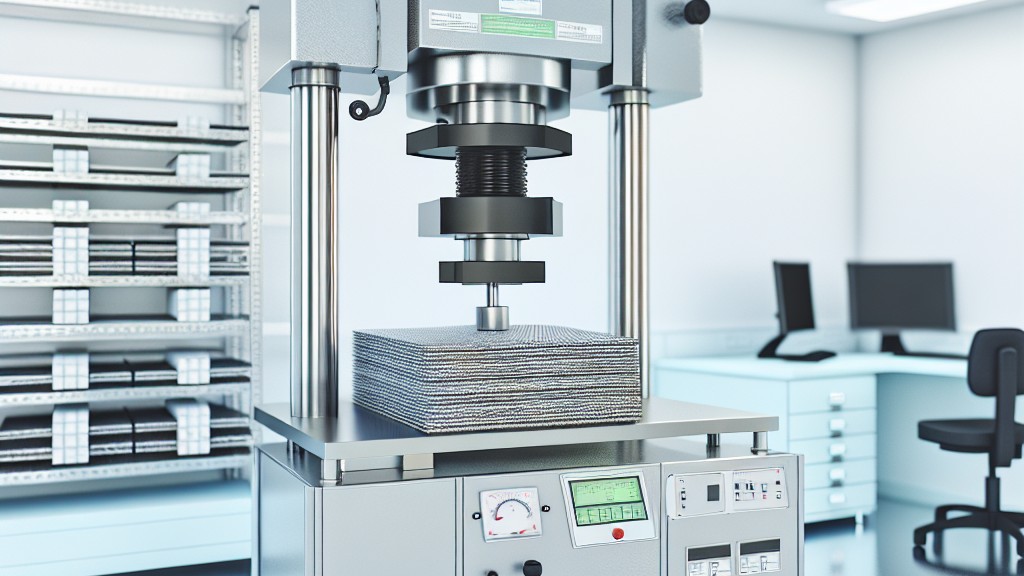
The described test method is based on the principle of measuring the pressure set of a sample of certain shape and size and constant thickness under certain time and temperature conditions.
Equipment used in this test method includes:
- Compression device: Consists of two polished, flat, parallel plates made of chrome-plated steel or stainless steel and is used to compress one or more specimens simultaneously. These plates must be sufficiently rigid that they will not deform during testing. They must be large enough so that the specimen does not extend beyond the edges of the plates.
- A set of spacers or a device for maintaining a constant distance between planks.
- Equipment for cutting test samples (such as a band saw).
- Equipment for measuring thicknesses: This device is specified in the test method described in the PSA D45 1394 standard.
- Equipment for measuring the dimensions of other test specimens: This equipment is a ruler or caliper with a precision of 0,5 mm.
- Conditioned room: Must have a temperature of 23 degrees plus/minus 2 degrees and a relative humidity of 50 percent plus/minus 5 percent.
- Climatic room: Must have a temperature of 23 degrees plus/minus 2 degrees and a relative humidity of 50 percent plus/minus 5 percent.
- Thermoregulated oven: Must have forced air flow to maintain temperature at 70 degrees plus/minus 2 degrees or any temperature specified in the standard.
Test samples or specimens should be representative of the scale to be characterized. To ensure this representation, it is necessary to find out the basic characteristics of the population under study. Selection criteria for test samples or specimens should be stated in the test report in accordance with the standard “PSA A10 0156 Writing of test or measurement reports”. In case of doubt about the sampling, PSA should be contacted to find out the guidelines to be followed.
The following principles should be followed when preparing test samples:
- Shape and dimensions: The compressive load deflection sample is a parallelepiped sample with a 100 mm square base, 2 mm sides and a height of 30 mm to 60 mm. The parallelism and flatness of the sides must ensure that these characteristics are constant to an accuracy of 1 mm. If the sample size does not allow for the sample to be sampled, the required number of elements are placed on top of each other without gluing to obtain a total thickness ranging from 30 mm to 60 mm, the thickness of each element being at least 20 mm.
- Preparation of samples: Samples are cut at least 48 hours after peeling. The sample height is taken with the equipment in the dominant working direction of the part (usually the expansion direction).
- Conditioning: Samples are conditioned in the chamber or chamber for 16 hours.
- Number of samples: For the case of seat cushions, at least three samples from three different pieces are prepared for each test. For other cases, at least three samples from the same piece are prepared for each test, if possible.
When applying the test method:
- The initial height of the samples is determined with measuring instruments according to the PSA D100 100 standard test method under a preload of 0,1 kPa, i.e. 1 N, for a 45 mm x 1394 mm sample. For samples subjected to fatigue testing, the reference size is the size determined before the fatigue test.
- The sample is placed on the support plate.
- Spacers, wedges or spacers are adjusted to a height of 0,2 mm. Unless otherwise specified in the documentation, the specimen is compressed to 70 percent of its initial height using the compression device. For example, for a 50 mm specimen, the spacer is 15 mm. The gap between the plates is also the compressed thickness of the specimen.
- The load tray is placed and the spacers are secured to the chase.
- The assembly is placed in a thermoregulated oven at 2220 degrees for 70 hours unless otherwise stated in the documentation.
- The assembly is removed and the samples are regularly released (loosened crosswise) within a maximum of 2 minutes.
- The samples are allowed to rest in the room for 15 plus/minus 2/0 minutes.
- Using a ruler, the maximum and minimum heights of the samples are measured and the deviation in height is calculated. If the deviation is more than 20 percent, the test should be set aside.
- After the samples have rested in the chamber for 15 plus/minus 2/0 minutes, the height of the samples is determined according to the test method of the PSA D15 45 standard within a maximum period of 1394 minutes. The total duration of the actions described in these last three stages should not exceed 30 minutes.
The compression set, expressed as a percentage of the applied deformation, is obtained using the formula given in the standard. The percentage of deformation is calculated for each sample, and the individual values are recorded. The result is the average of the values obtained. The test is repeated when the relative deviation between the extreme values is greater than 15 percent. If the height cannot be determined, the permanent set cannot be calculated.
Our organization, which has been trying to support businesses from every sector with its testing, measurement, analysis and evaluation studies carried out in a wide range for years, has a strong staff that closely follows the developments in the world in the field of science and technology and constantly improves itself. In this context, testing services in accordance with the "PSA D45 1046 Flexible cellular flooring materials constant thickness compression set" standard are also provided to businesses.



