

The “GMW 3211 Resistance to Stretch and Permanent Deformation” standard, developed by General Motors Worldwide (GMW), is a test standard used to evaluate the stretch behavior and permanent deformation (partial deformation) of automotive interior materials. This standard is particularly applicable to materials such as textiles, leather, backed vinyl, and automotive carpets, where important performance characteristics like dimensional stability and resistance to permanent deformation are crucial.
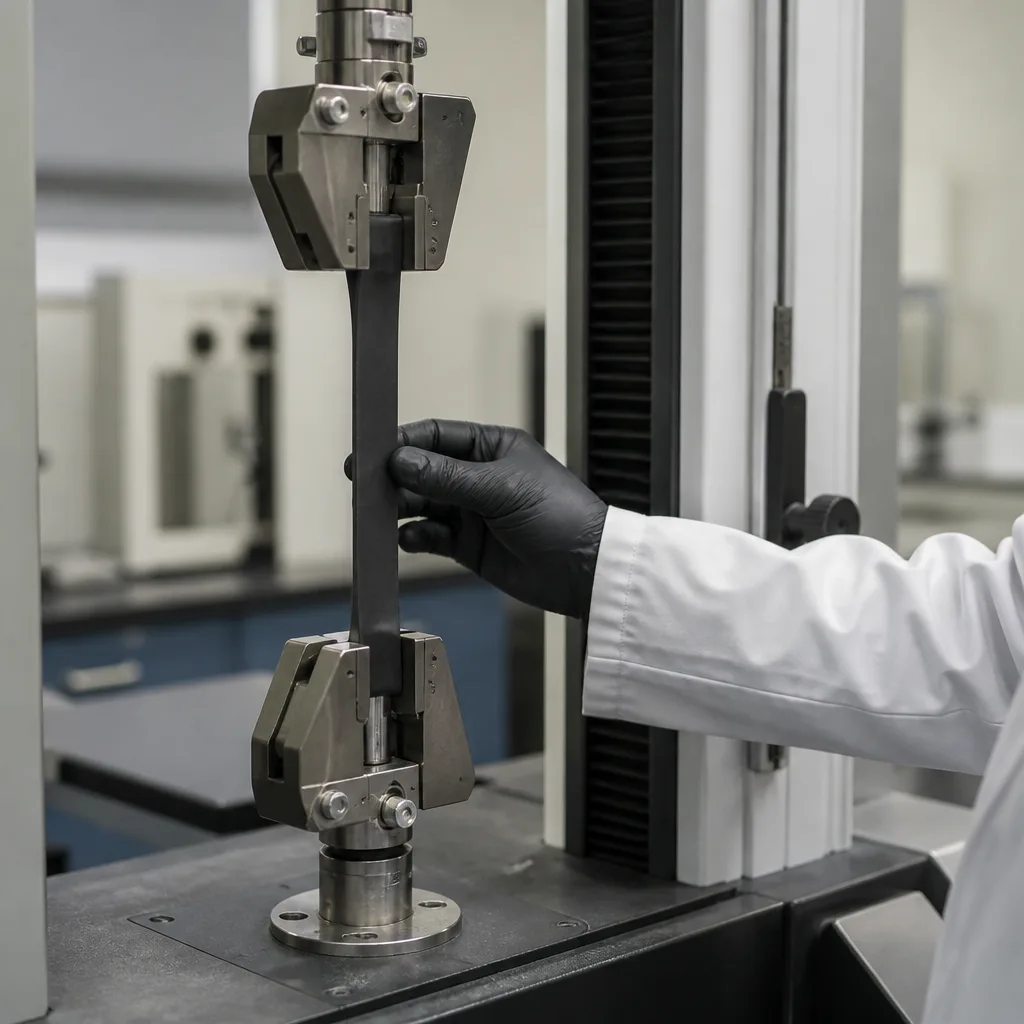
The primary purpose of the GMW 3211 standard is to determine how a material behaves when subjected to a specific static tensile stress. This standard evaluates two key properties:
One material might initially stretch significantly but recover most of its original dimensions. Another material might remain permanently elongated after loading. The GMW 3211 standard helps distinguish between these behaviors. This is important in automotive interiors because materials can be subjected to stress during assembly, installation, upholstery, seating, and service use.
The GMW 3211 standard applies to a variety of flexible automotive materials, including those listed below:
The stated purpose of this standard is to define textiles/fabrics, leather, backed vinyl, and carpets in particular. Testing laboratories also verify its applicability to automotive interior materials by listing the GMW 3211 standard among accredited methods for textiles, coated textiles, and synthetic leather.
In general, the testing principle is simple. A test specimen is prepared from the material and subjected to a controlled tensile load for a specific period of time. The dimensional change of the specimen is then determined. The evaluation generally takes into account: initial size, loading, elongation, unloading, recovery, and permanent deformation.
The key distinction lies between the deformation that occurs under load and the deformation remaining after the load is removed. A material with good recovery properties will return to a value close to its original size. A material with low resistance to deformation, on the other hand, will exhibit a greater permanent elongation.
The results can be used to characterize the following:
These properties are important because excessive permanent elongation can lead to wrinkling, loosening, deterioration, poor fit, or loss of appearance in automotive coatings.
Automotive interior materials are frequently stretched during manufacturing and use. For example, upholstery material may stretch when it is installed onto a seat or trim piece. If it doesn't return to its original shape sufficiently, the finished part may suffer the following:
Therefore, the GMW 3211 standard provides a controlled method for evaluating whether a material exhibits adequate elastic recovery and resistance to permanent deformation. It is particularly valuable during material qualification testing, supplier approval, product development, and quality control.
The GMW 3211 standard may apply to materials used in the automotive industry in the following areas:
Therefore, the test is primarily concerned with the mechanical behavior of flexible interior materials, not just their ultimate tensile strength.
The GMW 3211 standard belongs to a broader group of automotive tests related to textile and flexible material deformation. For example, the SAE J855 standard is also defined as a tensile and permanent deformation method, and laboratories often list it alongside the GMW 3211 standard.
Other standards may measure relevant properties such as tensile strength, tear strength, or dimensional stability, but the GMW 3211 standard focuses specifically on tensile and permanent deformation behavior.
A laboratory performing this type of assessment typically uses equipment that can apply a controlled tensile load and accurately measure dimensional changes. Typical equipment includes:
The results are interpreted as follows:
Acceptance limits are generally determined by the relevant material or component specification, rather than the test method itself.
In conclusion, the GMW 3211 standard includes an important test method for evaluating the deformation and recovery behavior of flexible automotive interior materials. This method is particularly applicable to textiles, leather, backed vinyl, and carpet, and assesses how these materials respond to specified static tensile stresses.
The primary value of this standard is not to determine how much a material can stretch, but to determine how much deformation remains after stretching. This method is useful for checking the dimensional stability, fit, appearance, and long-term performance of automotive interior materials.
In short, the GMW 3211 standard answers this crucial question: when an automotive interior material is stretched under a given load, does it regain its original shape or does it remain permanently deformed?
For many years, our organization, with its competent and experienced staff, has been understanding the needs of its clients, providing the advanced testing services they require, and assisting them in the establishment, implementation, and improvement of management systems. Within this framework, we also provide testing services in accordance with the GMW 3211 standard.
To get an appointment, to get more detailed information or to request an evaluation, you can ask us to fill in our form and reach you.

