

The “ VW 96380 Corrosion test - Modified environmental cycle test” standard, developed by the Volkswagen automotive company , describes accelerated wear test methods used to evaluate the corrosion protection of components or assemblies. These test methods simulate typical corrosion processes of composite designs and produce corrosion patterns that correlate well with results obtained from customer operation, with open-air wear according to the DIN 55665 standard, and with corrosivity in various atmospheres according to the DIN EN ISO 9223 standard.
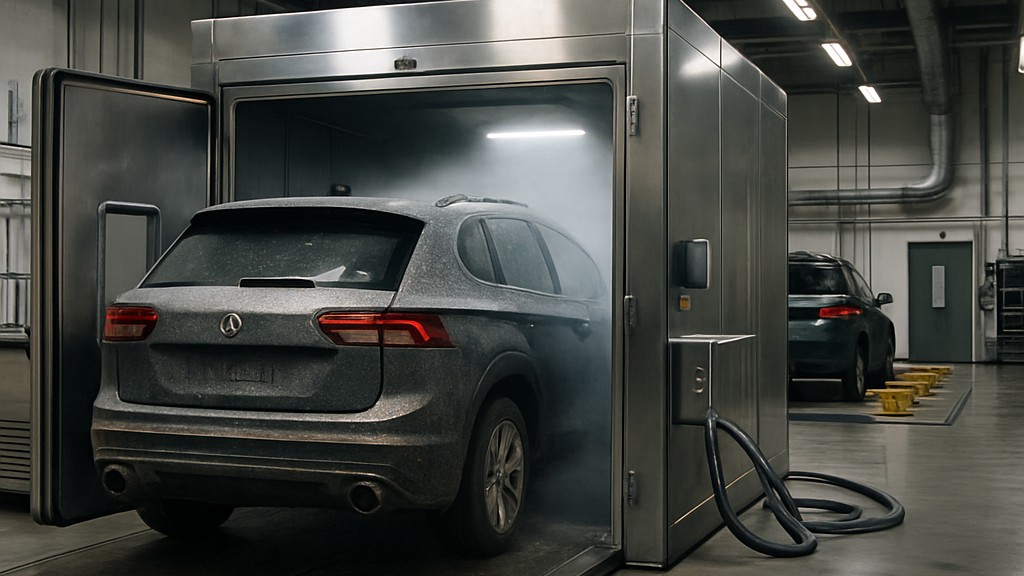
The protective effectiveness of corrosion protection systems can be checked using sample sheets. All vehicle components should be tested in their assembled position, as close as possible to real-life conditions. The sample location and salt load during testing should be agreed upon with the materials engineering department at Porsche AG.
A list of test institutes approved by Porsche AG is included in the standard appendix (Appendix B). Other testing service providers require approval from the Porsche AG materials engineering department.
Corrosion patterns are classified into corrosion classes according to VW 96076. The permitted corrosion class depends on the installation location and must be derived from VW 96023-2. Drawing requirements that deviate from this standard take precedence.
The various corrosivenesses (severities) of the test atmosphere and the modified environmental cycle test variants are based, among other things, on the various chemical compositions and applications of the corrosive test environment. These compositions are used depending on the relevant real-life load. The necessary preloads and preconditioning processes should be agreed upon with the Porsche AG materials engineering department.
During preparation for testing, the specifications described in this standard must be met to perform the test. When using this test method for the first time, the prior involvement of the Porsche AG materials engineering department is mandatory. If testing is solely assigned to a third party, the service providers listed in Annex B are approved for this testing.
To properly perform the modified environmental cycle test, an environmental test chamber with programmable one-hour temperature and relative humidity adjustments must be used. The low-temperature phase can be performed in separate climate chambers. All test chamber parts that come into contact with condensation or test solutions must be constructed of materials resistant to corrosive attack by the test solutions. A test chamber with a cooling unit, heater, pressure compensation, and the necessary measuring and control equipment to set and maintain the required environmental conditions is required. The tolerances for deviations for the target environmental conditions in the enclosed chamber are as follows:
The exception is during the cooling phases from 50°C to 23°C. In this case, temporarily larger humidity deviations may occur for technical reasons and must be reported to the materials engineering department of Porsche AG. The test room must be designed so that no drops from the ceiling or walls, or any existing deflectors, can fall on the samples below. The test solution is sprayed at a room temperature of 23°C plus/minus 2°C.
To ensure repeatability of test results obtained with one test chamber and comparability of test results obtained with different test chambers, it is necessary to control the operation of the test chambers. This is achieved, on the one hand, by corrosion on specially prepared control sheets. On the other hand, by an external environmental sensor. After two test cycles, the loss due to corrosion on the aforementioned control sheets should be within the specified limits.
The test duration is preferably 6 or 12 cycles, corresponding to a total test duration of 6 or 12 weeks, respectively. One cycle lasts 7 days and consists of 7 test segments of 24 hours each. The diagrams provided within the standard show diagrams for the various test segments. These diagrams show the relative temperature and humidity versus time.
Traditional corrosion tests, such as salt spray testing and constant humidity testing, often fail to mimic the complex corrosion mechanisms encountered in real automotive environments. The VW 96380 standard addresses this limitation by introducing a modified environmental cycle that better reflects real-life conditions and thus provides a more accurate assessment of material durability.
The key feature of the VW 96380 standard is that it is linked to the VW 96023-2 standard and is mandatory for all new Porsche AG designs. Corrosion patterns observed during testing are classified into corrosion classes according to the VW 96076 standard. The acceptable corrosion class for a component depends on its installation location, as specified in the VW 96023-2 standard.
Testing involves exposing samples to a series of environmental cycles simulating various conditions, including temperature fluctuations, humidity changes, and salt exposure. After testing, samples are evaluated for signs of corrosion through visual inspection, weight loss measurements, and analysis of corrosion products.
The VW 96380 standard is widely used in the automotive industry to ensure the long-term quality and durability of materials and coatings used in vehicles. By closely simulating real-world environmental conditions, the test helps manufacturers identify potential corrosion issues early in the design and development process, resulting in more reliable and longer-lasting automotive components.
The VW 96380 standard is considered important for the following reasons:
Our organization, which has been supporting businesses across all sectors for years through a wide range of testing, measurement, analysis, and evaluation activities, has a strong team of employees who closely follow global developments in science and technology and are constantly improving themselves. In this context, we also provide testing services in accordance with the "VW 96380 Corrosion test - Modified environmental cycle test" standard.
To get an appointment, to get more detailed information or to request an evaluation, you can ask us to fill in our form and reach you.

