

The “GMW 15891 Solvent Rubbing Method for Determining the Curing Degree of Painted Metal or Plastic Surfaces” standard, developed by General Motors Worldwide (GMW), is an engineering standard that incorporates a solvent rubbing method for determining the curing degree of painted metal or plastic surfaces. This method is used to assess whether an organic coating has adequately cured by examining its resistance to a specific solvent. This standard is particularly important for automotive painted components and manufacturing quality control.
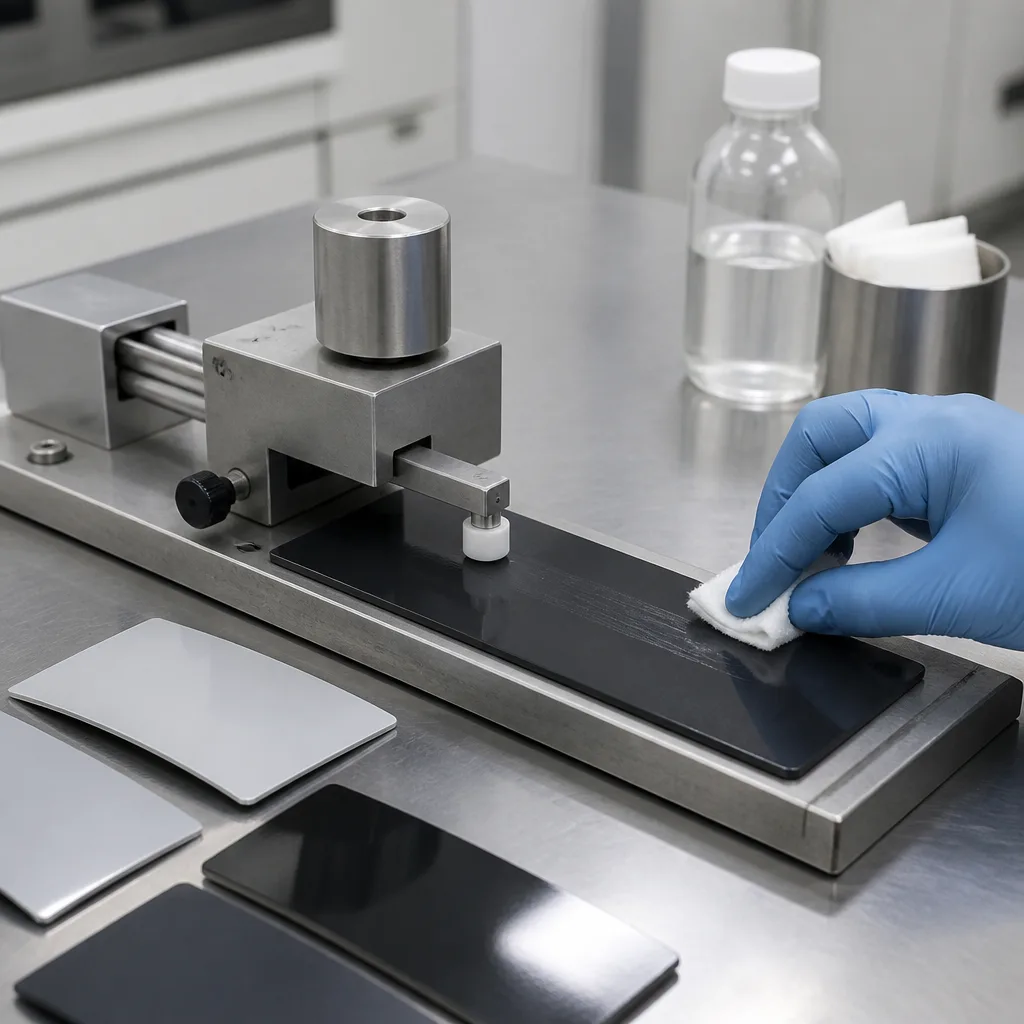
The primary purpose of the GMW 15891 standard is to determine the degree of curing of a paint or coating by measuring its solvent abrasion resistance. During curing, the coating undergoes chemical changes that increase its resistance to solvents and mechanical processes. An inadequately cured coating may soften, dissolve, leach into the abrasion material, or otherwise degrade when exposed to a suitable solvent.
In conclusion, this test offers a relatively simple way to check whether a coating process has achieved the required level of curing. The method can be used in both laboratory and production settings.
The GMW 15891 standard applies to painted metal or plastic surfaces and associated test panels. The method can be used for different coating systems, and the appropriate solvent is selected for the specific coating technology. The solvent is usually agreed upon by the paint supplier and General Motors. Therefore, the method may be applicable to the following types of coatings:
The evaluation method and grading criteria may depend on the type of coating being examined.
The basic principle of the described test method is simple: a cured coating should exhibit better resistance to the effects of the specified solvent than an under-cured coating. A piece of cloth is folded and saturated with the specified solvent. Excess solvent is removed, and the cloth is rubbed against the coated surface with controlled back-and-forth movements. The rubbing motion is approximately 25-50 mm, and the test involves 10 pairs of rubs. The contact area must be at least approximately 16 mm in diameter. After the rubbing process, both the coating and the rubbing cloth are examined for evidence of coating removal or transfer.
Where possible, samples are taken directly from the actual production component. The geometry and dimensions of the component must allow the test to be performed correctly. When testing the actual component is impractical, representative test panels can be prepared. These panels should reproduce the key characteristics of the production part. These include:
This approach helps ensure the test panel represents the actual production coating system rather than an unrelated laboratory sample.
A typical GMW 15891 assessment follows these steps:
This test aims to provide a standardized and repeatable indication of coating curing, rather than a general assessment of solvent resistance.
The outcome is primarily determined by examining the degree of coating damage or coating transfer. Key observations may include:
The GMW 15891 standard uses different evaluation criteria depending on the coating type. Generally, separate tables are used for systems such as electroplating, priming, conductive priming, and single-layer coating, while another table applies to samples with clear coatings.
The GMW 15891 standard is important because proper coating curing is directly related to the performance and durability of painted automotive parts. An improperly cured coating can reduce resistance to:
A coating that appears visually acceptable may still be insufficiently cured. Solvent rubbing tests provide a practical method for detecting this. This method is also used by laboratories operating under automotive testing and accreditation programs. For example, accredited laboratories list the GMW 15891 standard for curing testing and curing/solvent rubbing testing.
The GMW 15891 standard is applicable at various stages of automotive production:
Several manufacturing variables can affect the final curing of a coating:
Therefore, a low GMW 15891 result should generally be evaluated in conjunction with coating process parameters rather than interpreted in isolation.
The GMW 15891 standard is a component of a broader automotive coating performance program. Other tests may examine properties such as adhesion, abrasion, impact resistance, chemical resistance, corrosion resistance, hardness, and appearance. For example, the GMW 14829 standard addresses tape adhesion of paint coatings, while the GMW 14700 standard addresses stone chip resistance of coatings. The GMW 15891 standard differs from these methods because its primary purpose is to specifically evaluate coating curing through solvent rubbing.
In summary, the method defined by the GMW 15891 standard subjects a painted surface to a controlled solvent rubbing process and evaluates the resulting coating condition and paint transfer. Since sufficient curing is essential to achieve the intended durability and resistance of automotive coatings, this standard is useful for paint process development, material approval, production quality control, and troubleshooting.
In short, the test method answers a crucial manufacturing question: has the automotive coating cured sufficiently to provide the necessary resistance to solvent exposure? This makes the GMW 15891 standard a valuable quality control tool for painted metal and plastic automotive components.
For many years, our organization, with its competent and experienced staff, has been understanding the needs of its clients, providing the advanced testing services they require, and assisting them in the establishment, implementation, and improvement of management systems. Within this framework, we also provide testing services in accordance with the GMW 15891 standard.
To get an appointment, to get more detailed information or to request an evaluation, you can ask us to fill in our form and reach you.

