

The “GME 60401 Cross-line Test of Organic Coatings” standard, developed by General Motors Europe (GME), is an engineering standard that defines the cross-line test of organic coatings. This standard is used to evaluate the adhesion of organic coatings, such as paints, primers, powder coatings, and electroplatings, to metallic or non-metallic surfaces used in automotive components.
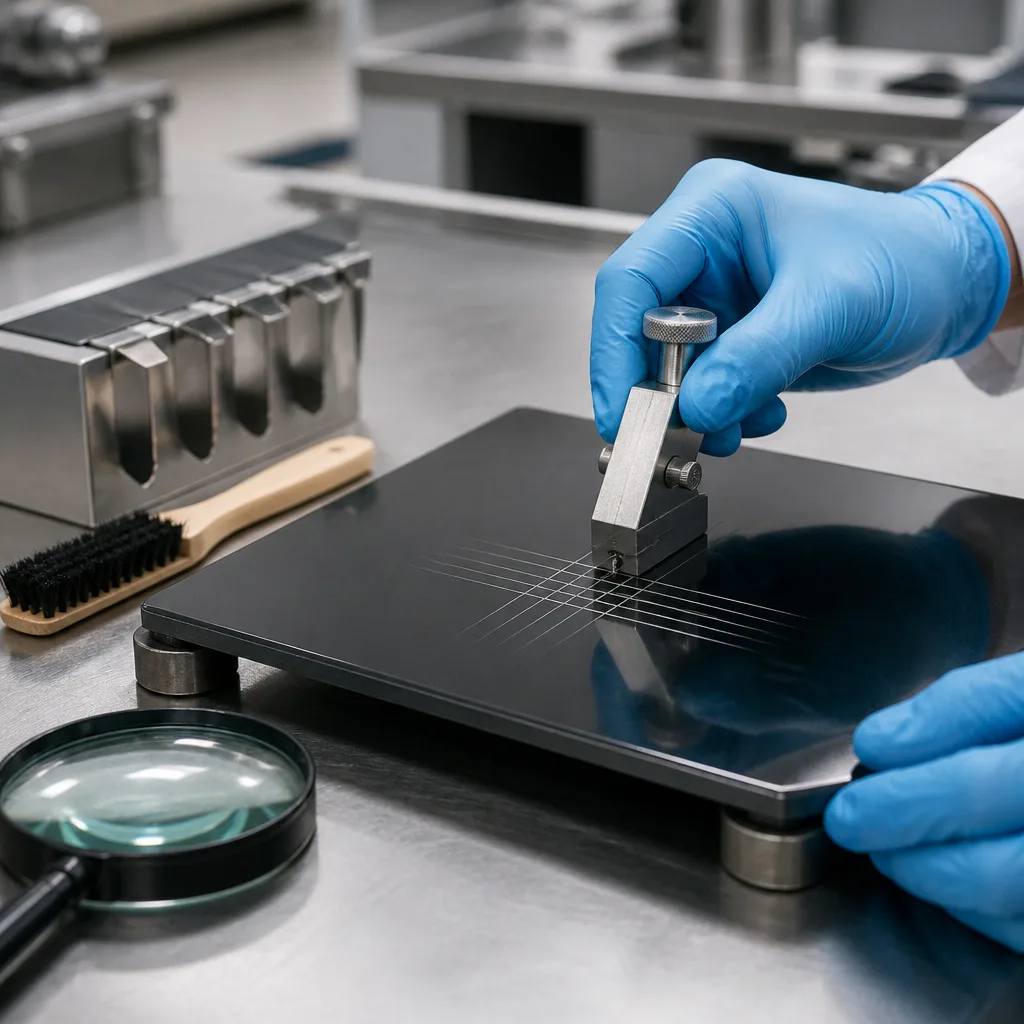
The described test method is a critical quality control procedure that determines whether a coating can remain firmly adhered to the surface throughout the vehicle's lifespan, despite exposure to environmental and mechanical stresses. The GME 60401 standard was later superseded by the GMW 14829 standard, a worldwide General Motors standard that combined various regional coating adhesion properties.
The main objectives of the GME 60401 standard are as follows:
This standard helps manufacturers ensure that coatings remain adhered during normal vehicle operation and when exposed to environmental factors.
In principle, the cross-hatch test is a destructive adhesion test. A grid pattern is cut through the coating using a special multi-blade cutting tool. After the cuts are made, a standardized adhesive tape is applied over the grid and then removed under controlled conditions. The amount of coating that separates from the surface is visually assessed and an adhesion rating is assigned.
These tests generally involve the following steps:
The distance between cuts generally depends on the coating thickness.
Adhesion is generally classified using ratings equivalent to the classification system defined in the “ISO 2409 Paints and varnishes - Cross-cut test” standard. Typical ratings are as follows:
Automotive manufacturers generally require the highest adhesion levels for their production components (typically Rating 0 or Rating 1).
The GME 60401 standard is commonly used in the automotive industry in the following areas:
It can be applied to many organic coating systems, including:
Paint adhesion directly affects corrosion protection and product durability. It is important in automotive manufacturing for the following reasons:
The GME 60401 standard helps maintain consistent coating quality and reliability by verifying adhesion before components enter production.
Several variables affect coating adhesion. Factors influencing test results include:
Proper control of these factors is crucial for achieving satisfactory results.
The GME 60401 standard is technically very similar to the “ISO 2409 Paints and Varnishes – Cross-cut test” standard. Both standards evaluate coating adhesion by creating a cross-hatched grid and assessing the removal of the coating after tape application. However, the GME 60401 standard includes General Motors-specific requirements, acceptance criteria, and application guidelines tailored specifically to automotive manufacturing.
General Motors subsequently replaced the GME 60401 standard with the GMW 14829 standard, a global standard that unified various regional General Motors coating adhesion methods. This new standard provides a consistent cross-screen adhesion procedure for GM's worldwide operations while maintaining the same basic test principle.
Implementing the GME 60401 standard offers several advantages:
In conclusion, the GME 60401 standard is a significant coating adhesion standard that defines the cross-line test for organic coatings. This standard helps automotive coatings achieve long-term durability, corrosion protection, and an attractive appearance by providing a repeatable and objective method for measuring paint adhesion. Although largely superseded by the GMW 14829 standard, the GME 60401 standard remains an important historical reference and still appears in older General Motors engineering specifications and supplier documentation.
For many years, our organization, with its competent and experienced staff, has been understanding the needs of its clients, providing the advanced testing services they require, and assisting them in the establishment, implementation, and improvement of management systems. Within this framework, we also provide testing services compliant with the GME 60401 standard.
To get an appointment, to get more detailed information or to request an evaluation, you can ask us to fill in our form and reach you.

