

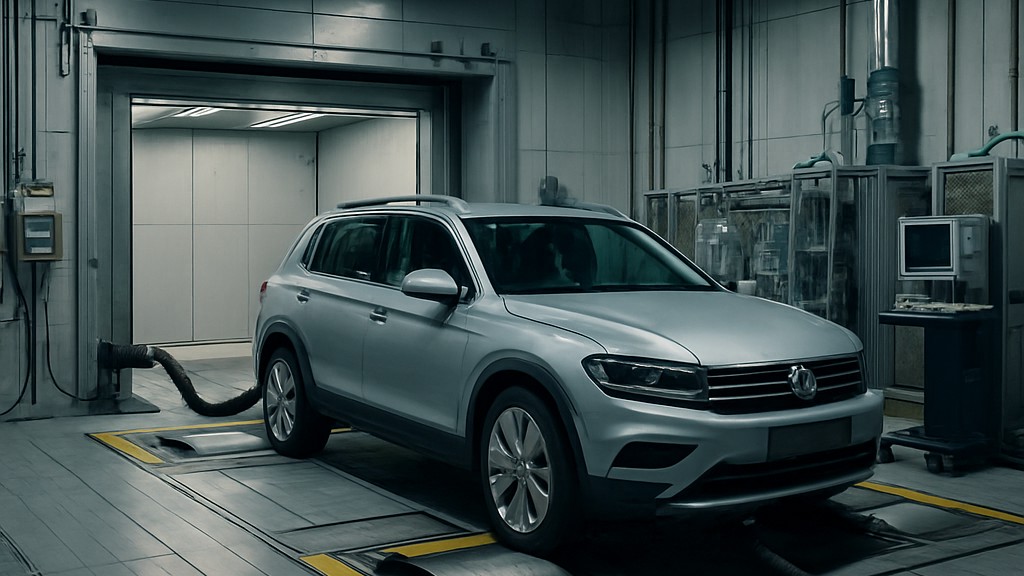
The “ VW 50554 Standard Atmospheres and Room Temperatures – Requirements for Standard Atmospheres” standard, developed by the Volkswagen automotive company , defines standard atmospheres and room temperatures with the aim of achieving greater consistency in applying the relevant external common assumption. This standard describes the requirements for standard atmospheres that allow for achieving and maintaining a defined state of temperature and humidity-sensitive objects. These atmospheres are called standard atmospheres because they are equivalent to average climatic conditions in laboratories and can be achieved in climate chambers, climate cabinets, and climate rooms. Furthermore, requirements for room temperatures are defined.
For the purposes of this standard, the following terms and definitions apply:
Standard atmospheres are defined as follows:
Depending on the object's condition (initial temperature, dimensions, physical and chemical properties), a sufficient aging time in a standard atmosphere is required to reach equilibrium. Hysteresis processes must also be taken into account (the property of a measuring device's response to a given stimulus depends on the sequence of preceding and subsequent stimulus events).
According to this standard, the pay temperature should be: 15 degrees to 35 degrees for short form 1, 18 degrees to 28 degrees for short form 2.
Standard atmospheres are important for several practical and scientific reasons. Here are why:
In short, standard atmospheres provide a universal, consistent set of atmospheric conditions that allow scientists, engineers, pilots, and laboratory workers to predict, design, compare, and operate systems reliably and accurately.
The VW 50554 standard specifies requirements for standard atmospheres and chamber temperatures to achieve and maintain specific environmental conditions, such as temperature, humidity, and air pressure, that must be maintained during laboratory testing, material conditioning, and product evaluation. These standardized conditions ensure consistency and reliability in test results across facilities and time periods. The conditions are designed to mimic average laboratory climates and can be achieved in climate-controlled environments such as rooms and chambers.
Maintaining these standardized environmental conditions is crucial for:
Compliance with the VW 50554 standard ensures that materials and products are evaluated under consistent and controlled conditions, which is important for quality control and product development processes.
Our organization, which has been supporting businesses across all sectors for years with a wide range of testing, measurement, analysis, and evaluation activities, has a strong team of employees who closely follow global developments in science and technology and are constantly improving themselves. In this context, we also provide testing services in accordance with the "VW 50554 Standard Atmospheres and Room Temperatures - Requirements for Standard Atmospheres" standard.
To get an appointment, to get more detailed information or to request an evaluation, you can ask us to fill in our form and reach you.

