SASO-GSO-97 Motor Vehicles - Seat Belts
The “SASO-GSO-97 Motor vehicles - Seat belts” standard published by the Saudi Standards, Metrology and Quality Organization (SASO) describes the requirements for adult seat belt assemblies to be used in motor vehicles.
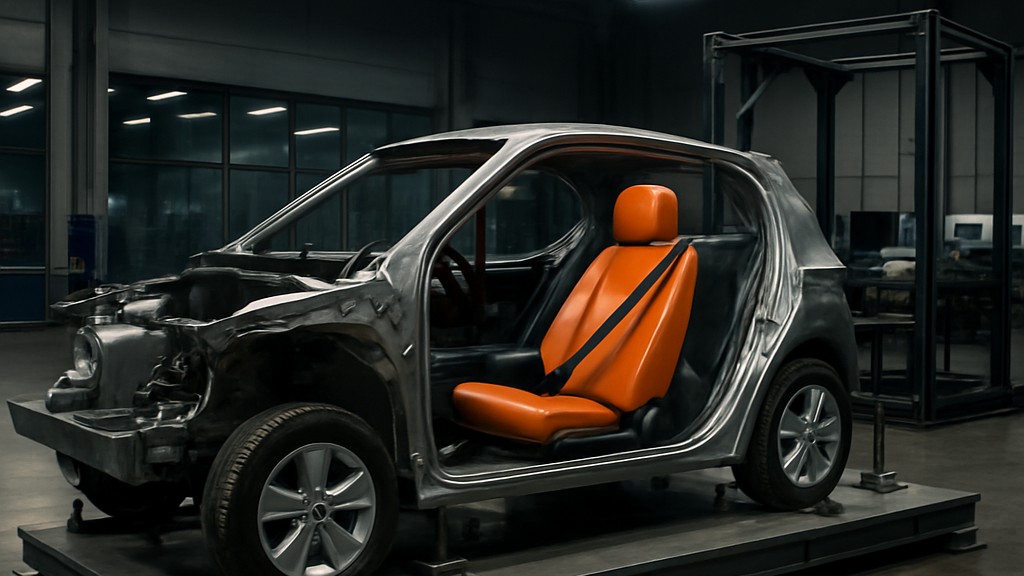
The requirements in this standard are stated as follows:
- General requirements:
- The assembly should consist of a strap, buckle, adjustment devices, rewind mechanism and connecting parts.
- A seat belt device must be designed and manufactured to reduce the risk of bodily injury in the event of an accident or collision when worn and used correctly.
- The seat belt device must be designed to be used by only one person at a time.
- The design of the device must be such that it will not cause serious injury to the user in the event of a collision.
- The device must be such that the force applied to the pelvic region during sudden deceleration is directed downwards and backwards and that the loads on the shoulder portion of the belt do not tend to pull the lap portion of the belt upwards.
- Hardware should be free of burrs and sharp edges and should be positioned in the fixture in a manner that minimizes the possibility of injury to the user.
- The adjustment device must be easily adjustable and easily accessible by the user. The operating force must not exceed 50 N.
- The buckle or other release device must be positioned so that it can be released separately by the user with both hands and, in an emergency, by any other person, and must be designed to eliminate any possibility of misuse.
- The strap ends in the assembly must be protected or treated to prevent unwinding.
- When the driver's seat belt is not fastened and the ignition key is in the start or on position, a warning system must be activated for at least four seconds. The warning must consist of a continuous or intermittent audible signal or a continuous or flashing warning light that the driver can see on the dashboard, indicating "Fasten seat belt" or another indicator.
- Strap:
- The breaking load must be at least 14,7 kN.
- When subjected to a load of 9,8 kN during the specified breaking strength test, the width of the belt must be at least 46 mm for the lap belt and at least 43 mm for the diagonal belt.
- The breaking strength of the belt shall not be less than the value specified above after each of the following conditions:
- Storage at a temperature of 60 degrees plus/minus 5 degrees and a relative humidity of 65 percent plus/minus 5 percent for 3 hours.
- Soak in distilled water for 3 hours.
- Exposure to carbon arc light for 100 hours.
- Passing over a hexagonal bar 2500 times.
- Storage in a cold environment of minus 30 degrees plus/minus 5 degrees for 2 hours.
- The energy absorption of the belt must be at least 800 Nm, and the irreversible proportional energy must be not less than 50 percent of the total energy absorbed when subjected to a load of 11,08 kN.
- Earth:
- All metal parts must be made of corrosion-resistant material or be suitably protected against corrosion.
- The width of the safety buckle should not be less than the width of the belt, and the width of the buckle contact surface should not be less than 46 mm.
- It should be designed so that it can be easily opened by one hand of the passenger and can also be easily opened by other people in an emergency.
- It should be designed to prevent accidental opening and should withstand repeated operations.
- It must be of the quick-release type and must not allow partial engagement by disengaging when a load of less than 23 N is applied.
- Push buttons designed for quick release of closed and non-closed type buckles must have a minimum surface area of 450 mm2 and 250 mm2 and a minimum linear dimension of 15 mm and 10 mm respectively.
- The fastening buckle must not break or be damaged under a load of less than 9,8 kN.
- Performance testing:
- Dynamic: The equipment must be free of any damage or cuts and the maximum forward displacement of the dummy must not exceed 200 mm at the lap for lap belts and 300 mm at the chest for diagonal belts.
- Static: The following requirements must be met when the assembly is subjected to a static load of 17,6 kN.
- There should be no damage or cuts.
- The maximum forward displacement of the dummy should not exceed 200 mm at lap level for lap belts and 300 mm at chest level for diagonal belts.
- The strap's slippage between buckles or adjustment devices must not exceed 25 mm for each buckle or 50 mm for the entire assembly.
- When the assembly is subjected to a load of 685 plus/minus 50 N, the force required to release the fastening buckle during the static test shall not exceed 140 N.
- Any other method equivalent to those stated above is acceptable.
- Retraction device:
- Retracting devices must meet the requirements specified below after being subjected to assembly durability testing, corrosion testing, and dust impact testing.
- Manual opening of the retractor:
- The belt should not move more than 25 mm between the locking positions of the retractor.
- The belt should not pull more than 6 mm of its maximum length when a tension of 14 N to 22 N is applied in the normal pulling direction.
- Automatic locking retraction device:
- The belt should not move more than 30 mm between the locking positions of the retractor.
- If the retractor is part of a lap belt, the retracting force of the belt must not be less than 7 N.
- If the retractor is part of a diagonal belt, the retraction force of the belt must not be less than 2 N and not more than 7 N.
- Emergency locking rewind:
- It should be locked when the vehicle deceleration is 6,8 m/s2 or less.
- It should not be locked when the belt acceleration measured in the direction in which the belt is removed is less than 7,8 m/s2.
- If the retractor is part of a lap belt, the retracting force of the belt must not be less than 7 N.
- If the retractor is part of a diagonal belt, the rewind force of the belt must not be less than 2 N and not more than 7 N.
- The design of the rewinder should be such that, when its operation depends on an external power source, it automatically locks in the event of failure or interruption of this power source.
The SASO-GSO-97 standard is important as it regulates the labeling of pre-packaged food products in Gulf Cooperation Council countries, which include Saudi Arabia, the UAE, Kuwait, Bahrain, Oman and Qatar.
This standard is considered important for the following reasons:
- Consumer protection: This standard ensures transparency by requiring labels to include critical information such as ingredients, allergens, expiration date, country of origin, and nutritional values. This helps consumers, especially those with dietary restrictions or allergies, make informed and safe choices.
- Regulatory Compliance: This standard is a mandatory requirement for the sale of pre-packaged food in the Gulf Cooperation Council (GCC) markets. Importers and manufacturers must comply with this standard to avoid fines, product recalls, and market bans.
- Trade facilitation: Reduces complexity for food exporters by providing a harmonized labeling framework across the Gulf Cooperation Council (GCC) countries. Promotes smoother cross-border trade within the region.
- Labeling standardization: Ensures consistency in the format, language, and content of food labels. It helps retailers and regulators easily identify non-compliant or counterfeit products.
- Traceability and accountability: Labels must include manufacturer or distributor information, batch numbers, and production dates. This supports product recalls and enforcement actions if safety issues arise.
Our organization, which has been supporting businesses across all sectors for years through a wide range of testing, measurement, analysis, and evaluation activities, has a strong team of employees who closely follow global developments in science and technology and are constantly improving themselves. In this context, we also provide testing services to businesses in accordance with the "SASO-GSO-97 Motor Vehicles - Seat Belts" standard.



