

The International Organization for Standardization (ISO) standard "ISO 27956 Road vehicles - Securing loads in delivery vans - Requirements and test methods" describes the requirements and test methods for use on vehicle-related equipment for securing loads in delivery vans with a gross vehicle mass of up to 7,5 tonnes. This standard specifies the minimum requirements and test methods for the reliable and roadworthy securing of loads to protect occupants from injuries caused by shifting loads.
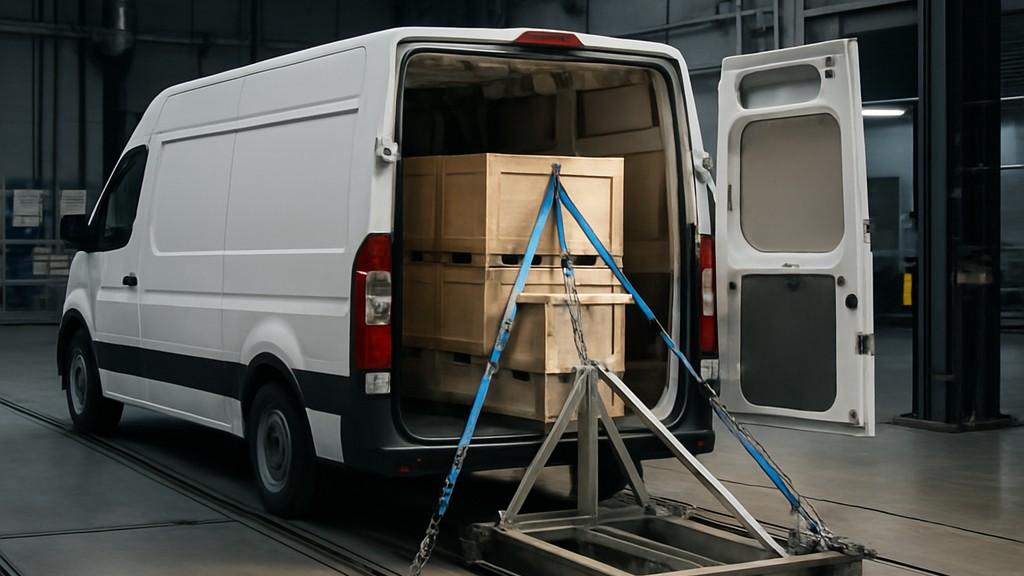
This standard applies to N1 and N2 vehicles up to 7,5 tonnes, in accordance with the Economic Commission for Europe (ECE) classification. For vehicles designed primarily for freight transport and derived from a passenger vehicle (M1), only the partition system requirements of this standard apply. Overloads that may occur during an accident (e.g., vehicle impacts) are outside the scope of this standard.
For the purposes of this standard, the following terms and definitions apply:
To prevent cargo from entering the passenger compartment, delivery vans must be equipped with adequate devices to protect passengers from cargo. Therefore, protective devices consisting of a partition system and tie-down points must be provided.
The partition system must completely separate the passenger compartment from the loadspace in terms of width and height. If a loading area is located above the passenger compartment, the partition system may be limited in height by the horizontal separation between the passenger compartment and the loadspace. However, in a vehicle with only a driver's seat and no passenger seats, the partition system need not span the entire width of the vehicle, provided the driver's protective zone is covered and the driver's seating position is adequately protected against lateral shifting cargo.
If there is a gap between the partition system and the vehicle body, this gap must not exceed 40 mm, without removing the cover or upholstery, if present. A greater gap is permitted for sidewall grooves and to ensure proper deployment of curtain airbags, if fitted. If the partition system consists of a grille or cargo net, a rigid testing machine with a 50 x 10 mm front surface, moved longitudinally, must pass through such nets or nets in any orientation.
The strength of the entire partition system is tested in accordance with this standard. The protection zones of the partition system must withstand testing conducted in accordance with this standard.
Each point within the protection zones must meet the requirements of a test using a Type 2 piston plunger. If windows or doors are located within the protection zone, these elements must also withstand this test. The window material can be broken as long as the deformation criteria listed below are met.
When tested to this standard, permanent deformations of the partition system of up to 300 mm are permitted, provided that these deformations do not result in sharp edges or other deformations that could lead to direct or indirect injury to occupants.
The loading area of delivery vans must be equipped with tie-down points. The geometry of the tie-down points is not specified in this standard but is determined by the vehicle manufacturer.
Our organization, which has been supporting businesses across all sectors for years through a wide range of testing, measurement, analysis, and evaluation activities, has a strong team of employees who closely follow global developments in science and technology and are constantly improving themselves. In this context, we also provide testing services in accordance with the "ISO 27956 Road Vehicles - Securing Loads in Delivery Vans - Requirements and Test Methods" standard.
To get an appointment, to get more detailed information or to request an evaluation, you can ask us to fill in our form and reach you.

