

The “GMW 15651 Martindale Method Hook Fastener Resistance” standard, developed by General Motors Worldwide (GMW), is a test standard used to evaluate the resistance of materials commonly associated with hook and loop fastener systems to hook fasteners. This standard is particularly important for automotive textiles and upholstery materials, where repeated contact with hook fasteners can damage the visible surface of the fabric.
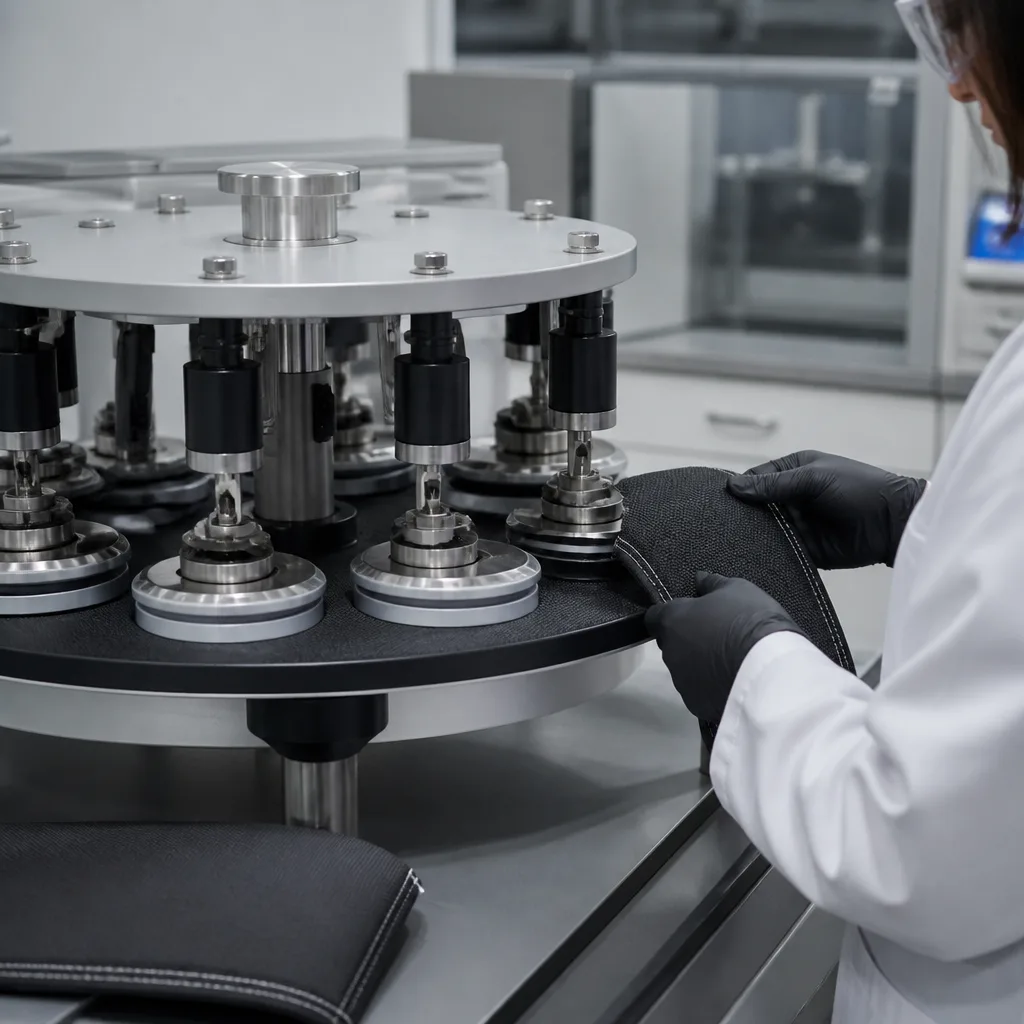
Testing laboratories list the GMW 15651 standard specifically for textile materials and automotive applications.
In applications such as automotive interior fabrics, seat covers, luggage compartments, upholstery components, carpets, and removable textile parts, hook fasteners may come into contact with the fabric. Repeated attachment and removal of hooks can cause the following:
The GMW 15651 standard provides a controlled laboratory method for evaluating this type of damage. This test method is based on the Martindale principle. A sample is repeatedly subjected to friction/contact with a hook fastener material under controlled conditions. During the test, the hook material repeatedly interacts with the surface of the test sample. This reproduces the mechanical movement that occurs when a hook fastener is attached to and detached from an automotive textile. Consequently, the surface condition is evaluated to determine the material's resistance to hook fastener movement.
The GMW 15651 standard primarily applies to textiles and upholstery materials. Potential applications include:
This standard is included in textile laboratory accreditation scopes along with other automotive textile methods such as GMW 14146 for seam break strength and GMW 3347 for lint collection and retention.
A Martindale abrasion tester or a suitable Martindale-type tester is used for the process. The equipment provides controlled relative movement between the hook-and-loop fastener material and the sample. Key features of this equipment include:
Following the specified test exposure, the sample is examined for signs of deterioration. Depending on the applicable specification or customer requirement, the evaluation may take into account the following characteristics:
Acceptance criteria should always be derived from the relevant General Motors material specification, engineering specification, drawing, or test plan.
The GMW 15651 standard is important because automotive interior materials must withstand repeated daily use without unacceptable degradation. For example, an interior textile may initially have excellent appearance and durability, but repeated contact with a hook fastener can quickly damage its surface. The GMW 15651 standard helps identify materials susceptible to this mechanism before they go into production. Therefore, the test supports:
The GMW 15651 standard should not be considered merely a general abrasion test. Traditional abrasion tests evaluate resistance to a specific abrasive surface or friction material. The GMW 15651 standard specifically addresses the interaction between a hook fastener and a textile surface. This distinction is important because a textile product may exhibit good general abrasion resistance while still being susceptible to snagging or fiber breakage by hooks.
In vehicle interiors, where removable or adjustable textile components use hook and loop fasteners, hook and loop resistance can be important. Examples include:
Therefore, the test can be part of a broader automotive material validation program, along with tensile, tear, abrasion, staining, chemical resistance, and appearance tests.
The GMW 15651 standard belongs to a broader group of General Motors materials and textile testing procedures. For example, laboratories list it alongside the following standards:
These tests address different failure mechanisms, so a materials qualification program may require several of them rather than relying solely on the GMW 15651 standard.
In short, the GMW 15651 standard is an automotive textile testing method designed to evaluate how well a material withstands repeated contact with hook fasteners.
Its primary value lies in its ability to assess a specific type of surface damage that ordinary tensile or general abrasion tests may not adequately reproduce. Using a controlled Martindale-based procedure, engineers and material suppliers can evaluate whether an automotive textile is durable enough for applications involving hook and loop fasteners.
For many years, our organization, with its competent and experienced staff, has been understanding the needs of its clients, providing the advanced testing services they require, and assisting them in the establishment, implementation, and improvement of management systems. Within this framework, we also provide testing services in accordance with the GMW 15651 standard.
To get an appointment, to get more detailed information or to request an evaluation, you can ask us to fill in our form and reach you.

