

PSA D41 1003 Resistance of Flexible Cellular Materials to Compression
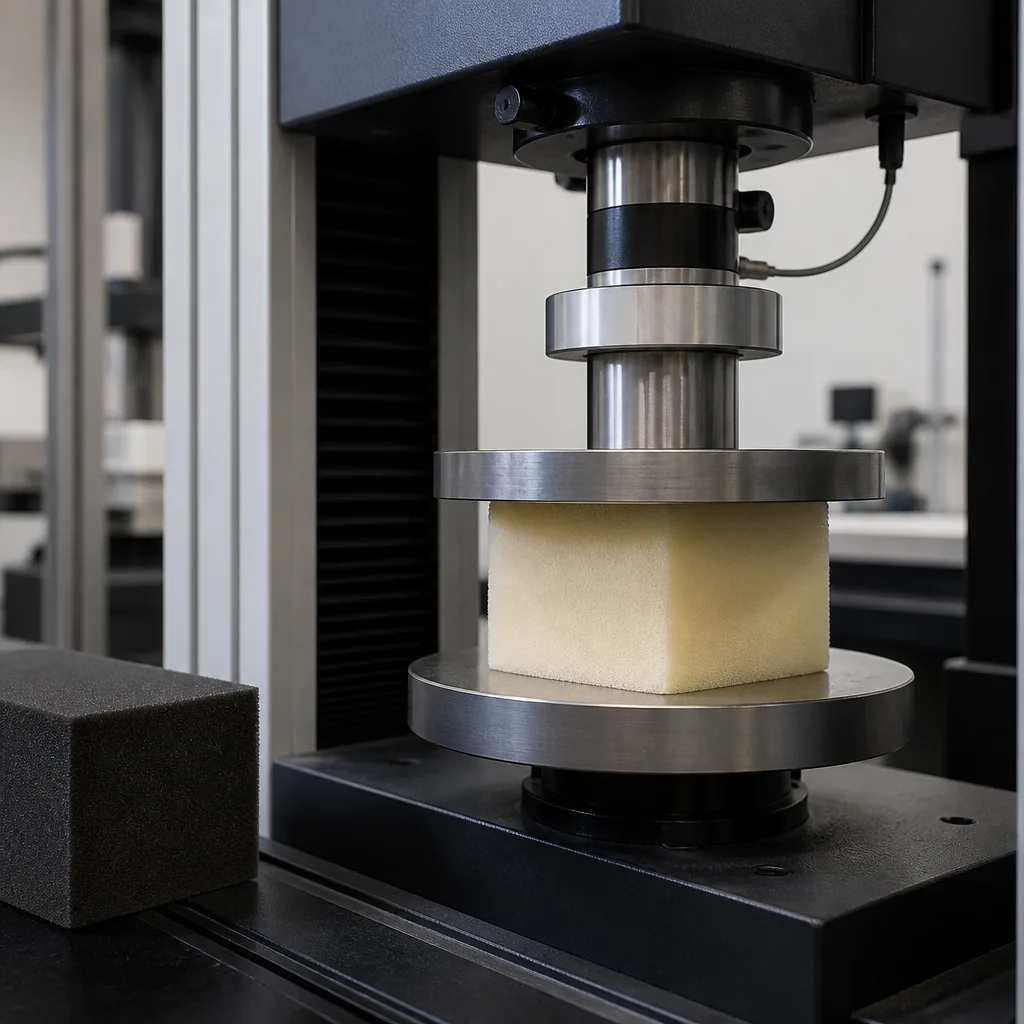
The “PSA D41 1003 Resistance of flexible cellular materials to compression” standard, developed by the French car manufacturer PSA Group, now part of Stellantis, describes a procedure for determining the resistance of polyurethane-based, open or closed-cell flexible cellular materials to compression as it occurs in the following ways:
In principle, a material's resistance to compression is characterized by the deflection of the compressive load required to compress the test specimen to a specific degree over the number of compression cycles specified in the standards.
The PSA D41 1003 standard is an automotive material testing specification. This standard addresses the compressive strength of flexible cellular materials, particularly soft foam materials used in automotive applications. It is especially important for foam and cellular materials used in vehicle interior components, where compressive strength is crucial for maintaining shape, comfort, dimensional stability, and functional performance during use.
The primary purpose of the PSA D41 1003 standard is to determine how a flexible cellular material reacts when compressed. Flexible foams can be subjected to repeated or continuous compression during vehicle use. For example, seat cushions, fillers, upholstery components, acoustic materials, and other foam-based parts can be compressed during assembly or normal use. Therefore, the test provides information about the material's compression behavior and resistance to deformation.
The PSA D41 1003 standard primarily deals with flexible cellular/foam materials. Specifically, it defines a method for soft foam materials and flexible cellular materials. Typical automotive applications may include:
Its exact applicability to a specific component depends on the relevant engineering specification and drawing requirements.
The general principle is to place a prepared foam sample between compression plates and apply controlled compression deformation. The compressive force generated while the sample is compressed is measured. This test establishes the relationship between compression/deformation and the force required to produce that deformation.
This standard describes conditioning at approximately 23 degrees Celsius and 50 percent relative humidity for 16 hours, and samples of approximately 100 mm x 100 mm in size. It also refers to force measurement according to the ISO 5893 standard.
The sample is typically prepared from flexible cellular material in a regular geometric form suitable for compression testing. Key sample properties include:
Since foam materials can be sensitive to thickness, density, shear damage, and surface irregularities, proper sample preparation is crucial.
Conditioning is particularly important for foam testing because flexible cellular materials can be affected by:
This standard requires conditioning at 23 degrees Celsius and 50 percent relative humidity for 16 hours prior to testing.
During compression measurement, the sample is compressed between two plates. The testing machine records the force required to achieve the specified deformation. This allows for the evaluation of the material's compressive strength. The reported result may be based on a specific deformation level rather than reporting a general stress value.
Typical equipment required for testing includes:
The method described refers to the ISO 5893 standard for force measuring equipment.
The tests provide information about a material's resistance to compression. A material that requires a higher force to achieve a given deformation is generally more resistant to compression, while a material that requires a lower force is softer or easier to compress. This information can be important for:
However, compressive strength should not be confused with compressive permanent deformation strength. Compressive strength describes the force/strain behavior during compression, while compressive permanent deformation evaluates the permanent deformation remaining after a defined compression history.
Foam materials are widely used in automotive interiors because they combine low weight with cushioning, insulation, and comfort. However, foam properties must be carefully controlled. Excessively soft material may lose support or deform excessively, while excessively rigid material may reduce comfort and cause assembly or functional problems. Therefore, the PSA D41 1003 standard helps manufacturers and suppliers determine whether a flexible cellular material possesses the necessary compression properties for its intended application. This can be particularly important for components subjected to localized loads or repeated compression.
The PSA D41 1003 standard is part of a broader group of material specifications that cover different mechanical properties of cellular materials. For example,
These standards address different aspects of foam performance and should not be considered interchangeable.
The PSA D41 1003 standard is important because it provides a controlled method for evaluating the fundamental mechanical properties of flexible foam materials. Its main benefits are:
In short, the PSA D41 1003 standard evaluates how much force is required to compress a foam sample under specified conditions. This makes it useful for checking the mechanical properties of automotive foam components such as cushioning, filling, upholstery, and insulation materials.
For many years, our organization, with its competent and experienced team, has been understanding the needs of its clients, providing the advanced testing services they require, and assisting them in the establishment, implementation, and improvement of management systems. Within this framework, we also provide testing services compliant with the PSA D41 1003 standard.
To get an appointment, to get more detailed information or to request an evaluation, you can ask us to fill in our form and reach you.

