

The “VW PV 1503 Paint on metallic and non-metallic materials - Pressure washer test” standard, developed by the Volkswagen automotive company, describes a procedure for determining paint adhesion on metallic and non-metallic materials. The procedure uses three test methods to simulate the stresses created when surfaces are cleaned with a pressure washer:
The test method to be used must be agreed upon with the relevant department.
Devices and ancillary equipment used in tests include:
The test parameters are listed in the table provided in the standard, based on PV 1503-A, PV 1503-B (corresponding to the test method A of DIN EN ISO 16925) and PV 1503-C (corresponding to the test method C of DIN EN ISO 16925).
After pressure washer loading, the equipment or sample being tested is visually inspected for peeling of the paint surface and the St. Andrew's cross. The degree of damage is assessed according to the test report section of DIN EN ISO 16925. Small areas of flaking, measuring up to 1 mm, in the cross-cut resulting from uneven cutting should be disregarded in the assessment. If traces of the substrate are visible to the naked eye in the peeling areas, the test cannot be evaluated.
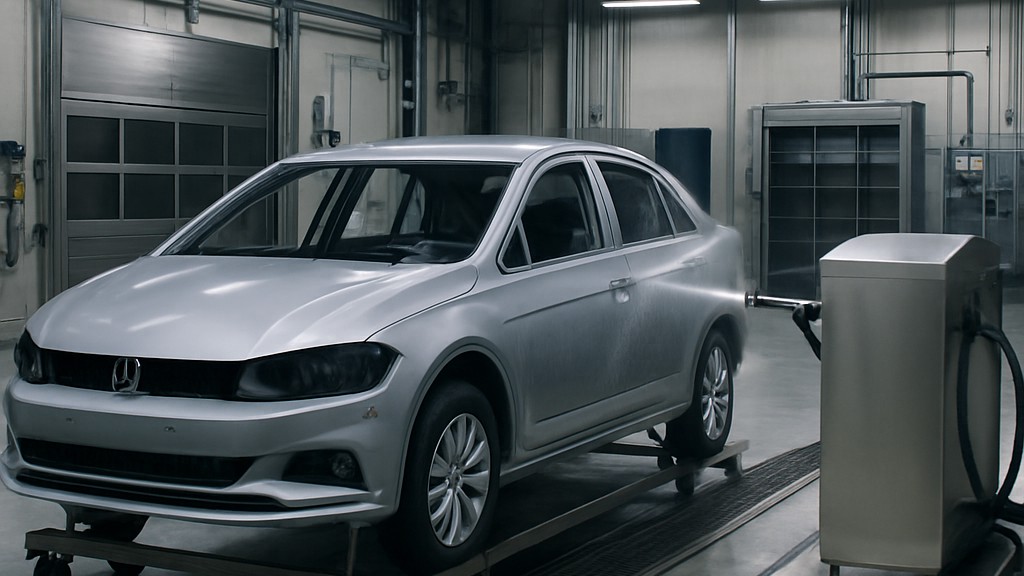
The method described in the VW PV 1503 standard, also known as the steam jet test or pressure washing test, evaluates the adhesion and durability of paint coatings on both metallic and non-metallic substrates by simulating the stresses experienced during high-pressure cleaning.
The primary purpose of this test is to evaluate the adhesion of paint coatings to surfaces when exposed to high-pressure water jets. This test is crucial for ensuring the longevity and appearance of automotive components exposed to these cleaning methods.
The VW PV 1503 standard has been widely adopted within the automotive industry to ensure that paint coatings can withstand the mechanical stresses of high-pressure cleaning. Compliance with this standard is frequently required by suppliers of painted components to Volkswagen and its associated brands.
Compliance with the VW PV 1503 standard is crucial for suppliers and manufacturers to ensure product quality and adherence to Volkswagen's stringent standards. This standard is particularly important in the automotive industry for the durability and adhesion of paint coatings. The importance of this standard lies in the following reasons:
In short, the VW PV 1503 standard is a critical test that tests whether paint coatings fulfill not only their aesthetic but also their protective and functional duties. For suppliers, compliance with this test is not only a quality expectation but also a prerequisite for continued collaboration.
Our organization, which has been supporting businesses across all sectors for years through a wide range of testing, measurement, analysis, and evaluation activities, boasts a strong team of employees who closely follow global developments in science and technology and are constantly improving themselves. In this context, we also provide testing services to businesses in accordance with the "VW PV 1503 Metallic and Non-Metallic Material Paint - Pressure Washer Testing" standard.
To get an appointment, to get more detailed information or to request an evaluation, you can ask us to fill in our form and reach you.

