

The “VW PV 3903 Non-metallic planar materials - Measurement of bending stiffness” standard, developed by the Volkswagen automotive company, describes a procedure for measuring the stiffness of textiles, films, artificial leather, cardboard, paper, and insulation materials as a function of direction when bent under defined conditions.
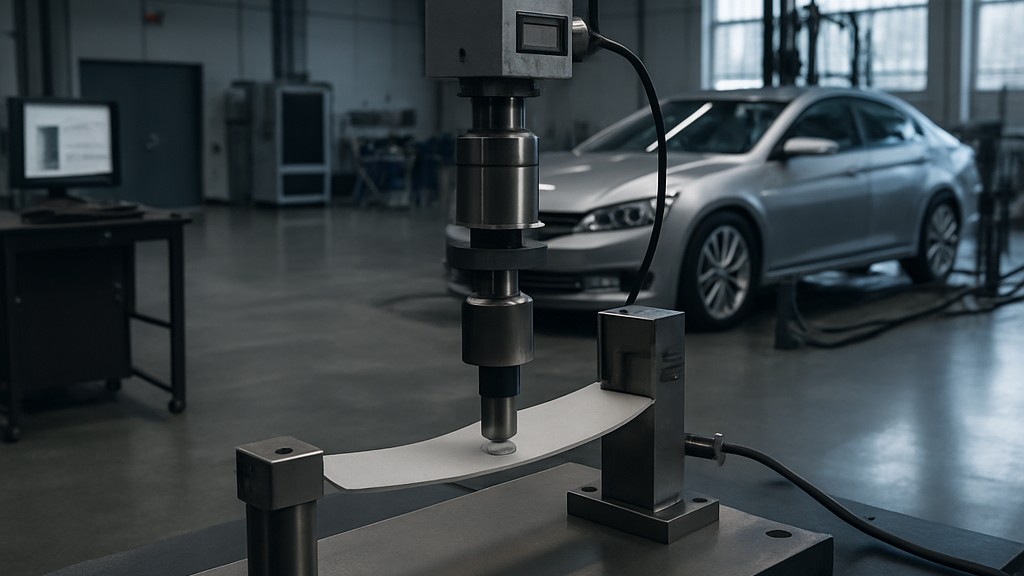
For the purposes of this standard, the term flexural stiffness is a measure of the resistance of a test strip (measuring strip) in response to a defined bending force.
The main devices and equipment used in the tests are:
Sample dimensions are 75 mm long and 20 mm wide. Material thickness must conform to the drawing, production permit, or technical supply specifications. Samples made from molded parts should be taken from areas showing the least deformation, if possible. Slightly convex samples should be clamped with the convex side facing the direction of rotation. If testing is performed on materials composed of woven or knitted fabrics, or if the materials have a woven or knitted underside, the sample should be taken parallel to the yarns or weaves. Preferably, five samples are tested in the longitudinal and transverse directions (warp and weft).
The specimens are clamped with a 1,0 cm bending clearance. The specimens are placed parallel to the holder's marking lines and flush with the holder's edge. The specimens are clamped using a torque screwdriver with a tightening torque of 10 Ncm. The relevant standard or drawing should specify whether the specimens should be clamped with the top side up or down. The holder or associated weight disc should also be identified in the relevant standard or drawing.
The bending test is performed in a room with a standard climate suitable for ISO 554, following the test device's user manual. A weight consisting of one or more weight discs is first placed on the mounting pin of the graduated disc. The device is then locked in the zero position, and the specimen is placed in the appropriate holder. The specimen is tightened using a torque wrench to a tightening torque of 10 Ncm. The specimen is then bent to a 45-degree angle.
Deviations, such as different specimen sizes, different conditioning, or testing with a different holder and different bending angle, must be specified in the relevant standard or drawing. The same applies to any restrictions on the test scope, such as bending only to one side or in a single direction.
The force applied during the bending stiffness test is determined according to the formula given in the standard.
In short, the VW PV 3903 standard falls within the broader VW PV 3900 series of standards, which focus on mechanical and chemical testing of non-metallic materials used in the passenger compartment of vehicles. The VW PV 3900 standard covers odor testing of interior materials after environmental aging; the VW PV 3904 standard covers flame retardant properties (aging resistance); and the VW PV 3905, VW PV 3909, VW PV 3919, VW PV 3922, and similar standards cover ball drop, abrasion, wear, static elongation, compression, scratch resistance, oil/water repellency, and more.
The VW PV 3903 standard measures how much bending stress a component can withstand before failure. This is important for the durability and safety of interior trim, panels, vents, or molded parts. The purpose of this standard is to verify that non-metallic plastic or composite parts in the cabin (e.g., dashboards, console components, headliner components) can withstand bending loads encountered during production, assembly, or service without cracking or premature failure. Automotive suppliers and testing laboratories use this standard to ensure that materials meet Volkswagen Group's mechanical specifications.
Tests generally consist of the following steps:
The VW PV 3903 standard is important because it ensures that Volkswagen vehicle interior components meet stringent mechanical strength requirements, particularly resistance to bending and twisting damage. The key reasons for this standard's importance are:
As a result, the VW PV 3903 standard is a test standard for assessing the flexural strength of non-metallic interior components. It ensures that components meet structural strength expectations under flexural stress. While the full methodology and threshold values require official VW documentation, this standard aligns with the VW PV 3900 series of standards, which focus on mechanical integrity and the customer sensory experience of interior materials.
Our organization, which has been serving for many years and meticulously following global developments in science and technology, employs a skilled team and extensive infrastructure to conduct testing, measurement, and analysis in a wide range of areas for businesses across all sectors. In this context, we also provide testing services in accordance with the "VW PV 3903 Non-Metallic Planar Materials - Measurement of Flexural Stiffness" standard.
To get an appointment, to get more detailed information or to request an evaluation, you can ask us to fill in our form and reach you.

