

The “Renault D45 1730 Fire Resistance of Ashtrays - Incandescent Wire Test” standard, developed by the French automobile company Renault, describes a test method for determining the fire resistance of ashtray materials (mostly containers), especially against cigarette extinguishings. This method is largely based on the “NF T51-074 Plastics - Fire Behavior - Incandescent Wire Test” standard.
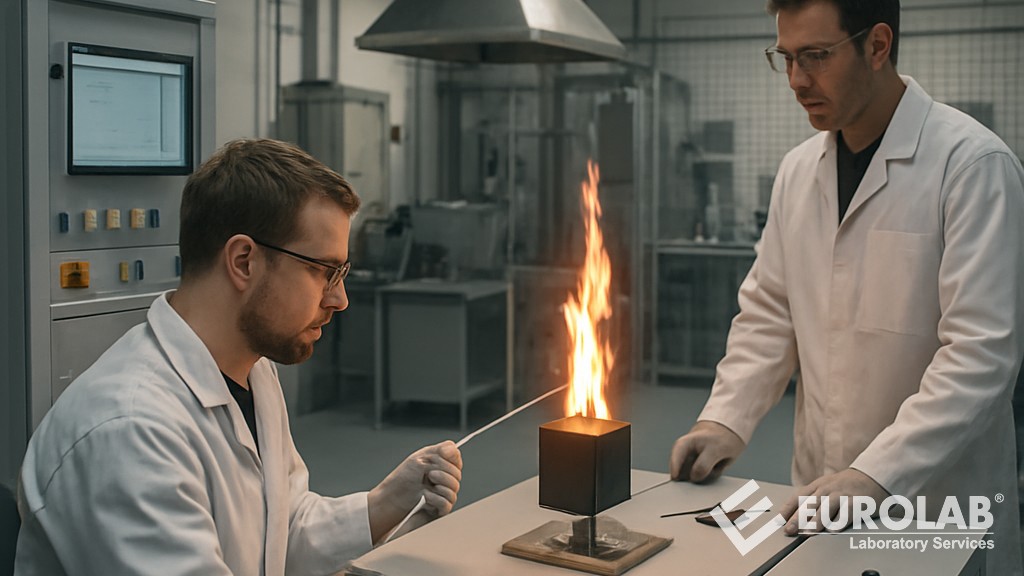
During the test, in principle, a defined heated wire is brought into contact with a sample of the material being tested at a specific pressure. The total puncture time is measured, and the combustion characteristics are recorded.
Samples are either cut from parts or taken from molded sheets made from the material specified for the manufacture of the parts. If samples are taken from a part, the sample is taken from the area where a cigarette butt is most likely to be extinguished, or, if this is not possible, from an area of similar thickness. If sheets are used, the minimum dimensions of the samples must be 50 mm x 50 mm, and the thickness must be equal to the thickness specified for the part or, by default, 3,0 mm plus/minus 0,2 mm. The thickness of each sample is measured at the point where it contacts the heating probe. Samples are conditioned at a temperature of 23 degrees plus/minus 2 degrees and 50 percent relative humidity.
The sample should be positioned so that the surface to which the incandescent wire is applied is vertical and corresponds to the surface subjected to thermal stress during use. If possible, the tip of the wire should be applied at least 15 mm away from the edges of the sample. The power amplifier is activated and the temperature of the incandescent wire is adjusted to the value specified in the normative documents (usually 550 degrees plus/minus 10 degrees). The temperature is verified with a temperature reading device connected to a thermocouple.
On the one hand, it is checked that this temperature remains within tolerances for at least 60 seconds before the test begins, and on the other hand, it is ensured that the sample is not exposed to any thermal radiation, for example by keeping it at a sufficient distance and protecting it with a suitable shield.
The tip of the incandescent wire is slowly brought into contact with the sample, and the stopwatch is immediately started. The stopwatch is stopped when the heating probe has completely passed the sample (when the carrier suddenly accelerates). The heating current is kept constant throughout the entire duration of the heat application. When complete, the incandescent wire and sample are slowly separated, preventing continuous heating of the sample and air movement that could affect test results.
After each test, the tip of the wire must be cleaned of any residue from the tested sample, for example, by using a wire brush and heating the wire to 750 degrees. Unless otherwise specified, the test is performed on 3 samples.
The thickness of each sample is noted at the point of contact with the heating probe. The time it takes for the sample to be completely punctured is recorded in seconds, an average is calculated, and the minimum value is noted. The presence or absence of flames, and if present, the maximum height of the flames, is observed.
In the automotive industry, ensuring the safety of vehicle interiors is paramount, especially when dealing with materials that interact with open flames or high temperatures. Ashtrays, once an indispensable part of passenger compartments, must be able to withstand accidental ignition from cigarette butts or lighters without spreading the fire. Renault applies strict standards for the fire resistance of components to comply with both internal specifications and broader European regulations.
The push for fire-resistant materials in vehicles gained momentum in the mid-20th century. Standards such as the French NF R13-415 and EN 60529 include fundamental criteria for flammability and sealing in electrical and interior components. Modern ashtray designs incorporate flame-retardant plastics, metal liners, and self-extinguishing mechanisms. However, standards like the Renault D45 1730 remain relevant for specialized applications and repairs, such as commercial fleets or classic car restorations.
This standard is a specific test method outlined in the company's connector and component specifications. Focusing on the fire resistance of components, the standard evaluates how materials behave under direct flame exposure.
The main objectives of the Renault D45 1730 standard are as follows:
In practice, the Renault D45 1730 standard involves exposing a sample to a calibrated flame (typically a Bunsen burner at 800-1000 degrees) for 10–30 seconds. Measurements include:
For ashtrays, this ensures that the plastic housing (typically ABS or polypropylene) and fabric liners do not contribute to cabinet fires, a risk that is even greater in enclosed spaces.
Renault vehicles feature ashtrays designed with fire safety in mind. Early models had ventilated ashtrays with lids that allowed ash to disperse and reduced ember residue. Today, flame-retardant ABS material with a metal lining is prominent.
The testing process for ashtrays under the Renault D45 1730 standard includes the following basic steps:
In conclusion, the Renault D45 1730 standard, by mandating rigorous testing, not only reduces risks but also sets benchmarks for the industry. As vehicles become more electric and interiors more digitized, these standards evolve, ensuring that fire resistance remains a cornerstone of passenger protection.
For many years, our organization, with its competent and experienced staff, has been understanding the needs of its customers, providing the advanced testing services they require, and assisting in the establishment, implementation, and improvement of management systems. Within this framework, we also provide testing services to businesses in accordance with the "Renault D45 1730 Ashtray Fire Resistance - Incandescent Wire Test" standard.
To get an appointment, to get more detailed information or to request an evaluation, you can ask us to fill in our form and reach you.

