GME 60303 Thickness Determination Test Method for Flooring Materials
The “GME 60303-1 Thickness Determination Test Method for Upholstery Materials” standard, developed by General Motors Europe (GME), is a materials testing standard. This standard specifies standardized procedures for measuring the thickness of automotive upholstery materials using precision measuring instruments such as calipers and compression gauges. It was developed to ensure consistent thickness measurements across suppliers, manufacturing facilities, and testing laboratories. It is primarily used in material qualification, quality control, and product development processes for automotive interior components.
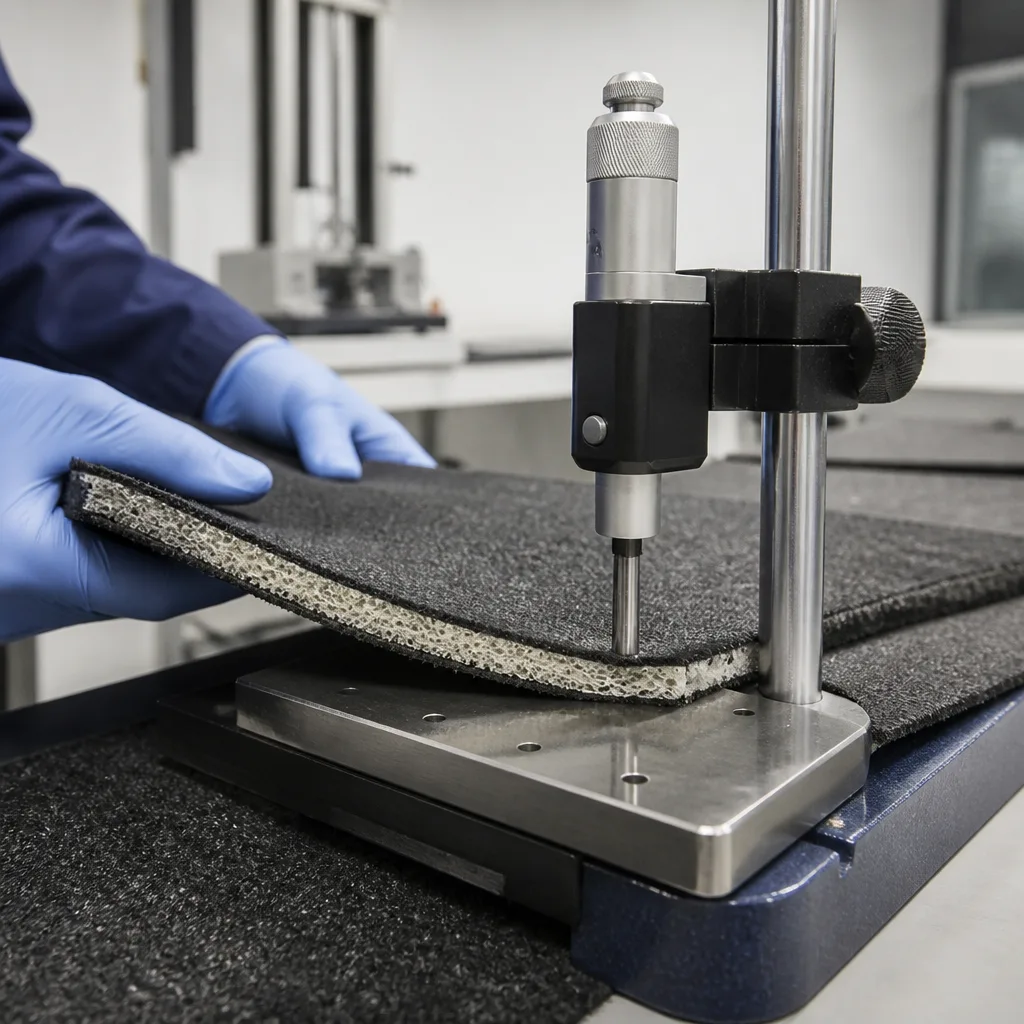
Although the GME 60303 standard served for many years, it has been replaced by new standards for new global vehicle programs. General Motors now recommends the use of appropriate international ISO standards depending on the material being tested.
This standard consists of the following sub-sections published under the same title:
- The “GME 60303-1 Coding 1: Caliper Equipment” standard is a materials testing standard that specifies a procedure for measuring the thickness of automotive interior trim materials using caliper equipment. This standard specifically addresses measurements made with precision calipers and is designed for materials whose thickness can be accurately determined without significant compression.
The purpose of the GME 60303-1 standard is to provide a standardized method for:
- Measuring the thickness of automotive interior trim materials using caliper equipment.
- Ensuring consistent measurements between laboratories and suppliers.
- Supporting material availability and production quality control.
- Verification of compliance with engineering specifications and design tolerances.
- Reducing measurement variability caused by different equipment or operator techniques.
The GME 60303-1 standard is designed for materials that are hard or stable enough to be measured directly with a caliper, including:
- Plastic sheets and films
- Decorative laminates
- Thin rubber sheets
- Leather with limited compressibility
- Composite flooring materials
- Fiberboard
- Paper-based flooring materials
- Other non-compressible or minimally compressible interior materials
Highly compressible materials, such as foams or thick textiles, are typically measured using other methods within the GME 60303 family of methods.
- The “GME 60303-2 Coding 2: Force Gauge Equipment” standard is a material testing standard. This standard specifies a standardized procedure for measuring the thickness of automotive trim materials using a force gauge (compression type thickness gauge). This method is primarily designed for soft, flexible, or compressible materials where conventional calipers may yield inaccurate results due to uncontrolled measuring force.
The objectives of the GME 60303-2 standard are as follows:
- To establish a repeatable method for measuring the thickness of compressible flooring materials.
- To ensure consistent measurements across suppliers, laboratories, and production facilities.
- To minimize measurement errors caused by variations in applied pressure.
- To verify compliance with GM engineering specifications.
- To support material availability, production control, and supplier quality assurance.
This standard applies to automotive trim materials whose thickness changes when pressure is applied. Typical materials include:
- Textile fabrics
- Nonwoven materials
- Felt
- Carpets
- Flexible cellular foams
- Rubberized fiber filling
- Soft leather and synthetic leather
- Laminated flooring materials
- Acoustic insulation materials
- Composite interior flooring products
These materials require a controlled measuring force to obtain reliable and repeatable thickness values.
- The “GME 60303-3 Coding 3: Thickness Gauge with Specific Contact Pressure” standard aims to determine the thickness of automotive upholstery materials. While GME 60303-1 covers caliper measurements and GME 60303-2 covers force gauge equipment, the GME 60303-3 standard specifies a thickness measurement method using a thickness gauge that applies a specific contact pressure for specific upholstery material categories. The chosen measurement method depends on the physical properties of the material to ensure accurate and repeatable results.
The objectives of the GME 60303-3 standard are as follows:
- To provide a standardized procedure for measuring the thickness of specific flooring materials.
- To ensure consistent results across GM laboratories and suppliers.
- To minimize errors caused by excessive or insufficient measuring pressure.
- To support material availability and production quality control.
- Verifying compliance with engineering drawings and material specifications.
The GME 60303-3 standard is designed for flooring materials that require a controlled measuring pressure due to their surface properties or compressibility, and whose thickness cannot be accurately measured with standard calipers. Typical materials include:
- Multilayer laminated materials
- Decorative composite flooring
- Coated textiles
- Soft plastic sheets
- Flexible inner linings
- Certain rubber-based flooring materials
- Special acoustic and insulation materials.
The measurement method to be applied is selected according to the material specification published by General Motors.
- The objectives of the “GME 60303-4 Coding 4” standard are as follows:
- To standardize thickness measurements for specific automotive upholstery materials.
- To ensure repeatable and reproducible test results between suppliers and GM laboratories.
- To minimize measurement errors caused by improper measurement techniques.
- Verifying compliance with engineering drawings and material specifications.
- Supporting material approval, supplier qualification, and production quality control.
The GME 60303-4 standard is designed for material categories requiring a specific thickness measurement method beyond those described in the GME 60303-1 (caliper), GME 60303-2 (force measuring equipment), and GME 60303-3 standards. Depending on the engineering specification, it may be applicable to:
- Multilayer trim laminates
- Soft composite materials
- Foam-backed textiles
- Decorative interior coverings
- Flexible insulation products
- Special automotive trim components
The applicable coding is specified in the relevant GM engineering drawing or material specification.
- The objectives of the “GME 60303-5 Coding 5” standard are as follows:
- To provide a standardized method for measuring the thickness of specified automotive upholstery materials.
- To ensure consistent and reproducible measurement results across GM laboratories and suppliers.
- To reduce measurement variation resulting from different equipment or operator techniques.
- Verifying compliance with engineering drawings and material specifications.
- To support supplier qualification, product development, and production quality control.
The GME 60303-5 standard is designed for materials that require a measurement procedure tailored to their physical properties. Depending on the applicable GM material specification, these may include:
- Laminated interior flooring materials
- Foam-backed fabrics
- Composite decorative materials
- Flexible plastic sheets
- Acoustic insulation materials
- Multilayered internal assemblies
The appropriate coding method is typically specified in the GM engineering drawing or material specification.
In short, the GME 60303 standard family includes multiple coding methods designed for different trim material categories:
- GME 60303-1
- Measurement method: Precision calipers
- Intended material type: Rigid or slightly compressible materials.
- GME 60303-2
- Measurement method: Force gauge/compression gauge
- Intended material type: Soft and highly compressible materials.
- GME 60303-3
- Measurement method: Controlled contact pressure gauge
- Intended material type: Special composite materials
- GME 60303-4
- Measurement method: Material-specific thickness method
- Intended material type: Selected trim materials
- GME 60303-5
- Measurement method: Material-specific thickness method
- Intended material type: Specified materials requiring a particular measurement procedure.
In principle, the GME 60303 standard determines material thickness by placing the sample between two parallel measuring surfaces. Depending on the material:
- Calipers can be used for hard or incompressible materials.
- Compression thickness gauges with a specified contact pressure are used for soft or compressible materials.
The measured distance between two contact surfaces represents the thickness of the sample. For compressible materials, controlling the measuring force is crucial, as excessive pressure can reduce the apparent thickness.
The general testing process follows these steps:
- Samples are prepared under the specified laboratory conditions.
- Representative samples are prepared, free from visible defects.
- The sample is placed between the measuring surfaces.
- The specified measurement pressure is applied.
- If necessary, we will wait for stabilization.
- The thickness reading is recorded.
- Measurements are taken from multiple points on the sample.
- The average thickness is calculated.
Multiple measurements improve repeatability and account for local thickness variations.
The GME 60303 standard is widely used in automotive engineering for evaluating materials used in the following areas:
- Seat upholstery
- Door trim panels
- Instrument panel trims
- Ceiling tiles
- Floor carpets
- Luggage compartment lining
- Insulation materials
- Acoustic pads
- Foam laminates
- Interior decorative fabrics
The measured thickness affects manufacturing processes such as cutting, sewing, thermoforming, lamination, and assembly.
Accurate thickness measurement is crucial because it affects:
- Component compatibility and dimensional accuracy
- Passenger comfort
- Interior view
- Noise and vibration insulation
- Thermal insulation
- Material durability
- Compression behavior
- Adhesive bonding performance
- Manufacturing tolerances
- Assembly consistency
Even small variations in thickness can lead to assembly problems or inconsistent product quality.
Although developed for General Motors Europe, the GME 60603 standard methodology is applicable to many sectors, including:
- Automotive production
- Automotive supplier quality laboratories
- Textile production
- Leather production
- Flexible foam production
- Plastic film production
- Composite materials
- Interior trim upgrade
- Research laboratories
For the new GM global material approvals, the GME 60303 standard has been replaced by a family of ISO standards selected according to the material being tested. These include:
- ISO 534 Thickness specification for paper and cardboard.
- ISO 1923 Cellular plastics
- ISO 2286-3 Rubber or plastic coated fabrics
- ISO 2589 Leather thickness measurement
- ISO 5084 Thickness of textiles and textile products.
- ISO 9073-2 Thickness of nonwoven materials
- ISO 17186 Thickness determination of geosynthetics.
In conclusion, the GME 60303 standard has become a vital quality control tool by establishing a standardized and reliable method for measuring the thickness of automotive trim materials. By defining consistent procedures and measurement conditions, this standard has helped ensure that interior materials meet stringent engineering requirements for fit, comfort, durability, and manufacturing performance. The GME 60303 standard remains an important historical reference today and is frequently applied in legacy vehicle programs and supplier documentation.
For many years, our organization, with its competent and experienced staff, has been understanding the needs of its clients, providing the advanced testing services they require, and assisting them in the establishment, implementation, and improvement of management systems. Within this framework, we also provide testing services compliant with the GME 60303 standard.



