Ford FLTM BO 040-01 Short-Term Environmental Cycle and Long-Term Heat Exposure
The “Ford FLTM BO 040-01 Short-Term Environmental Cycle and Long-Term Heat Exposure” standard, developed by Ford Motor Company (Ford), describes a test method used to evaluate the durability and dimensional stability of automotive components when exposed to harsh environmental conditions. This standard simulates the combined effects of extreme temperature, humidity, cold exposure, and long-term heat aging to which vehicle interior and upholstery components are subjected throughout their service life.
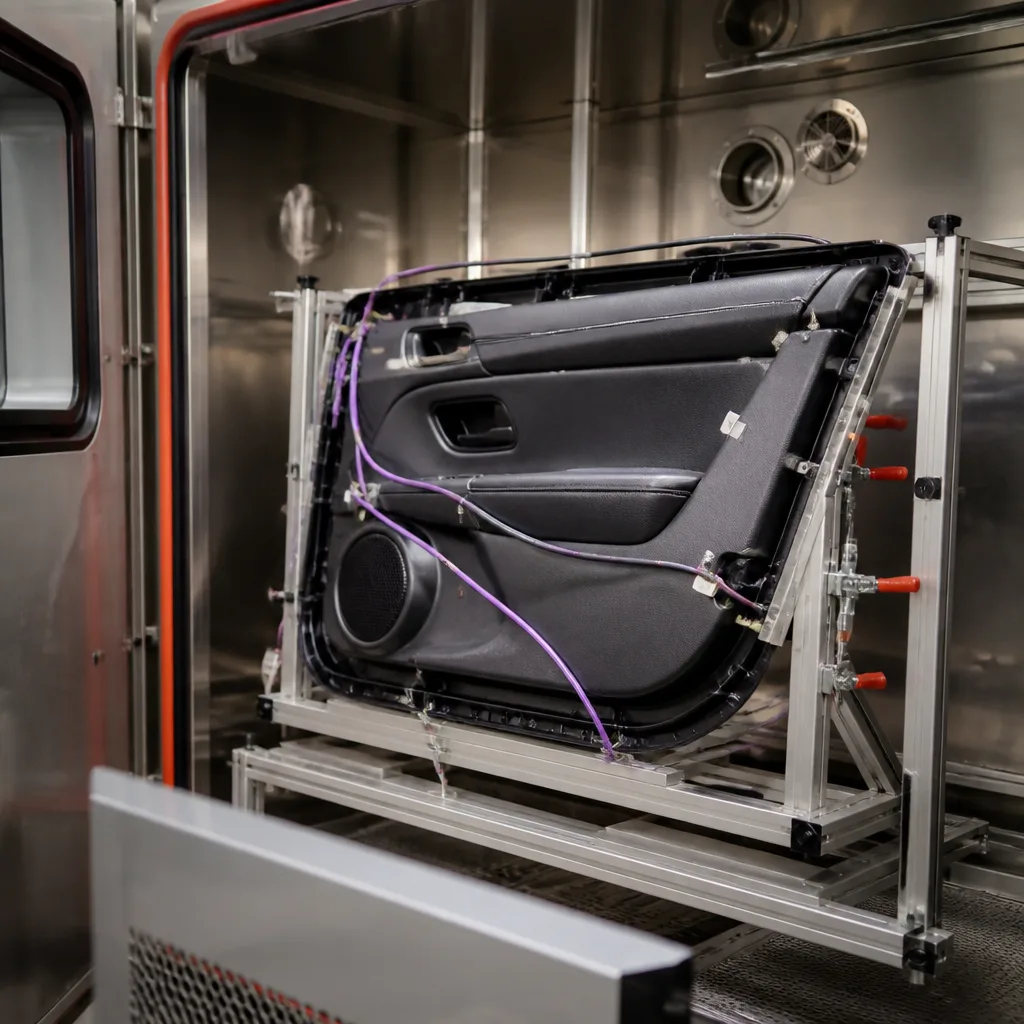
The primary purpose of the Ford FLTM BO 040-01 standard is to determine whether a component can maintain the following after short-term environmental cycling or prolonged heat exposure:
- Dimensional stability
- Functional performance
- Visual appearance
- Touch (tactile) properties
This method is commonly applied to interior trim, instrument panels, door panels, headliners, consoles, and other polymer-based vehicle components.
This standard evaluates complete components rather than isolated parts. Test specimens are mounted on actual or representative production fixtures, including all relevant hardware, wiring, speakers, clips, and mounting systems, to accurately reproduce vehicle conditions.
The Ford FLTM BO 040-01 standard includes two basic procedures:
- Procedure A - Short-term environmental cycling: This procedure exposes the components to repeated cycles:
- Low temperature exposure
- Environmental conditioning
- High temperature exposure
- High humidity exposure
This test is designed to simulate rapid environmental changes that occur during vehicle operation in different climates. Pre- and post-test measurements are taken to evaluate deformation, movement, and appearance changes.
- Procedure B - Long-term heat exposure: This procedure simulates years of solar load and heat aging in a vehicle cabin by exposing components to high temperatures for extended periods. The aim is to determine the component's resistance to the following under long-term thermal stress:
- Impact
- Corruption
- Shrinkage
- Layer separation
- Surface degradation
- Functional impairment
After being exposed to environmental influences, the components are evaluated in three main areas:
- Visual assessment: Auditors examine the component from the following perspectives:
- Color changes
- yellowing
- Wrinkle
- Surface adhesion
- blistering
- Layer separation
- Staining
- Tissue loss
- Blurring or hazing
Any unwanted changes in appearance may result in malfunction.
- Functional assessment: The component must continue to perform its intended function without the following conditions arising from environmental impacts:
- Attempt
- Alignment error
- Corruption
- Work problems
- Dimensional evaluation: Critical dimensions and motion points are measured before and after testing. Component displacement must remain within the limits of engineering drawing requirements and material specifications.
The Ford FLTM BO 040-01 standard is frequently used in the following areas:
- instrument panels
- Door trim panels
- Center consoles
- Ceiling tiles
- Pole coverings
- Interior decoration patterns
- Storage compartments
- Plastic and composite interior components
These components are highly susceptible to thermal expansion, moisture effects, and long-term heat aging.
Implementing this standard helps manufacturers in the following areas:
- To verify the long-term durability of the internal components.
- To reduce warranty claims related to impact and deformation.
- Improving fit and finish quality.
- Ensuring customer satisfaction in different climates.
- To validate material and assembly designs prior to production launch.
- Identifying environmental vulnerabilities during product development.
The Ford FLTM BO 040-01 standard is necessary because automotive interior and trim components are continuously exposed to harsh environmental conditions throughout a vehicle's lifespan. Extreme temperatures, humidity fluctuations, and prolonged solar heat can cause materials to deform, discolor, crack, or lose functionality. This standard helps ensure components remain durable, safe, and visually acceptable in real-world conditions. This standard is important for the following reasons:
- It simulates real vehicle environments: Vehicles are exposed to a wide variety of environmental conditions, including:
- Freezing winter temperatures
- Hot summer temperatures
- High humidity
- Rapid temperature changes between day and night.
- Prolonged accumulation of solar heat inside the cabin.
This standard allows engineers to predict long-term performance before production by recreating these conditions in a controlled laboratory environment.
- Prevents warping and deformation: Many internal components are made from plastics, composites, foams, fabrics, and adhesive-bonded assemblies that expand and contract with temperature changes. Without proper testing, components can experience warping, shrinkage, bending, warping, and loss of dimensional accuracy. This standard verifies that parts maintain their intended shape and conformity after exposure to environmental influences.
- Evaluates long-term heat aging resistance: In sunny climates, the interior temperatures of parked vehicles can exceed 80 degrees Celsius. Prolonged heat exposure can lead to material degradation, surface hardening, softening of plastics, adhesive failure, delamination, and loss of mechanical properties. Procedure B specifically evaluates resistance to long-term thermal aging.
- Maintains visual quality: Vehicle interiors should remain visually appealing for many years. Testing identifies potential issues such as color fading, yellowing, gloss changes, bubbling, wrinkling, surface adhesion, and decorative film detachment.
- Verifies functional performance: Internal components often contain moving or integrated components such as storage compartments, airbag covers, control panels, switch frames, and speaker grilles. Environmental exposure can negatively affect operation and alignment. This standard verifies that components continue to function correctly after testing.
In conclusion, the Ford FLTM BO 040-01 standard is a crucial environmental durability testing standard that evaluates how automotive components respond to extreme temperature cycling, moisture exposure, and prolonged heat aging. By assessing visual appearance, dimensional stability, and functional performance, the standard ensures that in-vehicle components maintain their quality and reliability throughout the vehicle's lifespan.
For many years, our organization, with its competent and experienced staff, has been understanding the needs of its customers, providing the advanced testing services they require, and assisting them in the establishment, implementation, and improvement of management systems. Within this framework, we also provide testing services to businesses in accordance with the Ford FLTM BO 040-01 standard.



