

The “GMW 4089 Determination of Lamination Curl Properties of Foam Laminated Materials” standard, developed by General Motors Worldwide (GMW), is a test procedure used to determine the curling tendency of foam laminated materials, particularly those used in automotive upholstery and interior applications. This procedure evaluates whether tension differences between layers of a laminate cause the material to curl after the layers are partially separated and allowed to relax.
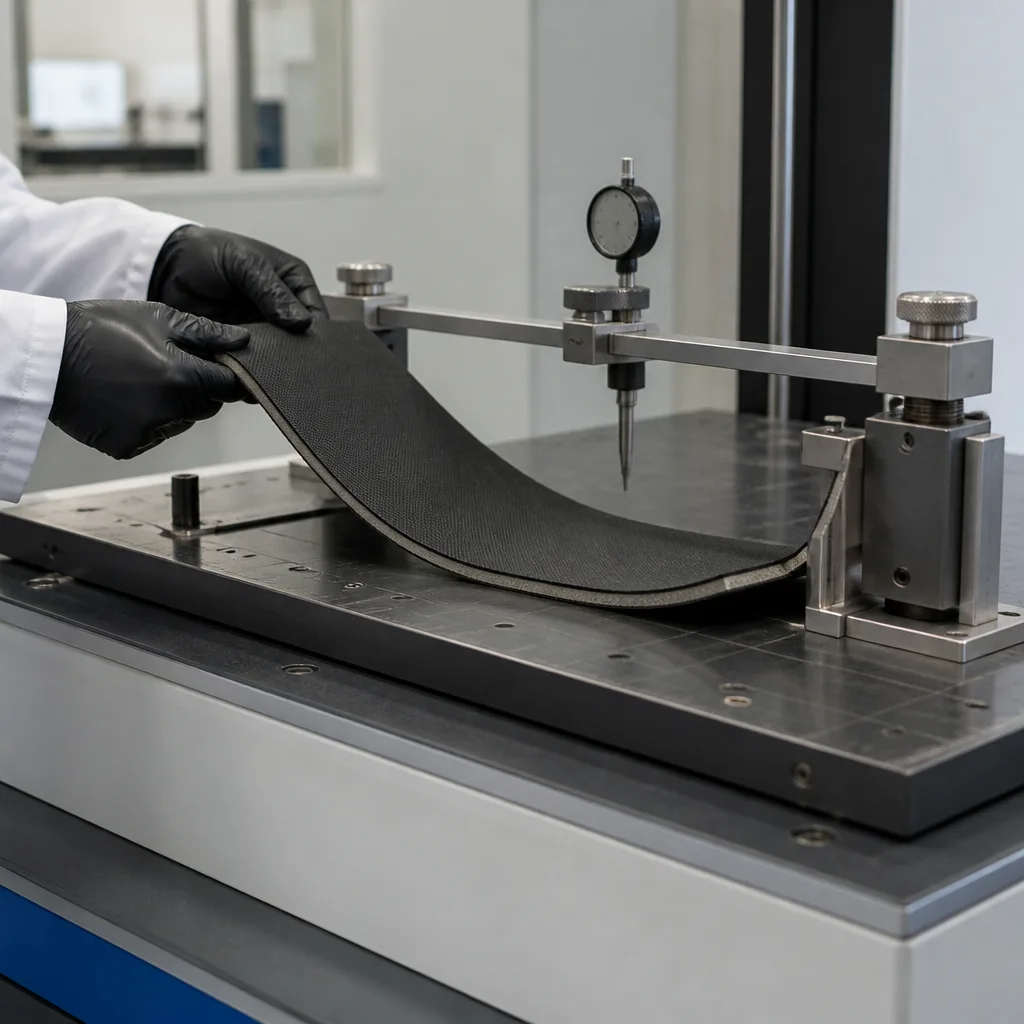
This standard is particularly important for automotive textiles and upholstery materials where a fabric, tulle, or similar layer is laminated onto a foam backing. Excessive curling can make the material difficult to process, cut, sew, glue, or assemble, and can negatively affect the appearance and dimensional stability of the finished component.
The primary purpose of the GMW 4089 standard is to determine the tendency of a laminated material to curl as a result of tension or length differences between its individual layers. A foam laminated material, for example, may consist of the following layers:
During lamination, these layers can develop different stresses or have slightly different effective lengths. When the layers separate, they can shrink or expand differently. This creates a curling force. The GMW 4089 standard offers a quantitative way to measure this effect, rather than relying solely on visual assessment.
This procedure applies to foam laminated upholstery materials. Therefore, it is particularly important for automotive interior materials such as:
Testing laboratories specifically list the GMW 4089 standard as a foam laminate curl test and indicate its use in automotive textile and laminate evaluation.
The basic principle of the described method is quite simple. A test strip is cut from the lamination material in either the warp or machine direction. Then, a specific section of the laminate is separated so that the individual layers can unwind independently. Since the layers may have different residual stresses or dimensions, they do not normally return to exactly the same length. The resulting length difference is measured. The measured length difference is then expressed as a percentage of the original reference length. This provides an objective indication of the laminate's tendency to curl.
Three samples are prepared for testing. The nominal sample dimensions are as follows:
Each sample is marked at a 250 mm reference position.
Testing multiple samples is important because textile and foam laminated materials can show some variation from sample to sample.
Unless otherwise specified in the applicable material specification, conditioning is performed according to GMW 3221 standard, Code A. This conditioning step helps ensure that test results are not strongly affected by uncontrolled environmental variations such as temperature and humidity. After the layers are separated, they are allowed to relax under the specified standard conditions before final measurements are taken.
This testing process generally follows these steps:
A higher percentage length difference indicates a greater dimensional mismatch between laminate layers after loosening. From a practical production perspective, a high value may indicate the following potential problems:
Conversely, a small length difference generally indicates that the layers remain more dimensionally compatible after the stresses are released.
The GMW 4089 standard is important because laminated automotive materials must maintain their dimensional behavior throughout manufacturing and service. A laminate may appear flat and stable immediately after manufacturing. However, stress differences between the fabric and foam layers can become apparent when the material is cut, processed, heated, conditioned, or otherwise relieved of manufacturing stresses. Therefore, curl testing helps identify potential problems before the material is incorporated into a vehicle component. It can also be useful for comparing:
Appearance and fit are important quality characteristics for automotive interior components. An excessively curling material can create visible defects even if its basic mechanical properties are acceptable. For example, a laminated textile used in a door panel may have adequate tensile strength and abrasion resistance, but may still be unsuitable if its layers exhibit excessively differential shrinkage or curling. Therefore, the GMW 4089 standard complements other automotive textile tests, focusing specifically on laminate dimensional conformity and curling behavior.
The percentage difference in average length calculated for the relevant fabric layers, including any front fabric and tulle fabric, should be reported. A typical laboratory report includes the following:
In summary, the GMW 4089 standard is a specific test procedure developed to evaluate the curling tendency of foam laminated materials. It does this by separating the laminated layers, allowing them to relax, measuring the difference in the resulting layer lengths, and expressing this difference as a percentage.
Its primary value lies in controlling the dimensional stability, processing behavior, and appearance quality of laminated automotive upholstery materials. The test is particularly useful for identifying incompatibilities between fabric, tulle, and foam layers before these materials are used in manufacturing components.
For many years, our organization, with its competent and experienced staff, has been understanding the needs of its clients, providing the advanced testing services they require, and assisting them in the establishment, implementation, and improvement of management systems. Within this framework, we also provide testing services in accordance with the GMW 4089 standard.
To get an appointment, to get more detailed information or to request an evaluation, you can ask us to fill in our form and reach you.

