Nissan NES M0131 High Temperature Test Methods for Passenger Compartment Synthetic Resin Parts
The standard "Nissan NES M0131 High-Temperature Test Methods for Passenger Compartment Synthetic Resin Parts," developed by Nissan Automobiles, describes high-temperature test methods for synthetic resin parts used in automobile passenger compartments. These tests check for abnormalities in configuration, size, appearance, color tone, and surface properties caused by continuous exposure to intense sunlight.
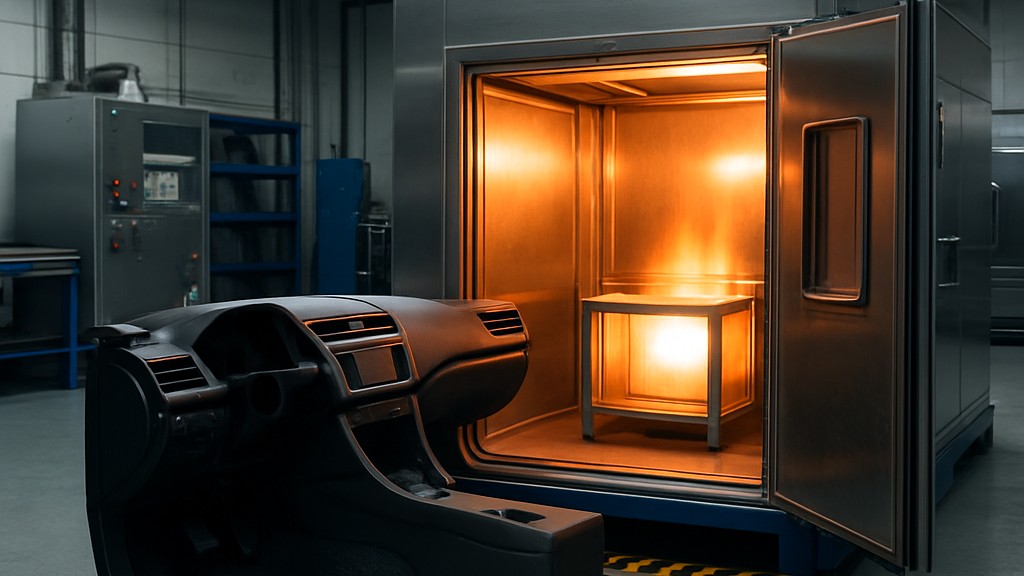
There are three test method classifications, determined by the part's location on the vehicle. The classifications are listed in the table provided in the standard:
- Method 1 Class A Vehicle interior components mounted horizontally above the bottom line of the door and exposed to direct sunlight. Test temperature: 124 degrees Celsius plus/minus 3 degrees Celsius for the front hood type, 105 degrees Celsius plus/minus 3 degrees Celsius for the cab-top type. Applicable examples: instrument panel, rear luggage shelf, rear seat backrest, and surface "A" of the instrument panel cover.
- Method 1 Class B Vehicle interior components mounted horizontally above the bottom line of the door and exposed to direct sunlight. Test temperature: 124 degrees Celsius plus/minus 3 degrees Celsius for the front hood type, 100 degrees Celsius plus/minus 3 degrees Celsius for the cab-top type. Applicable examples: instrument panel, rear luggage shelf, rear seat backrest, and surface "A" of the instrument panel cover.
- Method 2 Class A Vehicle interior components installed in areas exposed to direct sunlight. Test temperature: 105°C plus/minus 3°C for the front hood type, 95°C plus/minus 2°C for the cab-top type. Applicable examples: column trim, horn, door trim, door armrest, and center console.
- Method 2 Class B Vehicle interior components installed in areas exposed to direct sunlight. Test temperature: 100°C plus/minus 3°C for the front hood type, 90°C plus/minus 2°C for the cab-top type. Applicable examples: column trim, horn, door trim, door armrest, and center console.
- Method 3 Class A Vehicle interior components exposed to indirect or direct sunlight. Test temperature: 95°C plus/minus 2°C for the front hood type, 85°C plus/minus 2°C for the cab-top type. Applicable examples: upper surface of body side cladding and upper surface of trunk side cladding, roof lining, sun visor, upper pillar cladding, seat, rear trunk lining, door lining, and headliner.
- Method 3 Class B Vehicle interior components exposed to indirect or direct sunlight. Test temperature: 80°C plus/minus 2°C for the front hood type, 70°C plus/minus 2°C for the cab-top type. Applicable examples: upper surface of body side cladding and upper surface of trunk side cladding, roof lining, sun visor, upper pillar cladding, seat, rear trunk lining, door lining, and headliner.
The test area conditions were determined as follows:
- Test room temperatures: The test area should be provided in accordance with the “JIS Z 8703 Standard atmospheric conditions for testing” standard, respectively, Class 5 (temperature 20 degrees plus/minus 5 degrees) and Class 20 (relative humidity 65 percent plus/minus 20 percent).
- Standard conditions: The standard temperature and humidity conditions of the test location should be provided in accordance with the standards of Class 2 (temperature 20 degrees plus/minus 2 degrees) and Class 2 (relative humidity 65 percent plus/minus 2 percent) respectively in accordance with the “JIS Z 8703 Standard atmospheric conditions for testing” standard.
The main equipment used in these tests are:
- Constant temperature chamber equipped with infrared heat lamps
- Constant temperature chamber with temperature control feature
The temperature should be maintained within 3°C of the required test temperature setting for the reference height of the test piece. The temperature difference between pieces 100 mm above and below the reference height should be maintained within 5°C.
The distance between heat lamps should be reduced to an absolute minimum. This allows infrared radiation to reach the test piece. The chamber should regulate the amount of radiation and temperature through voltage and heat lamp height controls.
Whenever possible, finished parts should be used as test pieces. Test procedures are performed after 24 hours of aging under the standard conditions specified in this standard (unless otherwise specified). Test details and the number of test pieces may be determined by the personnel involved in the testing. Finished parts include molded products completed as assemblies or subassemblies, as well as composite parts.
The test duration is 4 hours. The test temperature should be as shown in the table.
The test conditions method consists of the following steps:
- Test parts are placed on fixtures in their installed positions on the vehicle. The fixtures are placed in the chamber. Temperature controls are adjusted to maintain the specified temperature for the specified test duration. The mounted vehicle positions represent the parts' positions on the fixtures as close to their actual vehicle mounting positions. If the part requires a weight to simulate load conditions, the weight, size, and position should be determined by the personnel involved in the test.
- The test pieces are heated for the specified time. The abnormal conditions listed here are examined. If it is not possible to examine the parts inside the chamber, the test pieces are removed from the chamber. The test piece is examined within 3 minutes.
- The test pieces are allowed to cool at room temperature for 30 minutes.
- At the end of the 30-minute cooling period, the test pieces are examined for abnormalities. If the piece requires a weight to simulate the load conditions, the weight, size, and position should be determined by the personnel involved in the test.
During evaluation, test pieces are examined for abnormalities listed in the table:
- Configuration and size
- Dimensional changes
- Deformation
- gaps
- Wavy contours
- View
- wrinkles
- Cracks or damage
- Peeling
- Swelling
- Blistering or floating
- Surface properties
- Blooming
- Stickiness
- Pollution
- Softening or hardening
- Color tone
- MISCELLANEOUS
- Seizing
- Smooth movement
- Loose mounting or free movement
- Damage or concern that may occur from normal use
In hot climates, especially on sunny days, cabinet temperatures can exceed 60 degrees Celsius. Thermal testing to the NES M0131 standard protects components against long-term heat-related failure. For example,
- Warping or distortion
- Changes in brightness or color
- Loss of mechanical fit or structural strength
This directly affects vehicle quality, safety and customer satisfaction.
Nissan NES M0131 is a sophisticated and vital standard that operates behind the scenes of automotive design. It ensures that plastic interior parts maintain their form and function even in extreme cabin temperatures. These standards maintain the high quality and reliability expected of vehicles. When selecting materials to meet this standard, particularly for interior plastic components, various criteria and material types come into play.
Our organization, which has been supporting businesses across all sectors for years through a wide range of testing, measurement, analysis, and evaluation activities, has a strong team of employees who closely follow global developments in science and technology and are constantly improving themselves. In this context, we also provide testing services in accordance with the "Nissan NES M0131 High-temperature test methods for passenger compartment synthetic resin parts" standard.



