

The “Ford WSS-M99P41-A Performance Requirements for Vehicle Labels” standard, developed by Ford Motor Company (Ford), defines the performance requirements for all Ford Motor Company vehicle labels. The base materials and adhesive types comprising a particular label are selected by the supplier according to the intended application. This information is documented in the appendix to this standard (Appendix A).
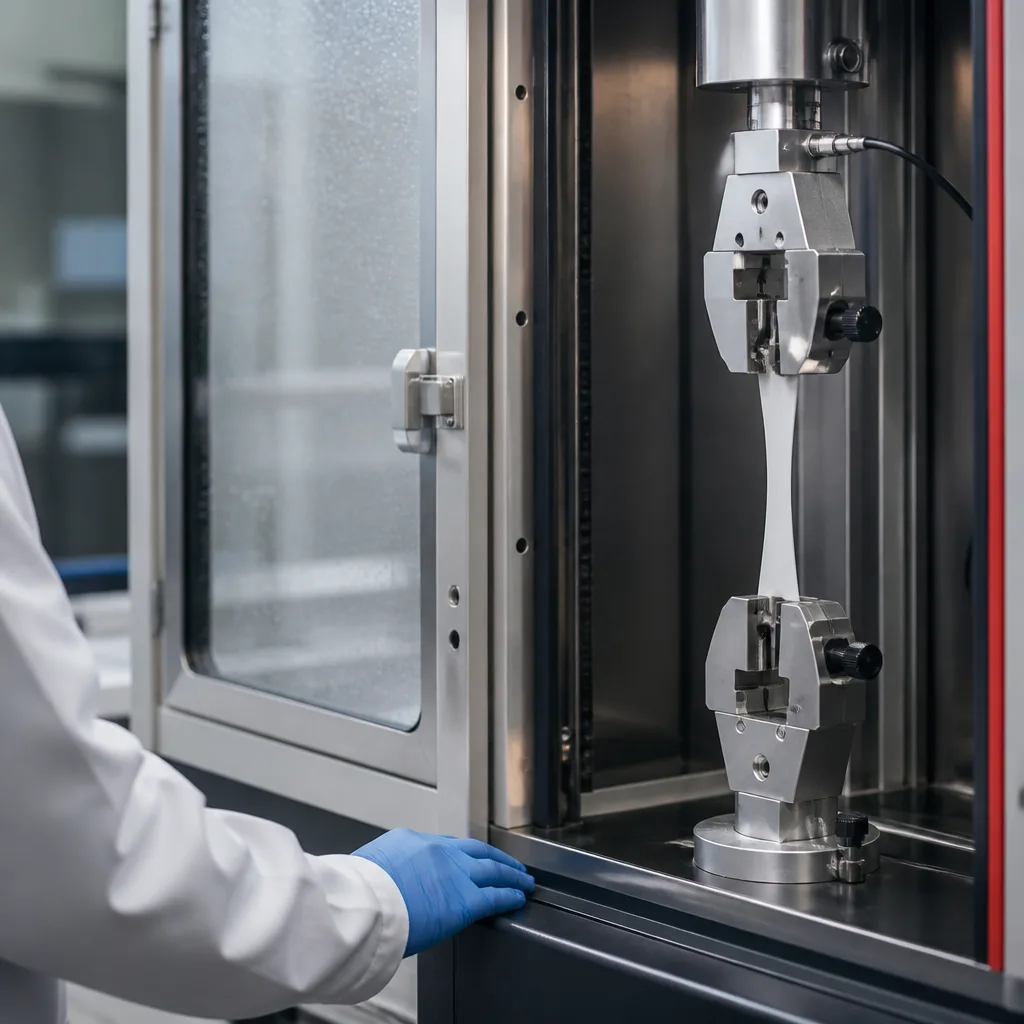
The Ford WSS-M99P41-A standard is an engineering materials specification that defines performance requirements for labels used on Ford vehicles. Unlike material specifications that define the composition of plastics, textiles, or metals, this standard focuses on ensuring that labels remain durable, legible, and securely attached for the entire lifespan of a vehicle.
The Ford WSS-M99P41-A standard family covers a wide range of automotive labeling, including interior labels, under-hood labels, tamper-evident labels, production tracking labels, security labels, and high abrasion-resistant labels. Each application has its own suffix specifying additional performance requirements for a particular environment (e.g., A33, A34, A41, A63, and A72). The specification is designed for use in conjunction with the Ford WSS-M99P1111-A standard, which provides general requirements for Ford labeling systems.
The primary purpose of the Ford WSS-M99P41-A standard is to ensure that vehicle labels meet the following requirements:
Reliable labeling is crucial because modern vehicles incorporate hundreds of identification labels for safety, maintenance, manufacturing, emissions, electrical systems, and quality control.
The Ford WSS-M99P41-A specification family includes requirements for numerous label categories, including:
Each version is optimized for its intended operating environment. For example, labels under the hood must withstand much higher temperatures and chemical exposures than labels inside the vehicle.
The Ford WSS-M99P41-As standard generally evaluates several critical performance characteristics:
Tests typically include the following:
These tests confirm that the labels neither detach nor lose readability after prolonged environmental aging.
Printed information must remain legible, and the adhesive must provide adequate adhesion.
High abrasion-resistant label types require more rigorous abrasion resistance than standard internal labels.
Critical information such as vehicle chassis numbers, safety warnings, and service instructions must remain legible for many years.
Suppliers should generally demonstrate consistent production quality through the following means:
These controls help ensure consistent labeling performance in high-volume vehicle production.
Compliant labels according to the Ford WSS-M99P41-A standard can be found on many vehicle components, including:
Although developed for Ford Motor Company, suppliers throughout the automotive supply chain widely use the Ford WSS-M99P41-A specification. These include:
Implementing the Ford WSS-M99P41-A standard offers several advantages:
The WSS-M99P41-A standard series is designed for use with the “Ford WSS-M99P1111-A Standard Requirements for Manufacturing Materials” standard, which is the general Ford specification for vehicle labeling systems. While the WSS-M99P1111-A standard defines general labeling requirements and documentation, the WSS-M99P41-A standard variants specify performance requirements for particular label types and applications.
In conclusion, the Ford WSS-M99P41-A standard is a crucial engineering specification that ensures automotive labels remain securely attached, readable, and functional throughout a vehicle's service life. By defining stringent requirements for adhesion, environmental durability, chemical resistance, abrasion resistance, print quality, and in some cases, tamper proof, the standard supports safety, regulatory compliance, production traceability, and efficient vehicle servicing. Various application-specific variants allow suppliers to select label systems adapted to challenging environments such as vehicle interiors, engine compartments, and production tracking systems.
For many years, our organization, with its competent and experienced staff, has been understanding the needs of its customers, providing the advanced testing services they require, and assisting them in the establishment, implementation, and improvement of management systems. Within this framework, we also provide testing services compliant with the Ford WSS-M99P41-A standard.
To get an appointment, to get more detailed information or to request an evaluation, you can ask us to fill in our form and reach you.

