

The International Organization for Standardization (ISO) standard "ISO 5011 Intake air cleaning equipment for internal combustion engines and compressors - Performance testing" describes uniform test procedures, conditions, equipment, and a performance report that allows direct laboratory performance comparisons of air cleaners. The key performance characteristics of most interest are airflow restriction or differential pressure, dust collection efficiency, dust capacity, and oil carryover in oil-bath air cleaners. Therefore, this test method is concerned with the measurement of these parameters.
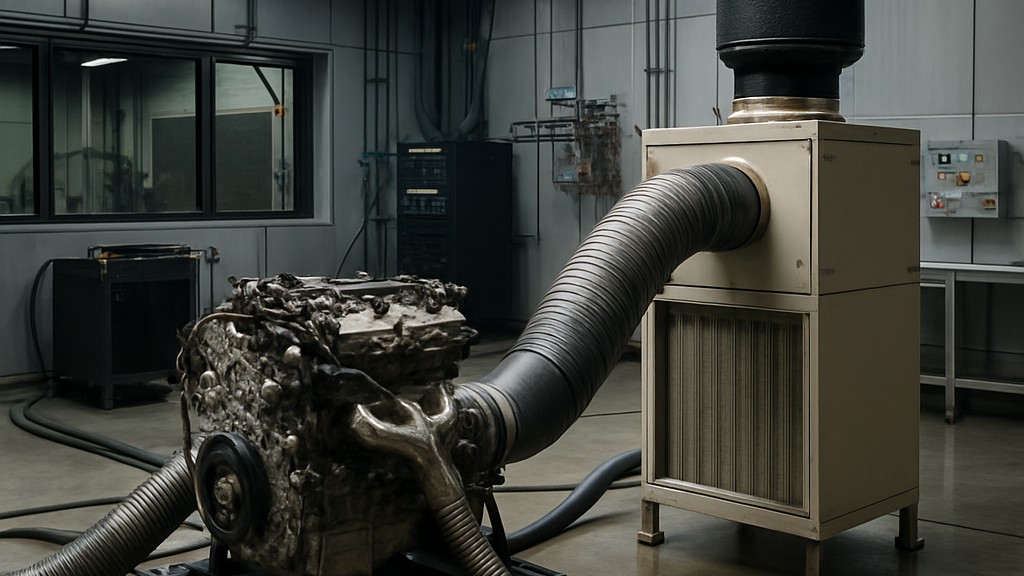
This standard applies to air cleaners used in internal combustion engines and compressors, typically used in automotive and industrial applications.
For measurement accuracy and precision, the airflow rate is measured to within plus or minus 2 percent of the actual value, except for the variable airflow test, which can provide an accuracy of plus or minus 2 percent of the maximum cyclic flow rate through the cleaner. The differential pressure and limiting pressure are measured to within 25 Pa for pressure readings up to 10 kPa and to within 1 percent of the reading for higher pressures. The temperature is measured to within 0,5 degrees of the actual value. Mass is measured to within 0,1 g, except for absolute filter mass, which is measured to within 0,01 g, and feeder mass, which is measured to within 1 percent. Relative humidity is measured to within plus or minus 2 percent. Barometric pressure is measured to within 0,3 kPa. Measuring equipment should be calibrated at regular intervals to maintain the required accuracy. Annex H should be followed to determine the reporting accuracy of the efficiency measurement.
All airflow measurements should be corrected to a standard condition of 20 degrees at 101,3 kPa.
In the high-risk world of internal combustion engines and compressors, clean air isn't a luxury; it's a necessity. Dust, dirt, and particulates can clog engines, reduce efficiency, and cause premature wear, costing industries significant repair and maintenance costs. That's where the ISO 5011 standard comes in. It provides a rigorous and repeatable framework for evaluating how well air filters and purifiers perform under real-world conditions.
This standard is an indispensable resource for automotive manufacturers, heavy machinery builders, and compressor designers worldwide. By harmonizing this standard with national practices, consistent quality is assured from assembly lines to oil fields. In today's world of stringent emissions regulations and fuel efficiency demands, the ISO 5011 standard helps engineers measure filter effectiveness, balancing airflow against particle capture to optimize engine life.
The ISO 5011 standard targets intake air cleaning devices (specifically filters) for engines and compressors in automotive, industrial, and off-road vehicles. It covers everything from passenger car air filters to large units in construction equipment or gas turbines, but excludes specialized systems such as turbochargers or electrostatic precipitators.
Establishing uniform testing procedures that allow for direct, head-to-head comparisons of filter performance in a laboratory environment. This involves measuring key metrics such as dust holding capacity (how many contaminants a filter can trap before clogging) and filtration efficiency (the percentage of particles it captures). By standardizing requirements, the standard eliminates guesswork and allows manufacturers to certify products, regulators to apply baseline values, and buyers to make informed choices. Crucially, it applies to both new and service replacement filters and addresses the aftermarket, where counterfeit products can significantly underperform.
The ISO 5011 test method is a blend of precision engineering and simulated harsh environments, using standardized dust to mimic road and construction site dirt (ISO 12103-1 Road vehicles - Test contaminants for filter evaluation - Part 1: Arizona test dust). Tests are performed on a flow bench, measuring pressure drop (restriction) and particle penetration at controlled airflow rates.
The testing process works as follows:
The ISO 5011 standard is essential for maintaining performance and compliance. In the automotive sector, it supports fuel economy claims, translates to cleaner air, improved combustion, and reduced carbon dioxide emissions. In industrial compressors in mining or power generation, it prevents wear that can halve equipment life. Regulatory bodies like the EPA indirectly reference the standard for emissions testing, while original equipment manufacturers reference it for warranties.
From an economic perspective, it's a game-changer: Superior filters, according to the ISO 5011 standard, extend service intervals by 50 percent, reducing maintenance costs. In the aftermarket, independent testing reveals weak spots, empowering consumers. As electrification increases, the standard's principles are also applicable to hybrid systems, where air quality also impacts battery cooling. The latest update of this standard addresses global dust variability by including finer particles from urban pollution, making it future-proof.
As a result, the ISO 5011 standard stands out as a benchmark for reliability in an industry where every breath counts. By unlocking the mysteries of air purifier performance, it fosters innovation, ensures safety, and improves efficiency from factory floors to the open road. In a dust-filled world, this standard keeps engines breathing easy and running strong.
Our organization, which has been operating for many years and meticulously follows global developments in science and technology, employs a skilled team and extensive infrastructure to conduct testing, measurement, and analysis in a wide range of areas for businesses across all sectors. In this context, we also provide testing services in accordance with the ISO 5011 "Intake Air Cleaning Equipment for Internal Combustion Engines and Compressors - Performance Testing" standard.
To get an appointment, to get more detailed information or to request an evaluation, you can ask us to fill in our form and reach you.

