Fiat - Resistance Test Against Thermal Cycles
Developed by Fiat Chrysler Automobiles (FCA) (now Stellantis), an Italian-American automotive company, the heat cycle resistance test is an environmental durability test used in the automotive industry to evaluate how materials, components, and interior and exterior parts withstand repeated high and low temperature changes over time. This test is frequently used as a reference in Fiat material and component specifications to verify long-term thermal durability.
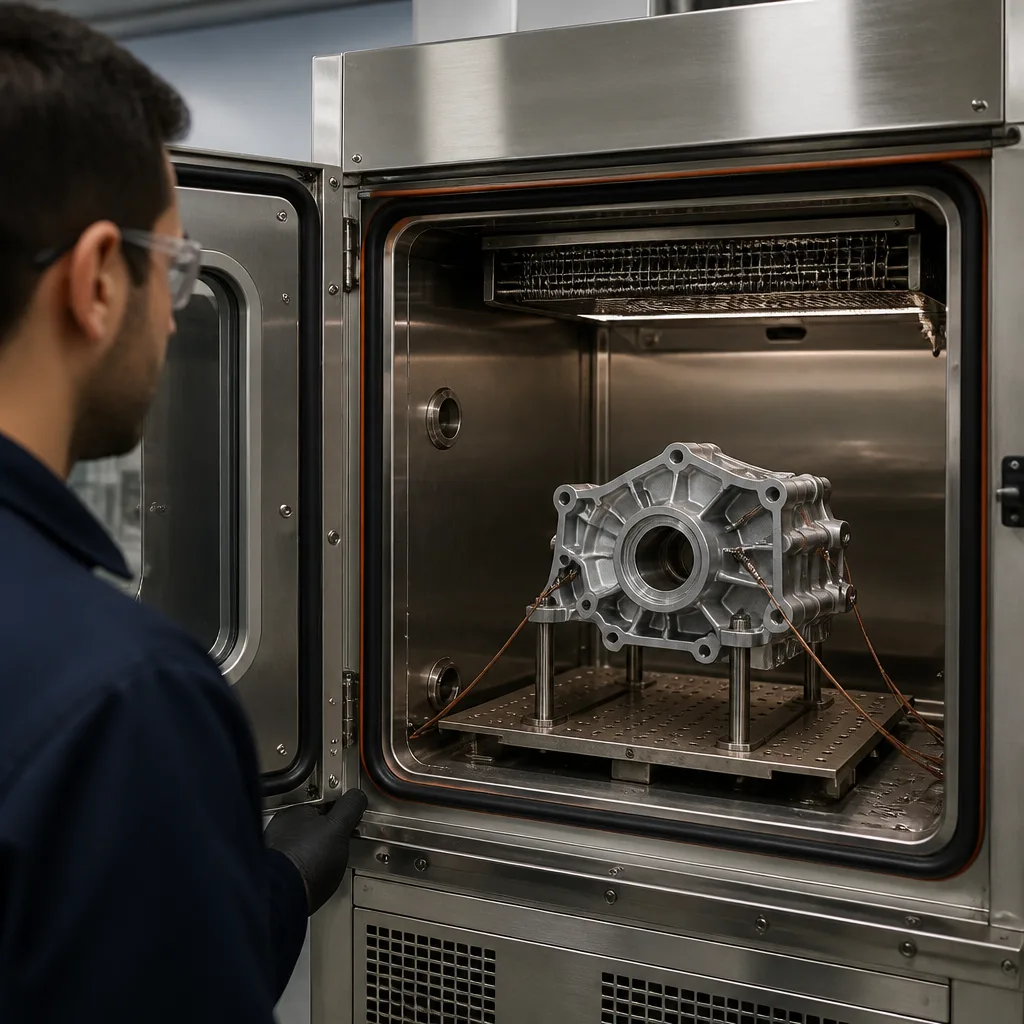
Automotive parts are subjected to continuous thermal expansion and contraction throughout the life of the vehicle. A component may be subjected to:
- Cold beginnings of winter
- Summer sun warming
- Heating, ventilation and air conditioning (HVAC) thermal shocks
- Engine compartment temperature
- Repeated parking and solar load cycles
Thermal cycling resistance testing confirms that repeated thermal cycling does not cause the following:
- Cracking
- Bending
- Layer separation
- Loss of adhesion
- Dimensional instability
- Surface whitening
- Gasket failure
- Electrical fault
- Reduced mechanical strength
Testing resistance to thermal cycling is particularly important for:
instrument panels
- interior trim
- Glued components
- Plastic housings
- Electronic modules
- Painted parts
- Composite materials
- Airbag deployment areas
- Outdoor lighting systems
In principle, during testing, the sample is exposed to extreme temperatures that change repeatedly according to a defined cycle. A typical thermal cycle includes:
- Exposure to low temperatures
- Transition period
- Exposure to high temperature
- Optional humidity control stage
- Return to ambient conditions
Repeated expansion and contraction create thermomechanical stresses within the material and at the interfaces. While precise conditions vary depending on component specifications, common Fiat automotive thermal cycling programs include:
- Low temperature: Minus 30 degrees to minus 40 degrees
- High temperature: +80 degrees to +120 degrees
- Number of cycles: 10-1000
- Waiting time: Between 30 minutes and 8 hours.
- Transition rate: Controlled or natural.
- Humidity: Optional
- Test duration: From a few days to a few weeks
A simplified example is as follows:
- Step one: Hold at -40 degrees for 2 hours.
- Second step: Raising to +90 degrees
- Third step: Hold at +90 degrees for 2 hours.
- Fourth step: Return to ambient temperature.
- Step five: Repeat for 50 cycles.
The components typically evaluated include:
- Internal components:
- Instrument panel components
- Door panels
- Center consoles
- Armrests
- Ventilation holes
- Decorative coating
- External components:
- Mirror housings
- Lamp assemblies
- Tampons
- Grids
- Sensor covers
- Under-hood components:
- Connectors
- Cable insulation
- Liquid storage tanks
- Electronic control units
The main failure modes examined are as follows:
- Cracking: Repeated thermal stress can cause fractures in rigid plastics.
- Layer separation: Multilayered materials can separate due to their different thermal expansion coefficients.
- Adhesive failure: Glued connections can weaken after cyclical use.
- Warping: Dimensional deformation can affect assembly tolerances.
- Surface defects: Possible observations include:
- blistering
- Brightness change
- Whitening
- Signs of collapse
- Electronic failures: Solder connections and printed circuit board (PCB) assemblies can fail due to cyclic expansion.
Modern vehicles incorporate many polymeric and multi-material systems with varying thermal expansion behaviors. For example, material-based thermal expansion behaviors are as follows:
- Steel: Low expansion.
- ABS plastic: Higher expansion.
- Polypropylene: Very high expansion.
- Glass fiber composites: Directional expansion
When bonded together, thermal cycling creates internal stresses. If verification testing is not performed,
- Coating voids may form.
- Airbag tear stitches may weaken.
- Electronic components may fail prematurely.
- Noises and clicking sounds may occur.
- Waterproofing may be compromised.
After testing, the components are examined from the following perspectives:
- Visual defects
- Functional performance
- Dimensional stability
- Adhesion strength
- Mechanical integrity
- Electrical continuity
- impermeability
Meanwhile, many Fiat specifications require the following:
- There should be no visible cracks.
- Permanent deformation should not disappear.
- There should be no functional impairment.
Heat cycle testing concepts are also included in the following standards:
- ISO 16750 Road vehicles – Environmental conditions and tests for electrical and electronic equipment.
- J1455 Recommended environmental practices for the design of electronic equipment in heavy vehicle applications.
- IEC 60068-2-14 Environmental tests - Part 2-14: Tests - Test N: Temperature change
- LV124 Electrical and electronic components in motor vehicles up to 3,5 tonnes - General requirements, test conditions and test methods.
- PV1200 Vehicle Parts - Environmental cycle durability test (80 degrees / -40 degrees)
- GS 95024 Electrical and electronic components in motor vehicles - Environmental requirements and tests
Heat resistance and heat cycle resistance are actually different concepts. Essentially, heat resistance refers to the following:
- Continuously high temperature
- It evaluates thermal stability.
- Static exposure
- Focused on aging
In contrast, heat cycle resistance refers to the following:
- Repeated temperature changes
- It assesses fatigue behavior.
- Dynamic exposure
- Focused on expansion/contraction.
A material can withstand constant heat but may still fail under repeated thermal cycling fatigue.
Heat cycle resistance testing is considered critical because it simulates years of real vehicle service within a compressed laboratory timeframe. It helps manufacturers in the following ways:
- Predicting long-term resilience
- Improving material selection
- Verifying adhesive systems
- Preventing warranty claims
- To ensure passenger safety.
- Maintaining dimensional accuracy
- Increasing reliability in global climates
For Fiat qualification programs, thermal cycling is considered a fundamental environmental durability verification test for both interior and exterior automotive components.
For many years, our organization, with its competent and experienced team, has been understanding the needs of its clients, providing the advanced testing services they require, and assisting in the establishment, implementation, and improvement of management systems. Within this framework, we also provide heat cycle resistance testing services to businesses.



