

The “BMW AA 0136 High-Pressure Water Jet Resistance Test (Steam Jet Test)” standard, developed by BMW, a multinational vehicle manufacturer, describes a method used to evaluate the resistance of coatings to high-pressure water jets (steam jet test or high-pressure water jet test). This method assesses the adhesion and durability of organic coatings (paints, clear coatings) on exterior vehicle surfaces such as body panels, upholstery, and accessories.
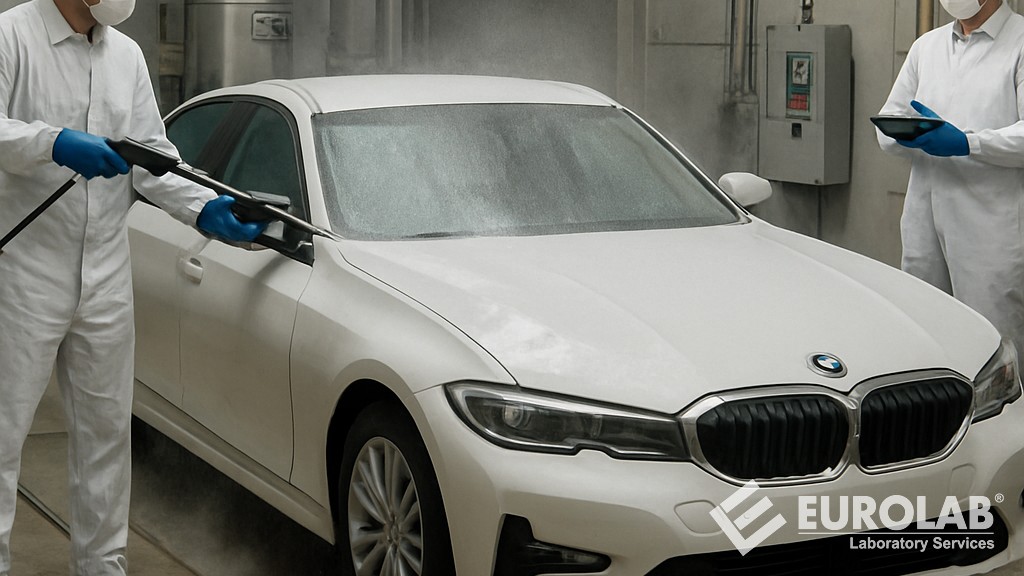
The test simulates the intense cleaning conditions of high-pressure washers (steam jets) commonly used in car washes or by vehicle owners, ensuring that coatings do not peel, blister, crack, or lose their adhesion when exposed to hot, high-pressure streams of water.
The method described in the BMW AA 0136 standard is based on the DIN EN ISO 16925 standard (Testing of coating adhesion and resistance using high-pressure water jet) with parameters specific to BMW. The key elements are:
This standard differs from general vapor jet testing (e.g., the BMW AAP 290 standard) and focuses on exterior organic coatings.
The BMW AA 0136 standard method evaluates the adhesion and resistance of organic coatings (paints, varnishes) on vehicle exterior surfaces (e.g., body panels, upholstery, accessories) to high-pressure hot water jets that simulate aggressive car washing or steam cleaning.
The equipment required for the tests includes the following.
As samples, plain or actual component test specimens with a production coating system are used. The specimens are conditioned for a specific period in a standard climate (e.g., 23 degrees plus/minus 2 degrees Celsius temperature and 50 percent plus/minus 10 percent relative humidity). Optionally, a cross-cut (grid cut) is made on the coating to evaluate adhesion under stress (common in automotive variants). The specimen is securely fixed in the test chamber. The nozzle is positioned at the specified distance (typically 100-130 mm, shorter distances increase the intensity). The water temperature is adjusted (usually high, around 60-80 degrees Celsius to simulate hot steam cleaning). The pressure is adjusted (typically 70-150 bar, depending on BMW requirements).
A jet of pressurized hot water is directed onto the sample surface. Spraying is applied according to predicted patterns: for example, at specific angles (usually 90 degrees or at an angle), for a specific duration, and over targeted areas or, if applied, across the cross-section. The spraying simulates high-pressure cleaning pulses.
The sample is allowed to dry and condition before post-test evaluation. Defects are visually inspected: delamination, blistering, cracking, peeling, swelling, or loss of adhesion (especially from cross-sections). Damage is assessed using comparative images or grading scales (according to ISO 16925 standard), or by measuring the maximum delamination distance. Grading is done according to BMW acceptance criteria (pass/fail: no significant coating delamination or damage).
The main reasons why this standard is considered important are:
This test method is more severe than general water exposure and focuses on the mechanical and thermal stress resulting from jet impact. The precise BMW parameters (pressure, temperature, distance, cycles, acceptance limits) are specified in the official BMW AA 0136 standard. Tests are performed in accredited laboratories. This standard is often used in conjunction with cross-line adhesion (BMW AA 0180 standard) or stone chip tests (BMW AA 0079 standard).
Consequently, in the high-end automotive sector, standards like BMW AA 0136 are crucial for delivering vehicles with flawless, durable exteriors that can withstand aggressive cleaning and maintain their appearance and structural integrity. The tests are carried out by accredited laboratories.
For many years, our organization, with its competent and experienced team, has been understanding the needs of its clients, providing the advanced testing services they require, and assisting them in the establishment, implementation, and improvement of management systems. Within this framework, we also provide testing services in accordance with the BMW AA 0136 standard.
To get an appointment, to get more detailed information or to request an evaluation, you can ask us to fill in our form and reach you.

