

Developed by General Motors Worldwide (GMW), the “GMW 15287 Fine Thread Corrosion Test for Painted Aluminum Wheels” is a test standard used to evaluate the resistance of painted aluminum wheels and painted aluminum wheel coatings to fine thread corrosion.
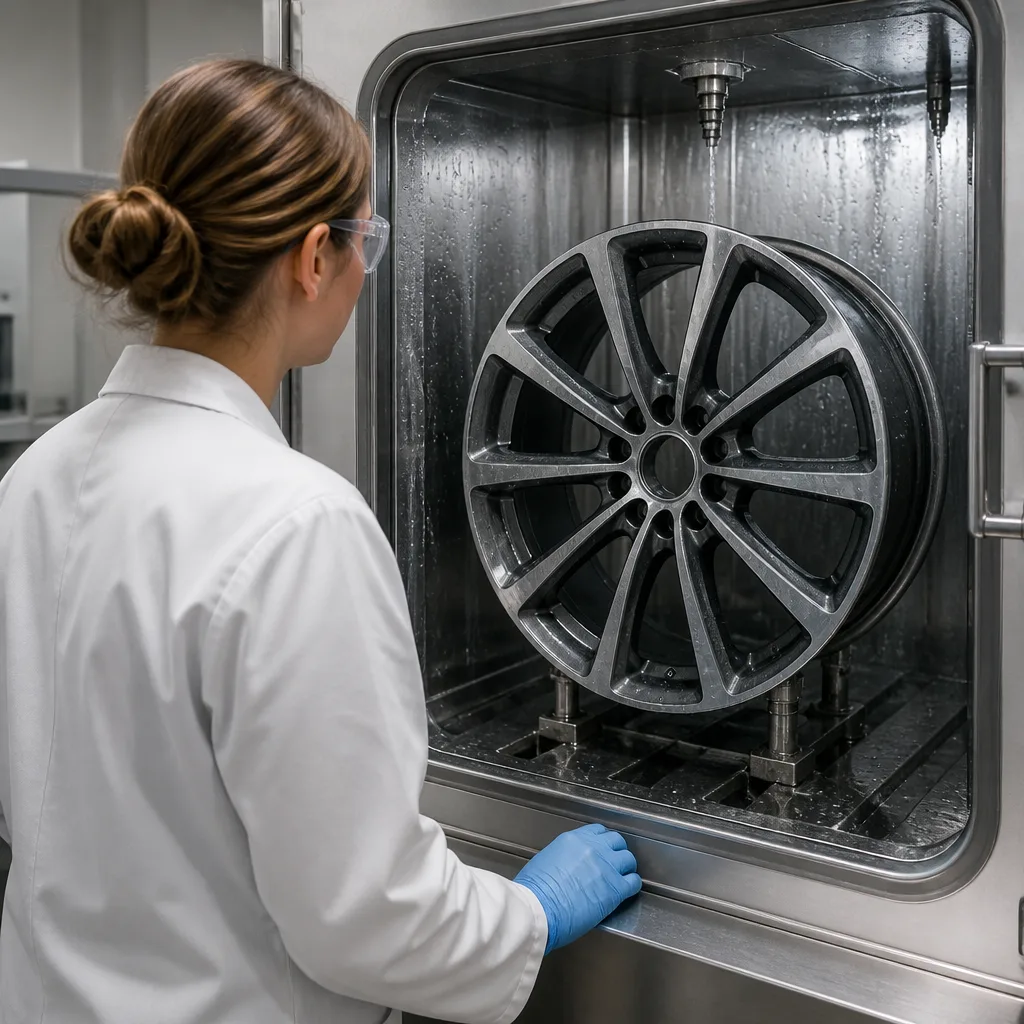
Thread corrosion is a specific type of corrosion that develops beneath an organic coating, typically paint. It appears as fine, thread-like corrosion marks that can grow outwards from scratches, exposed edges, or coating defects. Because aluminum rims are exposed to moisture, salts, temperature variations, and road contaminants, controlling this type of corrosion is important for both appearance and long-term coating performance.
Thread corrosion is a subfilm corrosion mechanism. When the protective coating is locally damaged or punctured, moisture and corrosive substances can reach the aluminum substrate. Corrosion can then spread along narrow, thread-like paths beneath the coating. Unlike general surface corrosion, thread-like corrosion can be difficult to detect initially. However, it can gradually lead to:
For painted aluminum rims, these effects can become particularly significant, as the rims are constantly exposed to a harsh outdoor environment.
The primary purpose of the GMW 15287 standard is to provide a controlled laboratory procedure to determine whether a painted aluminum wheel or wheel trim has adequate resistance to thread-like corrosion. This test helps manufacturers and suppliers evaluate the following aspects:
The GMW 15287 standard is more specifically related to painted aluminum wheels and painted aluminum wheel covers, rather than being a general corrosion test for every automotive component.
In principle, this test method is based on exposing properly prepared and damaged coated aluminum samples to an aggressive corrosive environment, followed by the creation of conditions favorable for the development of filamentous corrosion.
In general, this method follows these steps:
It's not just the presence of corrosion that matters, but also the extent and appearance of corrosion penetration beneath the coating. Typical observations might include:
The applicable General Motors specification or engineering drawing determines the acceptance criteria. Therefore, passing the GMW 15287 standard does not mean that every application uses the same numerical acceptance limit.
GMW 15287 standard is considered important for the following reasons:
GMW 15287 standard is closely related to SAE J2635 standard, which defines a filiform corrosion test procedure for painted aluminum wheels and wheel covers. Accredited laboratories often list both methods together for filiform corrosion testing. However, laboratories should not assume that the two standards are automatically interchangeable for a particular customer program. The required method, revision, sample preparation, exposure conditions, and acceptance criteria must be validated against the relevant engineering requirement.
GMW 15287 standard is primarily related to the following standards:
Therefore, the GMW 15287 standard should not be considered merely a salt spray test. Its purpose is to evaluate filamentous corrosion beneath the coating using an accelerated circumferential array designed specifically for painted aluminum wheel applications.
GMW 15287 standard may relate to the following:
Consequently, the GMW 15287 standard uses accelerated environmental exposure to induce corrosion beneath the coating, allowing engineers to assess how effectively a coating system resists such degradation.
This standard is particularly valuable because aluminum rims must combine corrosion protection, coating durability, and high cosmetic quality. A coating that performs well in a standard salt spray test may not provide adequate protection against filamentous corrosion. Therefore, this standard allows for a more targeted assessment of this specific failure mechanism.
For many years, our organization, with its competent and experienced staff, has been understanding the needs of its clients, providing the advanced testing services they require, and assisting them in the establishment, implementation, and improvement of management systems. Within this framework, we also provide testing services in accordance with the GMW 15287 standard.
To get an appointment, to get more detailed information or to request an evaluation, you can ask us to fill in our form and reach you.

