

The “GMW 16953 Fabric Abrasion Test for Body Air Seal Strips” standard, developed by General Motors Worldwide (GMW), describes a laboratory method for evaluating the abrasion and friction resistance of coated automotive air seal strips from contact with fabric or textile surfaces.
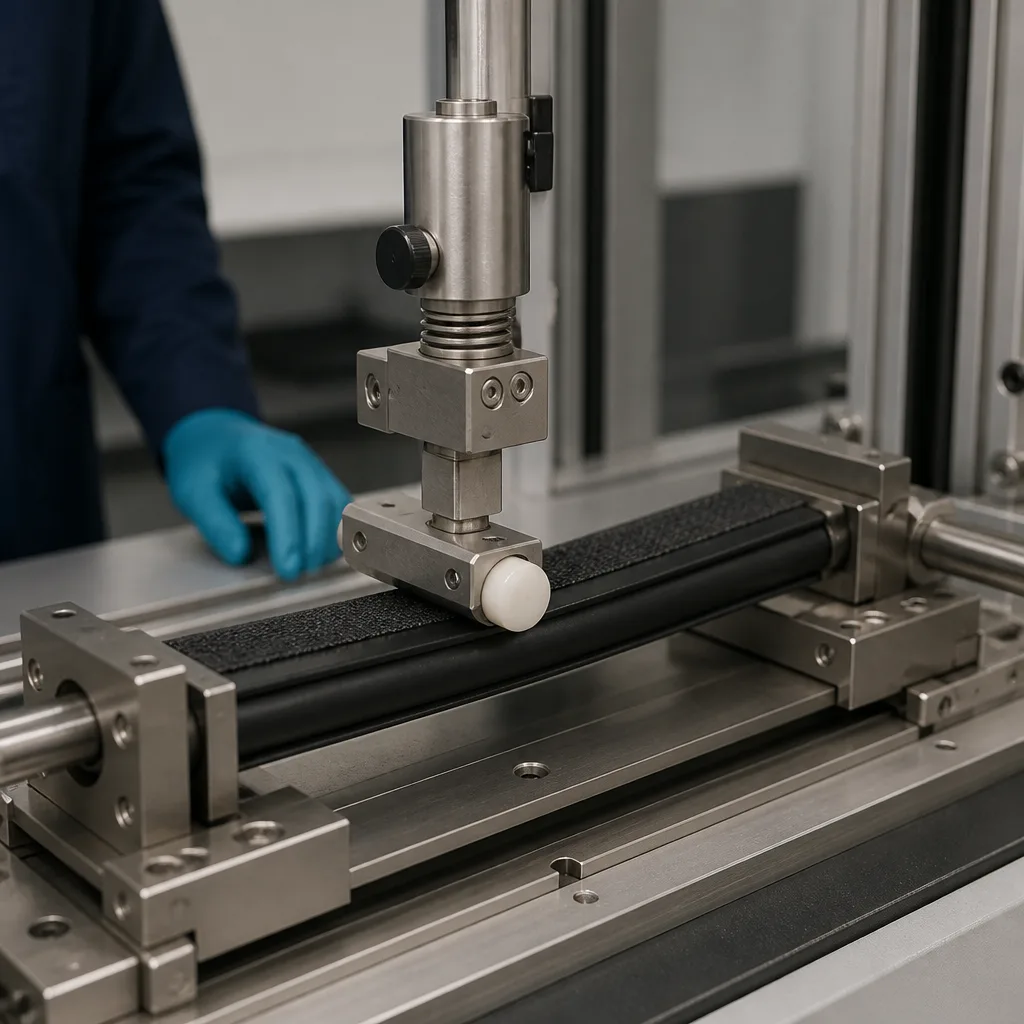
Automotive body air seal strips are sealing components fitted around doors, windows, and other body openings. They help prevent the entry of water, dust, air, and noise while also providing controlled contact between moving or closing body components.
During vehicle use, air seal strips may repeatedly rub against textile-covered surfaces or other materials. This friction can gradually damage the surface coating, causing visible scuffing or leading to discoloration of the air seal strip.
The GMW 16953 standard provides a controlled wear/abrasion test to evaluate this behavior. The stated purpose of this standard is to determine the resistance of a coated air seal strip to wear and abrasion.
Body air seal strip is an elastic sealing component used in vehicle bodies. Typical applications include:
Air seal strips may contain rubber or other elastic materials and may have special surface coatings, coatings, or textile/flock layers. The surface is particularly important because it may be subjected to repeated sliding contact during vehicle operation.
The GMW 16953 standard is essentially a fabric-air strip abrasion test. A representative fabric abrasion material is brought into controlled contact with the air strip surface and subjected to repeated friction. The test aims to reproduce the type of mechanical wear that might occur if a coated air strip were to repeatedly come into contact with a textile or fabric surface. Therefore, the test evaluates more than just simple material strength. It focuses on surface durability and resistance to visible or functional wear.
A suitable abrasion testing device is required to ensure controlled friction between the sample and the specified fabric. Equipment associated with the GMW 16953 standard includes specialized air strip/fabric abrasion testing devices. As an example, the APG1000 system, which is stated to be used for fabric/flock abrasion testing and GMW 16953 standard air strip testing, can be given.
The equipment should generally check the following parameters:
The precise configuration of the equipment, loads, stroke dimensions, number of cycles, and evaluation criteria should be taken from the relevant controlled version of the GMW 16953 standard, rather than being derived from general wear testing equipment.
The test specimen typically represents the finished body airtight strip, including the surface treatment or coating that will be used in production. This is important because the test aims to evaluate the performance of the actual surface system, not just the volumetric elastomer. Depending on the application, the evaluation may take into account the following aspects:
The primary purpose of the test is to determine whether the air strip surface remains in an acceptable condition after the specified abrasion exposure. Possible observations may include:
Acceptance criteria are application-specific and should be derived from the relevant General Motors engineering specification or material/component requirement associated with the test.
Testing according to GMW 16953 standard is important because air strips are repeatedly subjected to mechanical contact during vehicle operation. A new air seal strip may appear acceptable, but surface damage can occur after repeated contact. Such damage can lead to:
The GMW 16953 standard helps identify these issues during material and component verification before production tools are released to the market.
The GMW 16953 standard should not be treated as a general abrasion test like the traditional Martindale textile abrasion test. While a specified textile/wool fabric can be used as an abrasive medium, the application is specifically geared towards automotive body linings. Test material suppliers list the SM 25 wool abrasive for both general textile abrasion methods and the GMW 16953 standard, and indicate the relationship between the materials used in these test systems. The key difference lies in the automotive component/application and the prescribed test configuration and evaluation requirements.
In automotive development, the GMW 16953 standard can be useful in the following situations:
This is especially important if the air strip has a surface that needs to maintain its appearance and functionality despite repeated friction.
The use of the GMW 16953 standard provides a standardized way for manufacturers and suppliers to compare different air strip constructions and surface treatments. For example, an engineering team might request abrasion exposure and surface condition assessment for different materials. This makes it easier to identify a surface system with better durability and determine whether a new supplier's material performs consistently with the approved design.
Consequently, the GMW 16953 standard includes an automotive durability testing method focusing on the resistance of coated air seal strips to fabric-induced abrasion and friction. This test is particularly valuable because air seal strips are subjected to repeated mechanical contact throughout a vehicle's lifespan.
By subjecting the airtight strip to controlled fabric abrasion, engineers can assess surface durability and identify unacceptable degradations before the component reaches production.
For many years, our organization, with its competent and experienced staff, has been understanding the needs of its clients, providing the advanced testing services they require, and assisting them in the establishment, implementation, and improvement of management systems. Within this framework, we also provide testing services in accordance with the GMW 16953 standard.
To get an appointment, to get more detailed information or to request an evaluation, you can ask us to fill in our form and reach you.

