VW TL 256 Powder Coating on Metal Surfaces - Surface Protection Requirements
The standard "VW TL 256 Powder coating on metal surfaces - Surface protection requirements," developed by the Volkswagen Automobile Company, specifies requirements for powder coatings on various substrates. However, this standard does not apply to exterior and interior decorative surfaces (VW TL 52451 and VW TL 226 standards), drive shafts (VW TL 216 standard, coil springs (VW TL 261 standard), and wheels (VW TL 238 and VW TL 239 standards).
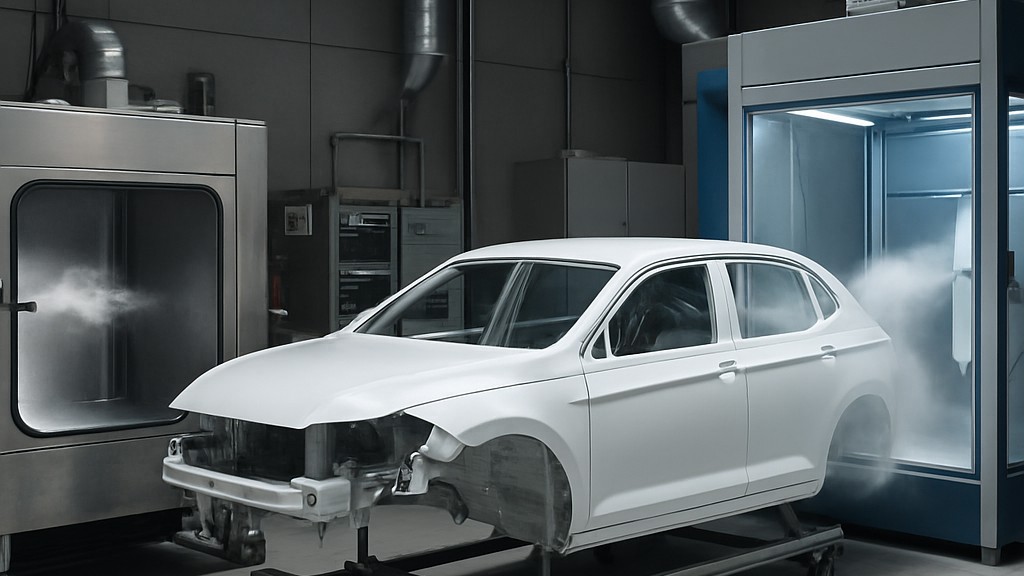
For surface protection types, the surface protection types listed in the table provided in the standard are applied. The protection types in the table are determined as follows:
- Ofl-x340: Medium protection with any pretreatment ((for internal parts in non-visible areas)
- Ofl-x650: Heavy protection with film-forming or layer-forming pretreatment
- Ofl-x651: extra heavy-duty protection with film-forming or layer-forming pretreatment and primer
The basic requirements in this standard are determined as follows:
- Initial supply and approval of changes must be ensured in accordance with the VW 01155 standard.
- Material conformity must be ensured according to the VW 91101 standard.
- A minimum of 10 components are required for a complete review.
- Complete product documentation includes the following information: pretreatment type (product name and company), paint name and binder type, paint manufacturer and coating company, and painting date.
The paint requirements are determined as follows:
- The paint finish must provide the required surface protection with the specified specifications across the entire surface.
- Coatings must be free from pores, cracks, paint runs, foreign material inclusions, damage, and other manufacturing irregularities that could impair corrosion protection or the specified appearance.
- The paint finish should adhere tightly to the base material when the parts are used as intended.
- The manufacturing process must be designed and controlled so that the performance characteristics of the finished part are not compromised.
- Proper installation should prevent damage that could impair functionality or reduce specified corrosion protection.
Within the framework of this standard, the following tests are applied:
- Paint adhesion: This test should be performed using adhesive tape with an adhesive force of 10 N plus/minus 1 N per 25 mm width. The adhesive tape should be pressed firmly against the surface by hand, with a diagonal line applied, and then suddenly peeled off perpendicularly to the surface. Tesa Tape 4657 is suitable for this test, for example.
- Stone chip resistance: Adherent paint residue should be removed by peeling off the adhesive tape. The adhesive tape should be pressed firmly against the exposed surface by hand and then suddenly pulled off perpendicularly to the surface. Tesa Tape 4657, for example, is suitable for this test.
- Scratch mark: This test complies with the DIN EN ISO 9227 standard. Scratch tools (Sikkens scratch tool) according to the DIN EN ISO 9227 standard that produce rectangular or trapezoidal scratch profiles or scratch tools (van Laar scratch pen) according to the DIN EN ISO 17872 standard that produce U-shaped scratch profiles are permitted in the tests.
- Condensate constant climate: The test duration is 240 hours. The test samples are then acclimatized at room temperature for at least 30 minutes (according to standard VW 50554-2).
- Heat storage: Test samples are stored in a circulating air oven at 90°C plus/minus 2°C for 240 hours. The test samples are then acclimatized for at least 30 minutes according to VW 50554-2.
- Cold storage: After heat storage, the same samples are subjected to cold storage at minus 40 degrees Celsius (+/- 3 degrees Celsius) for 24 hours. Immediately thereafter, the same samples are tested according to the table provided in the standard.
- Impact test: After heat storage (heat and cold phases), the test is performed on a rigid, rigid base with a specified test force of 90 N, based on DIN ISO 4532. After cold impact, the spillage around the penetration area must be completely removed. The maximum diameter of the spillage must be determined, and the layer thickness determined next to the spillage must be documented.
In short, the VW TL 256 standard is an internal Volkswagen Group (VW) specification that defines the requirements for engine coolants (antifreeze/coolants) used in its vehicles. This technical delivery condition (TL) outlines physical, chemical, and performance criteria, such as:
- Corrosion protection
- Thermal stability
- Compatibility with materials used in the engine and cooling system
- Freeze and boil protection
- Service life / durability
The VW TL 256 standard generally applies to coolants classified as G11 or G12, depending on the revision or version. If a coolant or antifreeze product meets the VW TL 256 standard, it means it has passed Volkswagen's internal testing and is safe for use in the specified VW, Audi, Skoda, or SEAT vehicles.
The vehicle's owner's manual should be checked to see which VW coolant specification (e.g. G13, TL 774-J) is required, as using the wrong coolant can damage the engine.
Our organization, which has been supporting businesses across all sectors for years through a wide range of testing, measurement, analysis, and evaluation activities, has a strong team of employees who closely follow global developments in science and technology and are constantly improving themselves. In this context, we also provide testing services in accordance with the "VW TL 256 Powder Coating on Metal Surfaces - Surface Protection Requirements" standard.



